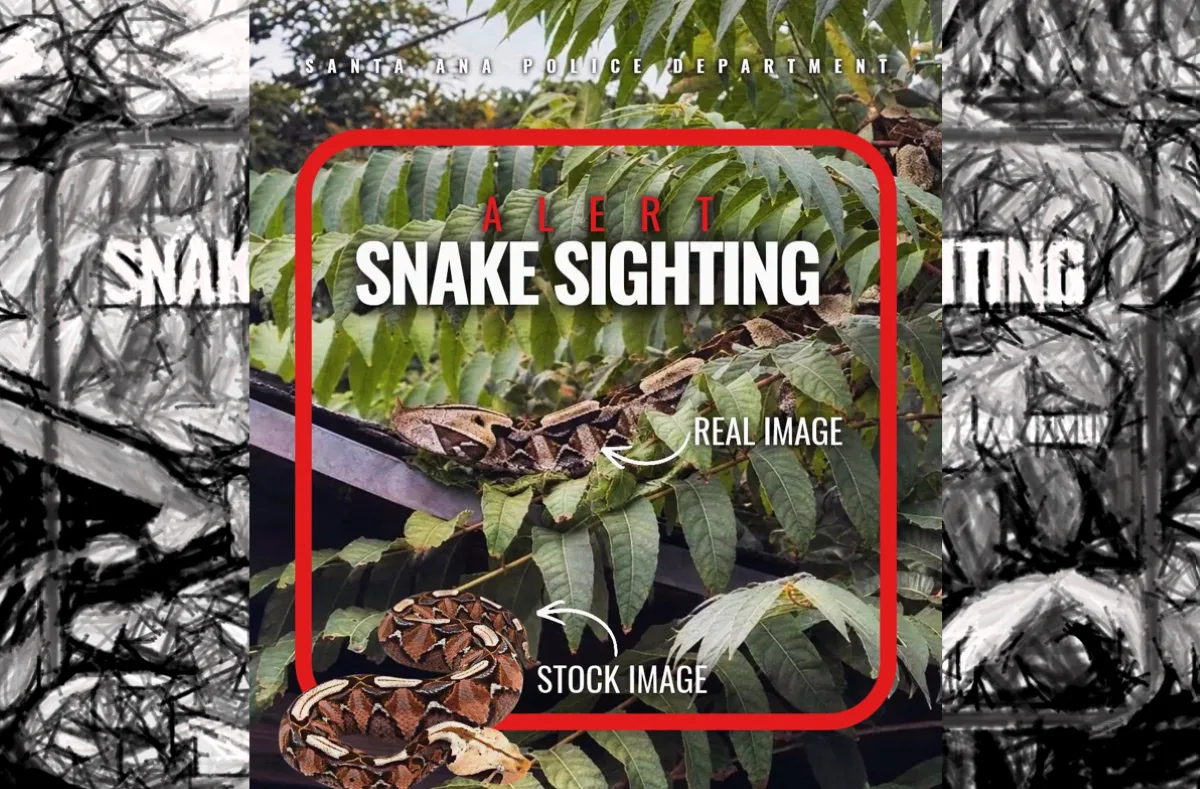
Santa Ana Police have issued a public safety alert after receiving reports of a snake believed to be a Gaboon Viper, spotted in a tree within a residential neighborhood near Main Street and Edinger Avenue. The snake is estimated at 4 to 5 feet long, and officers are urging residents to avoid approaching it and immediately call SAPD’s non‑emergency line at (714) 834‑4211 if seen.

Update from the SAPD:
Yesterday, SAPD personnel responded to a report of a suspected Gaboon Viper in the backyard of a residence in the 1400 block of S. Cypress Ave. Herpetologists (reptile experts) responded to assist and conducted an extensive search of the area. They did not find the snake or any evidence that a snake matching the description had been there.
Today, detectives followed up with the reporting party, who initially said he saw the snake and provided the original photo. During the follow-up investigation, he admitted the photo was AI-generated and that the report was false.
While there was speculation from the beginning that the photo may have been AI-generated, SAPD had to investigate and follow up to confirm what actually happened.
AI-generated images can look very real, and when false information is shared as fact, it can quickly create unnecessary fear, confusion, and concern in our community.
We appreciate the community’s patience while our officers and reptile experts worked to investigate the report, search the area, and determine what actually happened.
About the Gaboon Viper
The Gaboon Viper (Bitis gabonica) is one of Africa’s most dangerous snakes, native to rainforests and savannas in countries such as Cameroon, Nigeria, Uganda, and Tanzania. It is known for:
- Extremely potent venom containing cytotoxins and neurotoxins
- The longest fangs of any venomous snake (up to 2 inches)
- Massive venom yield, capable of causing rapid tissue destruction
Gaboon Vipers do not exist naturally anywhere in North America, including California.
How a Gaboon Viper Could Appear in Santa Ana
Because Gaboon Vipers are illegal to possess in California, any specimen found in Santa Ana almost certainly arrived through human activity, not natural migration. Possible explanations include:
- Illegal exotic pet ownership Individuals sometimes keep prohibited venomous reptiles in private collections. Escapes occur during feeding, enclosure cleaning, or transport.
- Abandonment by an owner fearing legal consequences When enforcement increases or neighbors notice unusual animals, owners sometimes release them.
- Transport through the illegal wildlife trade Gaboon Vipers are trafficked internationally. A specimen may have been transported into the region and escaped during transit.
- Accidental release during relocation Exotic animals occasionally escape during moves or when kept in unsecured outdoor enclosures.
Santa Ana’s dense neighborhoods and mature landscaping provide ample hiding spots, making detection difficult.
Hospitals That May Carry Antivenom
Gaboon Viper bites require specialized antivenom, typically polyvalent antivenom used for African viper species. Only select hospitals maintain such stock. In Southern California, the most likely facilities to have or rapidly obtain antivenom include:
- UCI Medical Center (Orange) — Level I trauma center with access to rare antivenoms
- CHOC Children’s Hospital (Orange) — Works with regional poison control for exotic envenomations
- Cedars‑Sinai Medical Center (Los Angeles) — Known for maintaining specialized antivenom inventories
- Ronald Reagan UCLA Medical Center (Los Angeles) — Major trauma and toxicology center
- Loma Linda University Medical Center (Loma Linda) — Frequently handles venomous reptile cases
In any suspected bite, residents should call 911 immediately, as antivenom must be administered as soon as possible.
Top Five Most Venomous Snakes in the World
- Inland Taipan — Often considered the most venomous snake globally
- Eastern Brown Snake — Responsible for most snakebite deaths in Australia
- Coastal Taipan — Extremely fast and highly venomous
- Black Mamba — Known for speed and neurotoxic venom
- Gaboon Viper — Massive venom yield and long fangs
Safety Tips if You Encounter This Snake
- Stay Back — Keep at least 20 feet of distance
- Do Not Attempt Capture — Gaboon Vipers strike quickly and unpredictably
- Call SAPD — Report sightings to (714) 834‑4211
- Warn Neighbors — Especially those with children or pets
- Secure Pets — Keep dogs and cats indoors until the area is cleared
- Avoid Dense Shrubbery — Gaboon Vipers hide in thick vegetation
Historical Context: Invasive Snake Releases in the U.S.
The United States has a long history of non‑native snakes being released, often due to illegal ownership or accidental escape. Notable examples include:
- Burmese Pythons in Florida — Now numbering in the tens of thousands after decades of releases and escapes from the exotic pet trade
- Boa Constrictors in Puerto Rico — Established populations traced to abandoned pets
- Reticulated Pythons in Texas — Multiple captures linked to illegal private collections
- African Rock Pythons in Miami — Small but persistent population discovered in the early 2000s
- Various venomous species seized in California — Including cobras, mambas, and vipers found in private homes
These incidents show how illegal wildlife possession can create serious public‑safety risks, especially in dense urban areas like Santa Ana.
Community Impace
Santa Ana residents near Main Street and Edinger Avenue should remain alert after the reported sighting of a highly venomous Gaboon Viper, a snake not native to California and capable of delivering life‑threatening bites. Anyone who sees the snake should immediately contact the Santa Ana Police Department and avoid approaching it. With proper awareness, reporting, and safety precautions, the community can help ensure a swift and safe resolution.