SANTA ANA, CA — The story begins with a six‑year‑old named Sebastian, sitting in a Santa Ana classroom, his hand shooting into the air the moment he heard Spanish spoken aloud for the first time.

“Language functions as the gatekeeper to belonging,” said Orange County School of the Arts student Sailee Charlu, recalling the moment that sparked a movement now reaching school districts, policymakers, and researchers across California.
Charlu, who grew up walking past La Chiquita Grocery and watching how alive Spanish was in Santa Ana, founded Habla Arte in 2022 at age thirteen. What started as a small table at El Sol Academy with three children, a box of art supplies, and her love for Spanish has grown into a bilingual arts and public‑speaking program now operating in 15 Title I schools across Orange County, Sacramento, and Dallas–Fort Worth. The program has reached more than 2,000 students, with curriculum shared digitally with teachers in Mexico City, Argentina, Colombia, El Salvador, and Spain.
At the end of her second class, a quiet boy wrapped his arms around her without saying a word — a moment Charlu still points to as proof that emotional safety is the foundation of learning. She has watched that safety turn introverted children into eager participants and self‑conscious students into confident artists.
Her second program, The Lit League, expanded her work to middle schoolers carrying grief, trauma, and untold stories. It has become one of the first multilingual spoken‑word poetry programs for middle schoolers in the country, reaching more than 5,000 youth and producing the largest multilingual middle‑school poetry slam in Orange County history. Students have used the platform to process addiction, sexual assault, deportation, and fear — stories that rarely find space in traditional classrooms.
But Charlu said teaching alone couldn’t fix what policy had broken. She partnered with UC Irvine researchers Dr. Elizabeth Peña and Reinaldo Cabrera Pérez to study Habla Arte’s impact on 45 bilingual K‑5 students. Their composite confidence scores rose from 2.38 to 4.17 on a five‑point scale, with 92% showing increased communicative confidence and 100% presenting their work publicly. The findings are set for publication in the Education Role of Language International Journal.
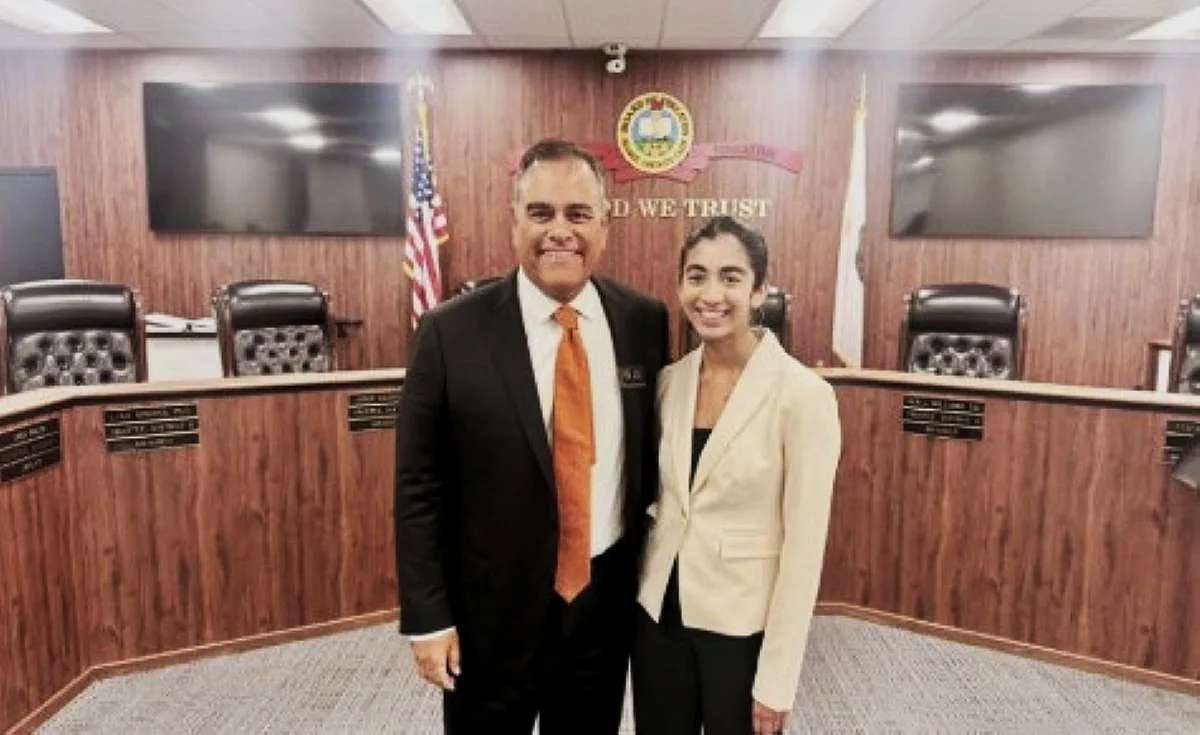
Those results helped carry Resolution 03‑26 to a unanimous 5–0 vote before the Orange County Board of Education on Feb. 2, 2026, urging expanded bilingual and dual‑language instruction countywide. The resolution was co‑authored by Sailee Charlu with Trustee Jorge Valdes and backed by Santa Ana Mayor Valerie Amezcua and Councilwoman Jessie Lopez. Charlu still points to the day Lopez handed her students certificates at Santa Ana City Council as the first time their government told them, “We see you.”
Charlu has also spent months working with Assemblymember Avelino Valencia’s office on a bill to formally recognize translanguaging under California Education Code §306(c), allowing credentialed teachers to use a student’s home language to support understanding while core instruction remains in English. A formal version has been drafted by state Senator Tom Umberg’s office and awaits a decision for the 2027 legislative cycle. The California Department of Education is separately weaving translanguaging into its 2027 Multilingual Literacy Guidance, where they considered feedback provided by Charlu.
In July, Charlu hosted the first Habla Futures Bilingual Education Research Conferencee, a virtual event built around one idea: moving evidence from classrooms into policy and back into communities. More than 100 attendees and 12 speakers from twelve countries joined, including educators from UC Irvine, Yale, Penn State, and the University of British Columbia.
Charlu says the work remains rooted in Santa Ana — in the children who first inspired her, in the families who speak Spanish at home but rarely see it honored in school, and in the belief that bilingualism is not an accommodation but a bridge to cultural empowerment.
Community Impact
- Habla Arte now serves 15 Title I schools and 2,000+ students.
- The Lit League has reached 5,000+ middle schoolers with multilingual poetry.
- Habla Futures connects classroom evidence to research, policy, and legislation.
- Resolution 03‑26 passed unanimously, urging expanded bilingual instruction countywide.
- A proposed translanguaging bill is being refined for potential advancement in 2027.
- UC Irvine research shows major gains in student confidence and public speaking.
- Santa Ana students’ stories continue to shape statewide conversations on multilingual education.
Why This Matters in Santa Ana
Santa Ana is one of the most linguistically rich cities in California, yet many classrooms still operate under English‑only norms. Charlu’s work — born at a small table at El Sol Academy — is now influencing county policy, state legislation, and international research. For families whose children speak Spanish at home, this movement represents something long overdue: recognition, belonging, and the right to learn in a way that honors who they are.