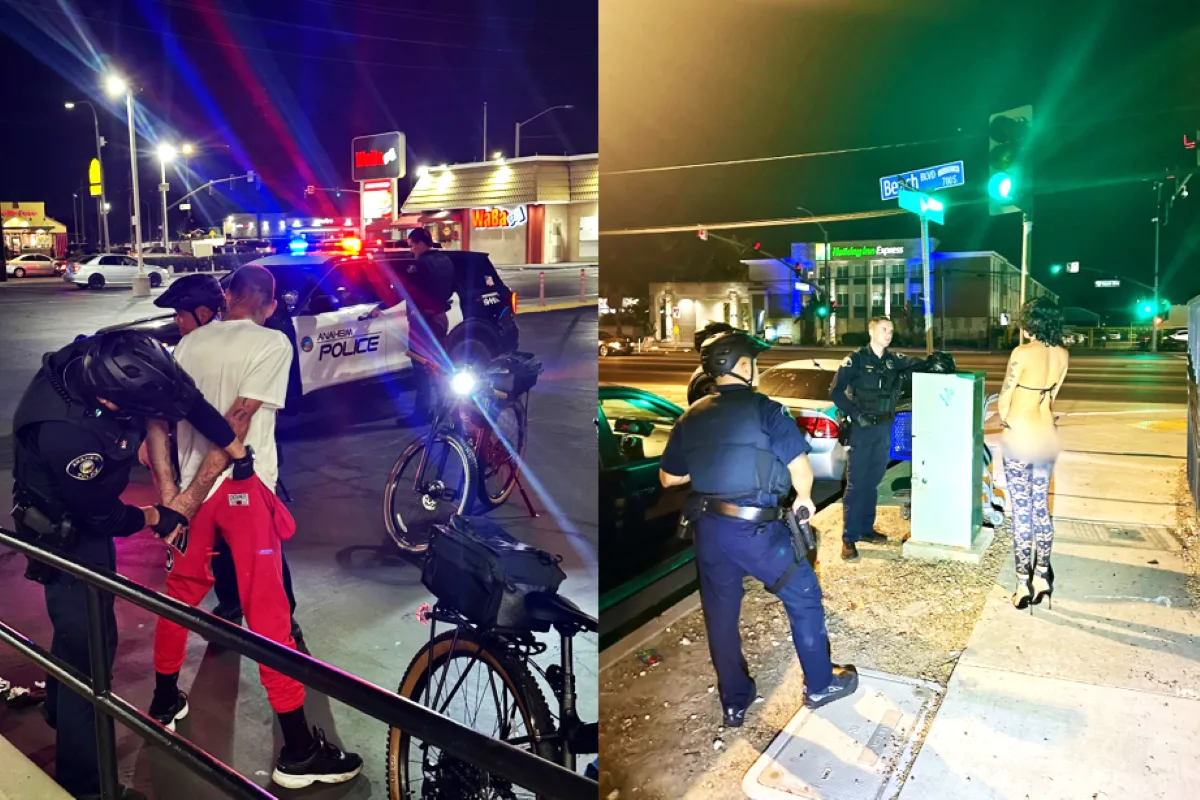
ANAHEIM, Calif. – The Anaheim Police Department shared photos today showing officers conducting enforcement activity involving unhoused individuals in west Anaheim near Beach Boulevard and commercial corridors that have long generated calls for service related to quality-of-life complaints, narcotics activity, trespassing, public intoxication, theft, and warrant arrests.

The photographs released by police depict officers making contact with multiple individuals during nighttime enforcement efforts. One image shows officers detaining an individual near Beach Boulevard and Crescent Avenue, while another shows officers arresting a bicyclist in a commercial parking area. The operation appears consistent with Anaheim’s ongoing strategy of combining enforcement with outreach services for individuals experiencing homelessness.
Anaheim police have repeatedly stated that quality-of-life enforcement operations are intended to address criminal activity while also connecting willing individuals with shelter beds, treatment programs, and social services. Similar operations conducted by Anaheim officers and the city’s Homeless Outreach Team have previously resulted in arrests for warrants, narcotics offenses, theft-related crimes, probation violations, and other criminal offenses. [newsantaana.com], [pd.anaheim.net]
Homelessness and Crime Continue to Collide in Orange County
Public debate often centers on how much crime is attributable to transient populations. While law enforcement agencies frequently report arrests involving unhoused offenders, there is no comprehensive Orange County database that identifies a precise percentage of all crimes committed by homeless individuals.
Criminologists and public policy researchers caution against assuming that homelessness automatically causes criminal behavior. However, research examining California data has found evidence of a relationship between homelessness and certain categories of crime, particularly violent offenses, while also finding that increases in property crime can contribute to increases in homelessness.
Local law enforcement agencies have nevertheless reported persistent transient-related problems that commonly include:
- Retail theft
- Vehicle burglaries
- Trespassing
- Drug possession and drug use
- Vandalism and graffiti
- Illegal camping
- Public intoxication
- Outstanding warrant arrests
- Disorderly conduct
Recent Orange County enforcement operations have generated significant arrest totals. In August, a multi-agency operation along the Orange-Santa Ana border resulted in 69 arrests, including 16 felony arrests and 53 misdemeanor arrests.
Orange County Cities Reporting the Most Transient Enforcement Activity
Orange County does not publish a countywide ranking of transient arrests by city. However, based on publicly reported enforcement operations and recurring homeless enforcement activity, the cities most frequently associated with large-scale transient-related arrests and sweeps have included:
- Santa Ana
- Anaheim
- Orange
- Huntington Beach
- Costa Mesa
Recent enforcement actions in Santa Ana, Orange, Anaheim, Huntington Beach, and Costa Mesa have generated dozens of arrests involving warrants, narcotics violations, illegal camping, probation violations, theft crimes, and other offenses.
It should be noted that these cities also contain some of Orange County’s largest concentrations of homeless individuals, making direct comparisons difficult without standardized countywide arrest statistics.
What Does Transient Crime Cost Orange County Residents?
There is currently no authoritative Orange County figure identifying the total annual cost of crime committed specifically by homeless or transient offenders.
What can be documented is that homelessness-related impacts generate substantial public costs through:
- Police patrol and enforcement
- Fire and emergency medical responses
- Environmental cleanup
- Encampment abatement
- Jail and court expenses
- Property damage
- Retail theft losses
- Public works repairs
- Social services and outreach programs
Several California cities spend tens of millions of dollars annually addressing homelessness-related issues, including enforcement, cleanup, shelter operations, healthcare responses, and supportive services. Public officials throughout Orange County continue to debate how much funding should be directed toward enforcement versus treatment and housing programs. [calmatters.org], [homelessne…s.ucsf.edu], [ppic.org]
Because no comprehensive county accounting exists, any claim that transient crime costs Orange County residents a specific dollar amount annually would be speculative.
California’s Homeless Crime Trends Compared to Other Western States
California continues to have one of the nation’s largest homeless populations. A recent Public Policy Institute of California report found that California had the nation’s second-highest unsheltered homelessness rate behind Oregon and the sixth-highest overall homelessness rate among states in 2025. [ppic.org]
Meanwhile, a statewide CalMatters analysis found that arrests and citations related to homelessness increased significantly in many California cities following the U.S. Supreme Court’s Grants Pass decision, which gave local governments greater authority to enforce anti-camping laws. Los Angeles, San Diego, Sacramento, and San Francisco all experienced notable increases in homelessness-related enforcement activity afterward. [calmatters.org]
Across western states, public safety agencies continue to report similar challenges involving:
- Open-air drug use
- Encampments in public spaces
- Property crime concerns
- Public health issues
- Mental health crises
- Repeat offenders cycling through the criminal justice system
While California, Oregon, Washington, Colorado, and Nevada have all experienced significant homelessness challenges, enforcement strategies vary widely among jurisdictions.
What the Community Can Do to Reduce Transient-Related Crime
Law enforcement experts generally agree that successful long-term reductions in transient-related crime require both enforcement and intervention.
Residents can help by:
- Promptly reporting suspicious activity and crimes.
- Using Anaheim’s and Orange County’s reporting systems for encampment concerns.
- Supporting neighborhood watch groups.
- Encouraging treatment options for substance abuse and mental health disorders.
- Securing vehicles and personal property.
- Supporting outreach organizations that successfully transition individuals into housing and treatment.
- Cooperating with police investigations and witness requests.
Police agencies throughout Orange County have increasingly relied on a dual-track approach that combines targeted enforcement against criminal offenders with outreach efforts designed to connect unhoused individuals to shelter, detoxification services, mental health treatment, and long-term housing resources. [newsantaana.com], [crimevoice.com]
Anaheim Police Continue Quality-of-Life Enforcement Efforts
The images released today underscore an ongoing reality facing Anaheim and many Orange County cities: addressing homelessness remains both a public safety challenge and a social services challenge.
While the majority of homeless individuals do not commit serious crimes, police agencies continue conducting enforcement operations aimed at repeat offenders, individuals with outstanding warrants, narcotics violators, and those accused of crimes affecting businesses, residents, and visitors.
As Anaheim continues to expand outreach services while maintaining proactive enforcement, city leaders, residents, and law enforcement officials will likely continue balancing compassion for those experiencing homelessness with demands for safer neighborhoods and improved quality of life throughout the community.