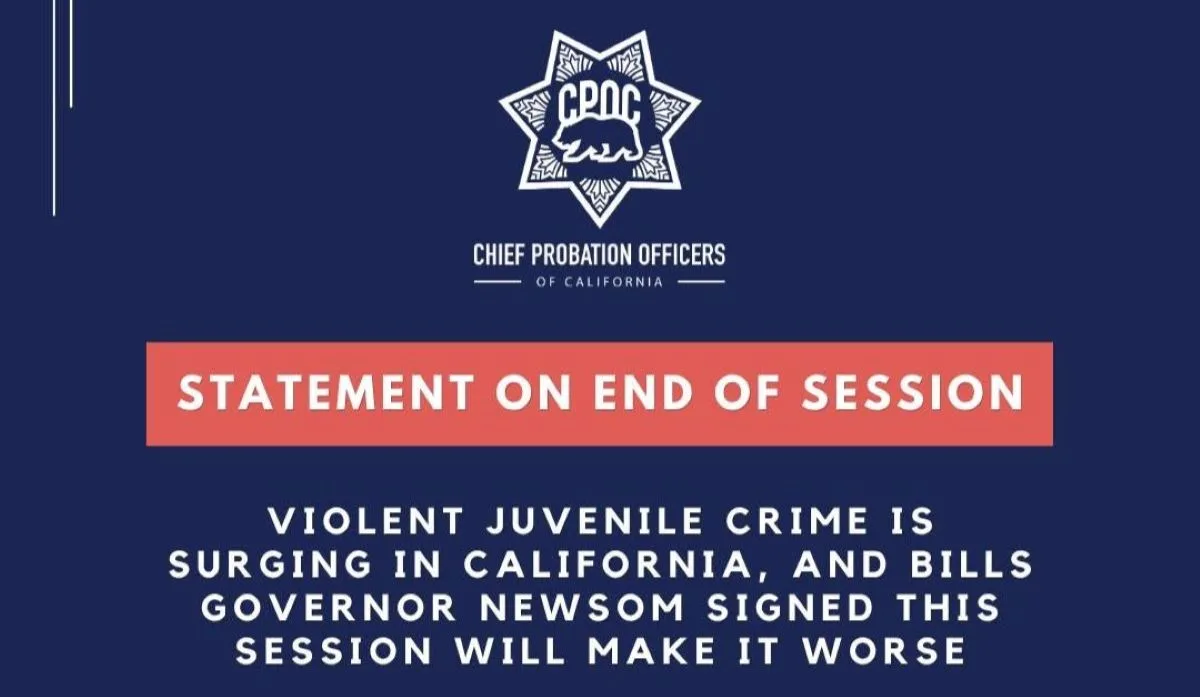
SACRAMENTO, Calif. — California’s chief probation officers are sounding the alarm over what they describe as a growing juvenile violent crime crisis, arguing that a series of bills signed by Governor Gavin Newsom during his final legislative session will make it more difficult to supervise, detain, and rehabilitate some of the state’s most serious youthful offenders.

The criticism comes from the Chief Probation Officers of California (CPOC), which released a statement Thursday citing rising juvenile violence and warning that recent legislative changes further weaken the state’s ability to respond to offenders accused of murder, attempted murder, rape, aggravated assault, and other serious crimes.
According to CPOC, violent felony arrests involving juveniles have increased nearly 60% since California closed the Division of Juvenile Justice. Juvenile homicide arrests have increased more than 80% since 2019, while the number of youths adjudicated for serious crimes, including murder and rape, reportedly climbed from 1,459 to 3,216 over a two-year period.
“We warned Governor Newsom this would happen. It happened,” CPOC Executive Director Karen Pank said in a statement.
Probation Chiefs Target Multiple Newsom-Signed Measures
CPOC specifically criticized several actions taken by Newsom this year, including:
- Senate Bill 1009, which probation officials say limits judicial discretion to detain serious juvenile offenders.
- Assembly Bill 1886, which limits the length of juvenile probation supervision regardless of offense severity.
- State budget decisions that shift juvenile justice funding away from counties while maintaining local responsibilities.
- Continued refusal to provide funding tied to Proposition 36, a voter-approved accountability and treatment initiative.
- Proposed reductions to probation and pretrial services funding.
The organization argues that the state’s juvenile offender population has become older and more violent since juvenile justice realignment efforts accelerated.
According to CPOC, nearly 70% of youths committed to Secure Youth Treatment Facilities are there for murder, attempted murder, or aggravated assault, while roughly 80% are between ages 17 and 25.
The group further contends that current probation limits may result in offenders being released from supervision before rehabilitation efforts are completed.
Has Crime Increased During Governor Newsom’s Tenure?
The answer depends on which crime category is examined.
Available statewide data show California experienced the same pandemic-era crime surge that occurred across much of the United States. The Public Policy Institute of California reported that California’s violent crime rate fell in 2024 but remained approximately 9.8% higher than 2019 levels. Homicide rates, meanwhile, declined significantly from pandemic highs and were nearly back to pre-pandemic levels by 2024. [ppic.org], [ppic.org]
Property crime presents a different picture. PPIC reported California’s property crime rate in 2024 reached its lowest level since 1985, although shoplifting remained substantially elevated compared with 2019. [ppic.org], [ppic.org]
As a result, both critics and supporters of Newsom cite different statistics when debating his public safety record.
Critics point to:
- Violent crime remaining above pre-pandemic levels.
- Elevated aggravated assault rates.
- Continued retail theft and shoplifting concerns.
- Rising juvenile violence cited by probation officials. [ppic.org], [ppic.org]
Supporters point to:
- Falling homicide rates.
- Declining robbery rates.
- Historically low property crime levels.
- Recent statewide decreases in most major crime categories. [ppic.org], [ppic.org], [gov.ca.gov]
How California Compares to Other Western States
Federal crime data show California is neither the safest nor the most dangerous state in the West.
Based on recent FBI-based state rankings, California’s violent crime rate was higher than neighboring Oregon, Washington, and Nevada averages, and also above the national average. However, states such as Alaska and New Mexico reported substantially higher violent crime rates than California. Arizona’s violent crime rate was somewhat lower than California’s. [en.wikipedia.org]
Recent violent crime rates per 100,000 residents:
- California: 486.0
- Colorado: 476.3
- Arizona: 421.9
- Nevada: 402.0
- Oregon: 331.0
- Washington: 326.1
- Alaska: 724.1
- New Mexico: 717.1 [en.wikipedia.org]
Those figures suggest California remains among the higher-crime states in the Western United States, though it is not the regional leader in violent crime. [en.wikipedia.org]
Will Crime Hurt Newsom’s Presidential Prospects?
Should Newsom pursue a future presidential campaign, public safety is likely to remain one of the most heavily scrutinized aspects of his record.
Political opponents would almost certainly highlight:
- California’s post-pandemic violent crime increases.
- Retail theft controversies.
- The state’s juvenile justice policies.
- Criticism from prosecutors, law enforcement organizations, and probation officials.
At the same time, Newsom would likely point to declining homicide trends, falling property crime rates, major state investments in law enforcement grants, and recent reductions in several major crime categories. [ppic.org], [ppic.org], [gov.ca.gov]
Whether crime becomes a major liability nationally may depend less on California’s overall crime numbers and more on public perception. Crime consistently ranks as a high-priority voter issue, and highly publicized incidents involving organized retail theft, repeat offenders, or violent juvenile crime often generate outsized political attention regardless of broader statistical trends.
The CPOC statement suggests juvenile crime and rehabilitation policy could become a particularly vulnerable area for Newsom if he seeks higher office. The organization openly stated it hopes to work with California’s next governor to reverse what it views as years of misguided juvenile justice reforms, marking a rare public rebuke from the state’s chief probation leadership at the close of Newsom’s administration.