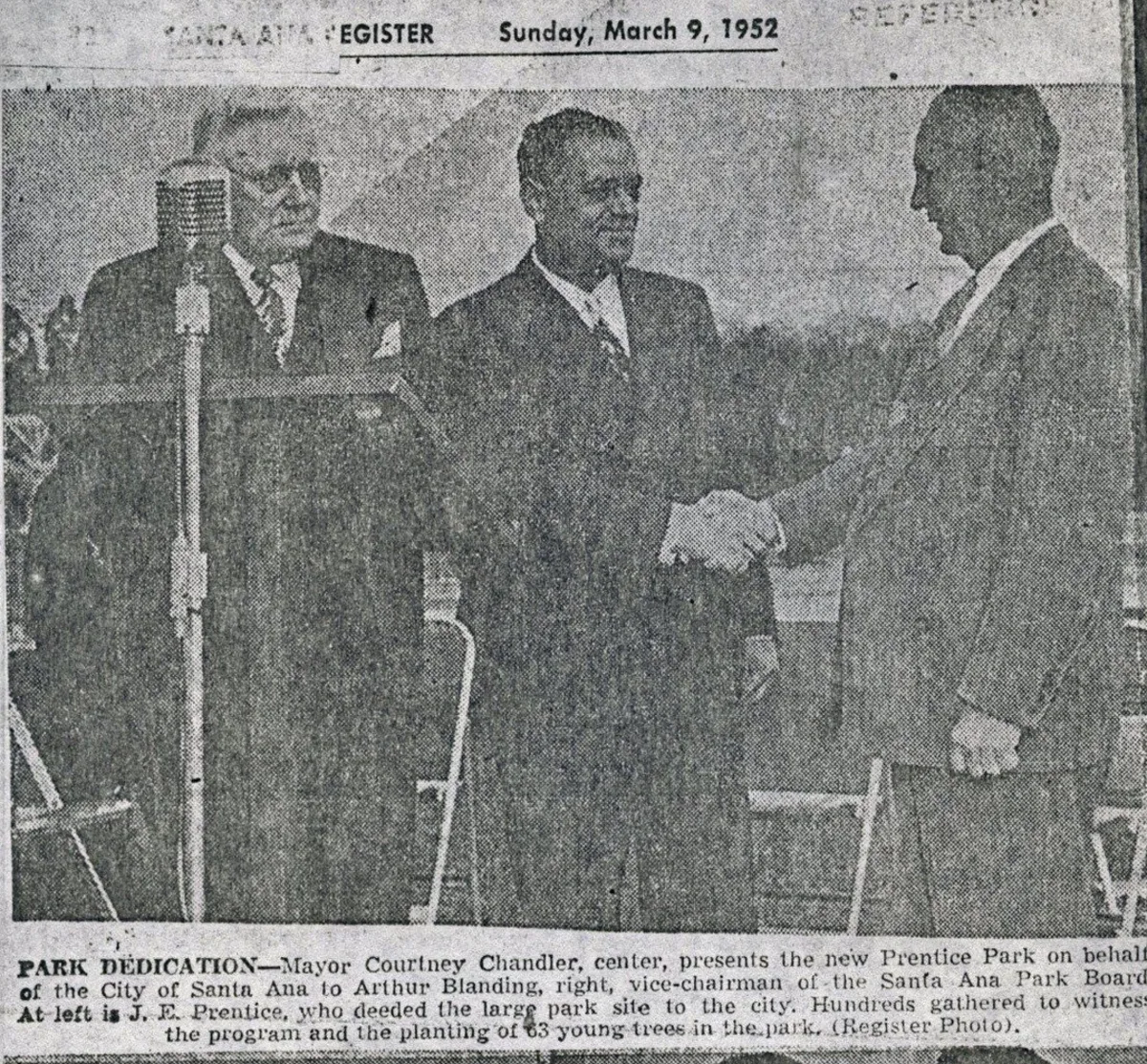
The Santa Ana Zoo opened 74 years ago today on March 8, 1952 after Joseph Edward Prentice donated 12 acres of his ranch to the City of Santa Ana.
Joseph Edward Prentice was definitely a “primate enthusiast.” He famously lived in a 16-room mansion with several monkeys and a gibbon that were given such free rein they supposedly caused multiple housekeepers to quit. He even built a massive 1.5-story cage over his tennis court just for his pets.
His obsession is actually why the zoo exists in its current form. When he donated the land in 1949, he included a strict “monkey clause” in the deed:
- The 50-Monkey Rule: The city is legally required to keep at least 50 monkeys on the property at all times.
- Land Reversion: If the monkey count ever drops below 50, the land could technically revert back to his heirs.
- Legacy: Because of this mandate, the Santa Ana Zoo has focused heavily on primate conservation and is affectionately known as “The Home of the 50 Monkeys”.
Interestingly, his heirs have actually threatened to take the land back in the past when the population dipped below the magic number.
Price Comparison and Evolution
- Current Cost (2026): Adult admission is $14.00, while children (3–12) and seniors (60+) pay $11.00.
- Historical Context: In the early 1950s, a “premium” attraction like Disneyland (opened in 1955) charged just $1.00 for adult admission. A community zoo like Santa Ana’s, which started with only 12 acres and focused primarily on Prentice’s monkey collection, would have cost significantly less or been free to the public.
- Inflation Factor: An item costing $1.00 in 1950 would be worth approximately $12.30 today. This means the zoo’s current $14 price is very close to a standard inflation-adjusted dollar from that era.
The Santa Ana Zoo’s price increase is considered below average or very reasonable compared to larger institutions.
- Comparison to Major Zoos: For perspective, the San Diego Zoo currently charges over $70.00 for a single-day adult ticket, and the L.A. Zoo has also seen frequent multi-dollar hikes to cover rising animal care costs.
- Value Strategy: The Santa Ana Zoo remains one of the most affordable wildlife experiences in Orange County. It maintains this “lower-than-normal” price by remaining a smaller, 20-acre facility with free parking—a rarity in Southern California.
- Community Access: To keep costs down for locals, the zoo offers Free Resident Days on the third Sunday of every month for Santa Ana residents.
The Orange County Zoo Still Charges only $2 per person
The Orange County Zoo, located inside Irvine Regional Park, is still famously affordable at $2.00 per person.
While it is one of the cheapest wildlife experiences in the state, it operates quite differently than the Santa Ana Zoo. Here is a breakdown of why it stays at that “two buck” price point:
- Admission Cost: Entry is $2.00 for anyone age 3 and older; children 2 and under are free.
- Parking Fees: Unlike the Santa Ana Zoo (which has free parking), the OC Zoo requires you to pay for entry into Irvine Regional Park. This is $3.00 per vehicle on weekdays and $5.00 on weekends.
- Focus & Size: The OC Zoo is smaller (about 8 acres) and focuses almost exclusively on native Southwestern animals, many of which are non-releasable rescues (like black bears, mountain lions, and jaguars).
- Funding: It is a county-run facility managed by OC Parks, which helps keep costs subsidized for the community.
The two zoos are only about 25 minutes apart, so many locals visit both depending on whether they want the monkey-heavy, exotic experience of Santa Ana or the native rescue-focused experience of the OC Zoo.
While it might seem like ticket prices are rising to fund new exhibits, the Santa Ana Zoo actually uses a mix of city funding, grants, and private donations to pay for these major projects. Admission fees contribute to daily operations, but they aren’t the primary driver for multi-million dollar expansions.
The zoo is currently in the middle of a $70 million, 20-year Master Plan aimed at transforming it into a modern, immersive regional attraction.
Major Recent & Upcoming Projects
- River’s Edge (Opened Dec 2025): This $8.6 million project is the most complex in the zoo’s history. It transformed the old “Amazon’s Edge” into a habitat for Asian small-clawed otters and multiple monkey species.
- HIVE Project: A new project scheduled for completion around November 2026.
- Future Upgrades: The long-term plan includes a new education building, a veterinary hospital, and a “Primate Forest” to replace older monkey enclosures.
Why the Price Increased
The primary reason for the recent push for new exhibits wasn’t just to raise prices, but to regain AZA Accreditation.
- Modernization Needs: The zoo lost its Association of Zoos & Aquariums (AZA) accreditation in 2017 because its primate habitats were considered outdated.
- Funding the Fix: Most of the $24 million spent on upgrades since 2021 came from state and private funding ($8 million) and Friends of Santa Ana Zoo ($1.6 million), with the city covering the rest.
- Accreditation Status: Thanks to these new exhibits like River’s Edge, the zoo successfully regained its AZA accreditation in late 2025.
By comparison, the L.A. Zoo recently increased its prices to $27.00 specifically to help address a city budget crisis. At $14.00, Santa Ana remains significantly cheaper while still adding world-class habitats.
Opposition to the Santa Ana Zoo
PETA’s relationship with the Santa Ana Zoo has historically been adversarial, centered primarily on the zoo’s past use of animals for entertainment. While PETA generally opposes the concept of all zoos, their specific focus on Santa Ana has shifted over time from active campaigning to a quieter, critical watch.
Historical Conflict: The Elephant Rides
The most significant clash occurred over the zoo’s elephant ride attraction, which PETA campaigned against for years.
- The Campaign: PETA, supported by celebrities like Charo, argued the rides were “cruel and dangerous”. They highlighted undercover footage of the zoo’s contractor, Have Trunk Will Travel, allegedly using bullhooks and electric prods on the animals.
- The Outcome: In December 2011, the zoo officially ended the elephant rides. PETA publicly applauded the decision, calling it a “victory” for animal welfare and public safety.
Current Stance: General Opposition
Today, PETA’s stance on the Santa Ana Zoo aligns with its broader philosophy that “animals are not ours to use for entertainment”.
- Captivity vs. Conservation: While the zoo focuses on conservation and recently regained its AZA accreditation, PETA remains critical of any facility that keeps animals in cages for public viewing.
- Primate Concerns: Given the zoo’s “monkey mandate,” animal rights advocates occasionally raise concerns about the welfare of primates in older enclosures, though major recent renovations like River’s Edge were designed specifically to address these modernization needs.
- Public Sentiment: Some animal rights supporters continue to leave negative reviews and report concerns to PETA regarding small enclosure sizes for birds and primates.
Despite past victories, PETA still encourages the public to avoid zoos altogether and instead support recommend facilities accredited by the Global Federation of Animal Sanctuaries (GFAS), which do not breed or sell animals and prioritize animal needs over visitor access.