The city of Santa Ana faces an overall long-term debt shortfall of $651.2 million. The city possesses approximately $545.4 million in available assets to cover total long-term accumulated bills and obligations worth $1.2 billion. This creates an individual “taxpayer burden” of $5,400 per taxpayer to completely erase the city’s financial hole.

The Santa Ana City Council wants to extend Measure X – which gave us the highest sales tax in Orange County, in order to pay for their self-inflicted financial crisis. However that high sales tax is a huge burden on Santa Ana families:
High Regressive Tax Burden on Low-Income Households
- Disproportionate Financial Strain: Santa Ana has one of the lowest per capita incomes in Orange County. Because lower-income households spend a larger share of their overall earnings on day-to-day retail goods, sales taxes are heavily regressive.
- Increased Daily Living Costs: Residents are forced to pay higher final out-of-pocket prices for non-exempt household items, electronics, clothing, and restaurant meals compared to nearby cities.
Out-of-City Retail Leaks (Cross-Border Shopping)
- Incentive to Shop Elsewhere: Residents can easily avoid Santa Ana’s 9.25% tax by driving across city borders to purchase goods.
- Wasted Resources: Neighbors like Tustin, Irvine, and Orange maintain a much lower 7.75% baseline sales tax rate. Traveling outside the city for major purchases causes residents to waste time and gasoline, while keeping their consumer dollars out of their local economy.
- The “Big Ticket” Penalty: On expensive items like appliances or electronics, the 1.5% tax difference causes noticeable price inflation, prompting community warnings to shop elsewhere.
Suppression of the Local Business Economy
- Competitive Disadvantage for Small Merchants: Santa Ana merchants must collect a higher tax rate at checkout than competitors in neighboring cities. This hurts local businesses by driving consumer traffic away.
- Business Stagnation: Decreased customer foot traffic and lower sales volumes compress profit margins for local shops. This makes it harder for small businesses to hire local workers or expand.
Lack of Long-Term Financial Relief
- The “Fiscal Band-Aid” Effect: Despite paying the county’s highest tax, residents do not see their tax burden solving the underlying issues. Local watchdog groups and the Orange County Register note that the high sales tax has merely acted as a temporary plug for skyrocketing worker pensions and police pay raises rather than securing permanent city stability.
- Risk of Permanent Taxation: Though originally passed as a temporary 10-year boost under Measure X, city council members are pushing to put a measure on the ballot to remove the expiration date. This threatens to lock residents into the highest tax bracket permanently.
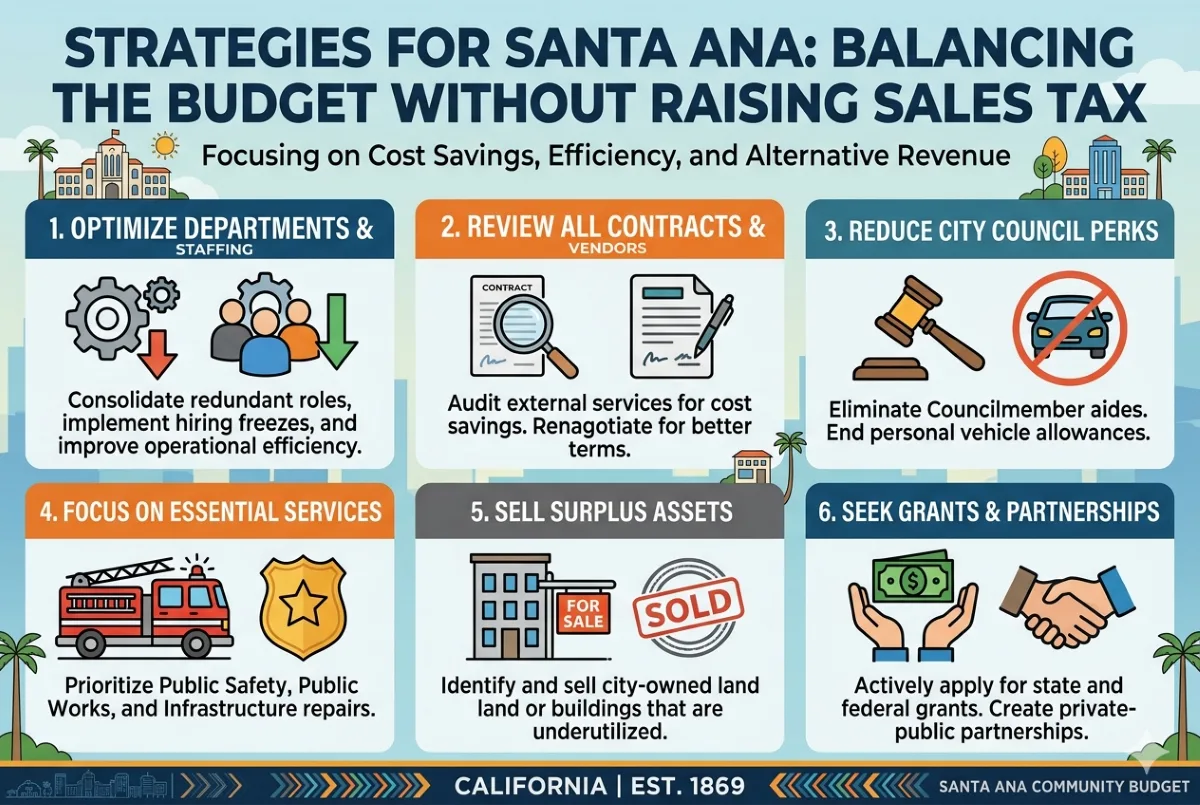
The City of Santa Ana can Reduce their Budget Without Increasing our Sales Tax again
In reality there is a lot the City of Santa Ana can do to get their finances in order – without have to raise our taxes again!
1. Reforming City Council Expenditures
- Eliminating Councilmember Aides: Terminating the employment contracts or budget allocations for individual City Council aides to save on direct administrative salaries and benefits.
- Abolishing Vehicle Allowances: Removing the monthly or annual stipend provided to councilmembers for personal vehicle use, requiring them to use standard mileage reimbursement or absorb travel costs.
- Cutting Discretionary Budgets: Reducing or entirely freezing the individual discretionary funds assigned to each councilmember for community events and office expenses.
2. Comprehensive Administrative and Internal Staffing Adjustments
- Freezing or defunding vacant positions: Leaving open city jobs unfilled rather than hiring new personnel.
- Reducing part-time staff hours: Cutting down seasonal or temporary part-time hours across city departments.
- Cutting official travel budgets: Lowering the travel and conference allowances allocated to City Council members and executive staff.
- Re-evaluating city commissions: Consolidating or eliminating unproductive commissions to save operational overhead.
- Halting equipment replacement funds: Keeping internal vehicle and technology equipment replacement contracts completely flat.
3. Program Reductions and Service Cuts
- Defunding non-mandatory programs: Place “nice-to-have” initiatives on the chopping block, such as local arts and culture programs or the ArtWalk.
- Trimming community and youth services: Scaling back after-school programs, youth resources, and senior services.
- Reducing library operating hours: Closing the main library branches on Sundays or limiting special program hours.
- Cutting public works contracts: Delaying or reducing the frequency of public works contracts, specifically park maintenance and non-urgent repairs.
4. Alternative Cost-Recovery and Revenue Generation
- Implementing fee increases: Hiking existing municipal fees for city permits, licensing, or specialized usage.
- Enforcing aggressive parking enforcement: Maximizing cost recovery by issuing targeted parking citations in heavy-traffic zones.
- Selling naming rights: Selling the commercial naming rights to city-owned venues, such as Eddie West Field at Santa Ana Stadium.
- Collecting unpaid debts: Dedicating city resources to identifying and collecting old or outstanding monies owed directly to the city.
5. Cost-Sharing and Strategic Partnerships
- Securing county financial aid: Petitioning the Orange County Board of Supervisors to help absorb regional program costs like traffic management and homelessness.
- Reducing transit fund contributions: Minimizing local general fund allocations toward major county transportation projects like the OC Streetcar.