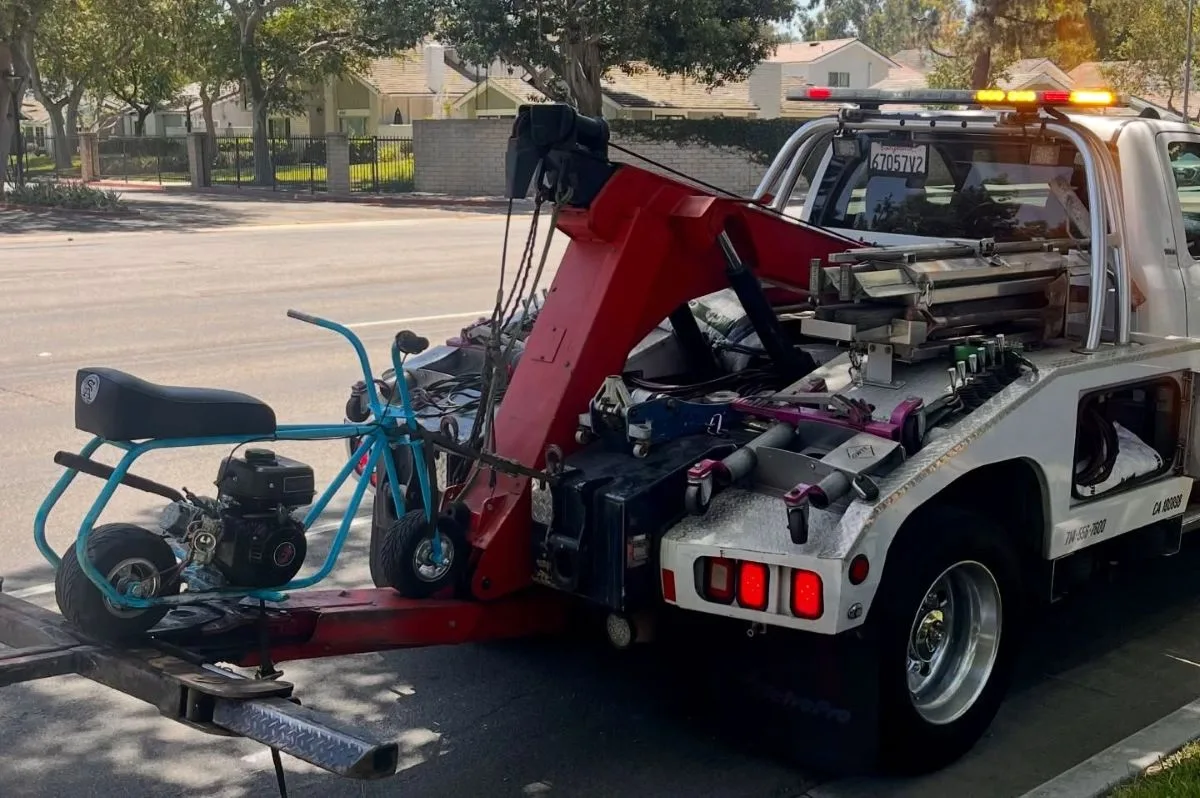
A juvenile rider tearing down Red Hill Avenue and Bristol Street at speeds pushing 40 mph recently learned a hard lesson about Southern California traffic safety.

After attempting to evade a motor officer, a short pursuit ended with the rider apprehended, a pocket bike loaded onto the back of a tow truck, and parents facing a formal admonishment.
As similar stories ripple through cities like Costa Mesa, Irvine, and Huntington Beach, local law enforcement agencies are making one thing very clear: pocket bikes and unclassified e-motorcycles are not street legal, and the parents who allow minors to ride them face heavy financial and criminal liabilities.
Criminal Charges, Fines, and Impound Penalties
Allowing a minor to take an illegal pocket bike or unclassified high-power e-moto out on public roads carries a strict legal toll under the California Vehicle Code (CVC). Because pocket bikes do not meet Federal Motor Vehicle Safety Standards, they cannot be registered or legally driven on public streets, sidewalks, or trails.
- CVC 14607 Violations: Parents who knowingly permit an unlicensed minor to drive a motorized vehicle on public roadways can be issued a misdemeanor citation under CVC 14607, carrying a baseline fine of $500 before court assessments.
- Felony Child Endangerment: Southern California district attorneys are actively escalating consequences for parental negligence. Providing an unsafe, high-power motorized vehicle to an underage child can result in felony child endangerment charges (Penal Code 273a), which can carry up to six years in state prison if a serious or life-threatening injury occurs.
- Evading a Peace Officer: If a minor attempts to flee a traffic stop, they can face severe juvenile court charges under CVC 2800.1 (willful flight from a peace officer).
- Towing and Impound Fees: When an illegal vehicle is seized, the owner is responsible for flat-rate towing fees and daily storage fees accumulated at the impound lot. These administrative penalties quickly stack up to hundreds or thousands of dollars before the vehicle can be released—if it can be released at all.
The Impact on Parents’ Insurance and Liability
Operating an unregistered, unclassified motor vehicle introduces astronomical civil liabilities for households. Standard homeowners or renters insurance policies strictly exclude coverage for motorized vehicle accidents occurring on public streets. Because pocket bikes and certain electric dirt bikes cannot be registered, they cannot be added to a standard auto insurance policy.
If a child injures someone or damages property while riding an illegal vehicle, the parents are personally on the hook for medical bills, property repair costs, and legal judgments. Additionally, if the parent’s regular auto policy provider discovers that a household member was involved in an illegal street pursuit, the insurer may classify the household as a high-risk entity, leading to sharply increased premiums or policy non-renewals.
Understanding the Law: Legal E-Bikes vs. Illegal Vehicles in Southern California
Navigating the spectrum of two-wheeled electric transport is critical for parents trying to ensure their purchases are street legal. California law explicitly categorizes electric bicycles into three distinct classes. Any device that falls outside these rules is treated as a motor vehicle subject to registration, licensing, and equipment restrictions.
- Class 1 E-Bikes: Equipped with a motor that provides assistance only when the rider pedals, stopping assistance at 20 mph. These are legal on most public roads, bike paths, and lanes.
- Class 2 E-Bikes: Equipped with a throttle-actuated motor that can propel the bicycle without pedaling, but cuts off completely at 20 mph. These share the same general access rules as Class 1.
- Class 3 E-Bikes: Speed-pedal-assisted e-bikes that can reach up to 28 mph. Operators must be at least 16 years old and must wear a helmet regardless of age. They are generally restricted from standard multi-use class I bike paths.
- Illegal Pocket Bikes and E-Motos: Vehicles featuring motors exceeding 750 watts, or unclassified electric motorcycles (such as Sur-Ron, Talaria, or gas pocket bikes) that travel at 30 to 60 mph, are entirely illegal on public roadways. They lack turn signals, mirrors, brake lights, and standard safety features required for registration. They may only be operated on closed, private property.
Rising Accident and Fatality Trends in Orange County
The regulatory crackdown by Southern California police departments is a direct response to a spike in pediatric trauma and roadway fatalities involving e-devices. The Children’s Hospital of Orange County (CHOC) reported an alarming surge in severe injuries requiring immediate emergency trauma activations. In 2021, CHOC treated only one severe trauma patient related to an e-bike injury. That number escalated drastically to 38 in 2022, 61 in 2023, and reached 125 in 2024. By 2025, CHOC handled 201 e-bike-related pediatric trauma patients, solidifying high-speed electric devices as a primary cause of pediatric emergency room admissions across Orange County.
Tragic outcomes underscore the real-world stakes of this traffic enforcement shift. In a devastating incident in Garden Grove, a 13-year-old boy lost his life while operating an unclassified e-moto after striking a center median and being thrown into the roadway. In another high-profile Southern California case, an 81-year-old Vietnam War veteran was fatally struck and killed by a teenager performing reckless stunts on a high-speed electric motorcycle. Furthermore, a Cal State Fullerton student athlete was killed in a collision involving an electric riding device and a commercial box truck.
Law enforcement officials emphasize that safety education starts at home. Before buying a high-power mini bike or electric motorcycle for a teenager, parents must recognize that the hidden costs often extend far beyond an impound lot—potentially altering lives forever.
I’m 100% in favor of this. But as this problem continues to escalate, the police need to invest in or contract with companies that use a more cost effective vehicles for impounding a kiddie bike. Showing up in a heavy duty wrecker to impound a tricycle just screams waste of resources, makes them look buffoonish, and further fuels anti-police sentiment.