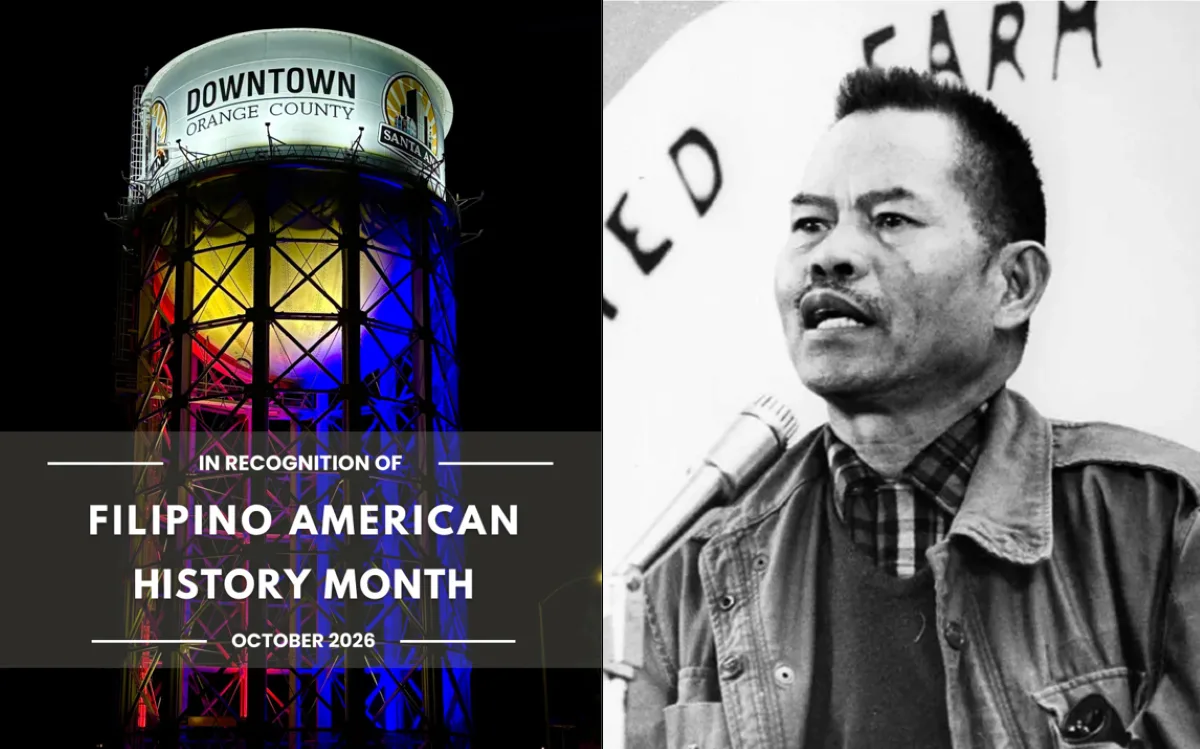
The City of Santa Ana is marking Filipino American History Month by illuminating the city’s iconic Downtown Orange County water tower in the colors of the Philippine flag, recognizing the contributions of Filipino Americans to Santa Ana, Orange County, California, and the nation.

Observed each October, Filipino American History Month commemorates the arrival of the first recorded Filipinos in what is now the United States in October 1587 along the California coast, making the Filipino American story one of the oldest Asian American histories in the country.
For Santa Ana, the recognition is especially meaningful. The city is home to a growing and active Filipino American community that has made contributions in healthcare, education, business, public service, and civic life.
Among those serving today is Santa Ana City Councilmember Phil Bacerra, whose family history connects directly to one of the most important chapters in California labor history. Bacerra is up for reelection this November.
Councilman Phil Bacerra’s Family Connection to Labor History
In a recent post recognizing Filipino American leader Larry Itliong, Bacerra reflected on his family’s connection to the labor movement.
“Happy 113th birthday to Larry Itliong, who, along with Philip Vera Cruz, led Filipino farm workers in walking off the farms of local grape growers demanding wages equal to the federal minimum wage in what we know today as the Delano Grape Strike,” Bacerra wrote.
According to Bacerra, one week after Filipino workers began the strike, Mexican farm workers joined the effort. The two groups eventually united to form the United Farm Workers of America. After years of organizing, marches, and nationwide boycotts, the workers secured contracts that included higher wages, healthcare, and improved working conditions.
“I am proud that my grandfather knew Larry Itliong and that he was involved with these hallmark accomplishments in the labor movement,” Bacerra added.
The story highlights a fact that is sometimes overlooked in discussions of California labor history: Filipino American farmworkers were instrumental in launching the movement that ultimately transformed conditions for agricultural laborers throughout the state. Historians credit Larry Itliong as one of the key leaders of the Delano Grape Strike, working alongside fellow Filipino American labor organizer Philip Vera Cruz and later with César Chávez and the United Farm Workers.
Filipino Americans Helped Build Orange County
Orange County’s Filipino American community traces its roots back more than a century. Historians have documented Filipino laborers working in the county’s agricultural economy during the 1920s and 1930s, including in citrus groves, bean fields, and other farming operations in communities such as Fullerton, Anaheim, and Huntington Beach.
Over subsequent decades, the community expanded through military service, education, professional careers, and family-based immigration. Today, Orange County is home to one of the largest Filipino populations in the United States, with thriving communities spread throughout the region.
Organizations such as the Filipino American National Historical Society Orange County and Inland Empire Chapter continue working to preserve the stories of Filipino farmworkers, veterans, business leaders, educators, and community activists whose efforts helped shape the county.
A Long History in Southern California
The Filipino American presence in Southern California predates California statehood and even the founding of the United States. Historians note that Filipinos first arrived on California shores in 1587, while later generations established communities throughout Los Angeles and Southern California during the early 20th century.
Many Filipino immigrants initially found work in agriculture, helping cultivate California’s fields and orchards. Others settled in urban centers, creating community institutions and businesses despite facing discrimination and barriers to economic opportunity.
Over time, Filipino Americans became prominent in the military, education, healthcare, engineering, technology, entrepreneurship, and public service sectors, helping drive California’s economic growth and cultural diversity.
The Cerritos-Artesia Corridor: An Unofficial Little Manila
While Southern California’s most well-known Filipino historic district is Historic Filipinotown in Los Angeles, many Filipino Americans in Orange County are familiar with the thriving Filipino business corridor centered around neighboring Cerritos and Artesia.
Often described as an unofficial “Little Manila,” the area is home to Filipino restaurants, bakeries, markets, professional services, and community organizations that draw visitors from throughout Orange County and Southern California.
Orange County’s Filipino Food Scene Reflects the Community’s Growing Influence
One of the most visible ways Filipino culture has become woven into the fabric of Orange County is through its thriving restaurant scene. From traditional family-run eateries serving adobo, pancit, lumpia, kare-kare, and sisig to modern chefs putting contemporary spins on classic dishes, Filipino cuisine has become an important part of Orange County’s diverse culinary landscape.
Among the Filipino restaurants and eateries most frequently praised by local diners and reviewers are:
- Lola’s by MFK in Anaheim, known for modern Filipino brunch offerings, silog plates, adobo specialties, and ube-inspired dishes.
- Manila Grille in Buena Park, a longtime favorite for traditional Filipino comfort food, party trays, lumpia, pancit, lechon kawali, and other classic dishes.
- Maria’s Kusina in Buena Park, a popular family-owned restaurant offering authentic home-style Filipino cooking, including adobo, sisig, and other traditional favorites.
- Kapit Bahay in Anaheim, a longtime staple known for serving traditional Filipino meals in a casual setting.
- Terrace by Mix Mix in Costa Mesa, the Filipino-inspired restaurant from acclaimed Santa Ana chef Ross Pangilinan, which blends Filipino flavors with contemporary California cuisine.
- Fil-Am BBQ Grill – Located right over the border in Orange (about a 7-minute drive from North Santa Ana), this is your go-to for traditional, home-style Filipino comfort food. It is a casual spot famous for its perfectly charred pork BBQ skewers, crispy lechon kawali, and savory sisig. The portions are generous, and the family who runs it is incredibly welcoming.
The popularity of these restaurants reflects the growth of Orange County’s Filipino American population over the past several decades. What began with agricultural workers in the early twentieth century has evolved into a vibrant community that has left its mark not only on healthcare, education, business, and public service, but also on the region’s culinary identity.
For many local families, Filipino restaurants are more than places to eat. They serve as cultural gathering places where traditions, language, recipes, and community connections are passed from one generation to the next. As Santa Ana celebrates Filipino American History Month, Orange County’s Filipino food scene offers another reminder of the community’s enduring contributions to the region.
Healthcare Remains One of the Community’s Greatest Contributions
Few professions are more strongly associated with Filipino Americans than nursing.
Because of historic educational ties between the United States and the Philippines, generations of highly trained Filipino nurses have entered the American healthcare workforce. Experts estimate that roughly 150,000 Filipino nurses have immigrated to the United States since 1960, and about one in twenty registered nurses nationwide was trained in the Philippines.
Filipino Americans comprise only a small percentage of the overall U.S. population but account for a disproportionately large share of the nursing workforce, making them indispensable to hospitals, clinics, nursing homes, and healthcare systems throughout California and the nation.
Orange County’s strong network of Filipino healthcare professionals continues that tradition today through organizations such as the Philippine Nurses Association of California Orange County.
Five Career Fields Where Filipino Americans Have Made a Strong Impact
While nursing remains the profession most commonly associated with Filipino Americans, the community has excelled across numerous industries. Some of the largest occupational categories include:
- Registered nurses and other healthcare professionals
- Healthcare support workers and caregivers
- Management and business professionals
- Office and administrative support occupations
- Education professionals, including teachers and school administrators
Filipino Americans are also heavily represented in engineering, information technology, accounting, government service, and the military.
Celebrating a Legacy of Service and Leadership
Santa Ana’s recognition of Filipino American History Month serves as a reminder that the Filipino American community has helped shape California in countless ways. From the farmworkers who launched one of the most significant labor movements in American history to the nurses caring for patients across the state, Filipino Americans have left an enduring mark on California society.
The story is particularly relevant in Santa Ana, where Filipino Americans continue to contribute as business owners, educators, healthcare workers, community leaders, and elected officials. The presence of Councilmember Phil Bacerra on the City Council, along with his family’s personal connection to labor leader Larry Itliong, underscores the deep roots that Filipino Americans have established in Orange County.
As the Downtown water tower shines in the colors of the Philippine flag this month, it stands as a visible tribute to generations of Filipino Americans whose hard work, sacrifice, and leadership helped build Santa Ana, Orange County, California, and the United States.