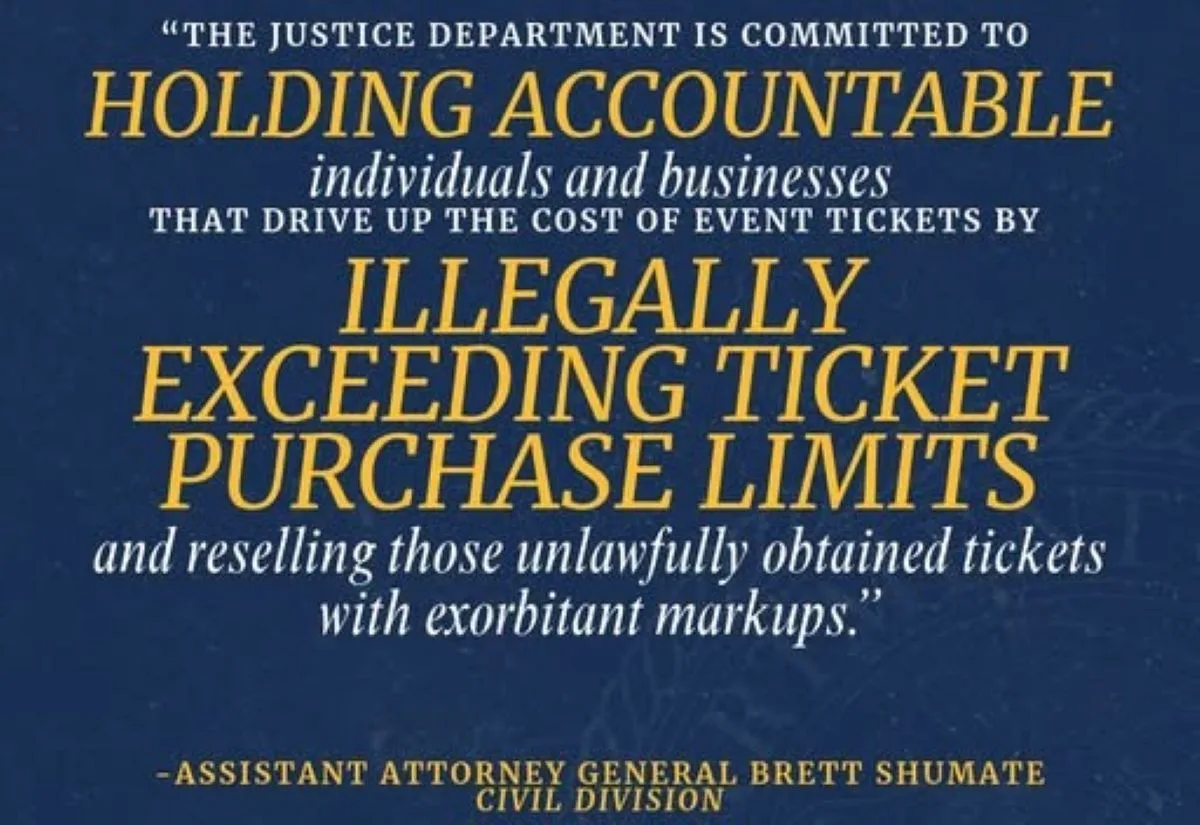
Federal prosecutors and the Federal Trade Commission have filed a civil lawsuit against California-based REPS & Company Inc. and three of its top executives, alleging the company used unlawful tactics to bypass ticket purchase limits and acquire millions of tickets to high-demand concerts, sporting events and other live events before reselling them at substantial markups. According to the complaint, the defendants generated at least $120.8 million in profit through the alleged scheme.

The lawsuit, filed in the U.S. District Court for the Southern District of California, names REPS & Company, CEO Ryan Pancheri, President Brian Archibald, and Chief Operating Officer Nicholas Totagrande. Federal authorities allege the defendants violated both the Federal Trade Commission Act and the Better Online Ticket Sales (BOTS) Act.
The allegations remain unproven, and the lawsuit represents claims made by the government. No court has determined liability.
Where the defendants were based and where they operated
REPS & Company is headquartered in San Diego, California, with its principal office located on Jutland Drive in the Clairemont area. Public business records and the company’s website identify the company as a San Diego-based ticket brokerage and technology company founded in 2017.
Although based in San Diego County, the company’s business was national in scope. The DOJ alleges the company purchased tickets for thousands of events across the United States and then resold those tickets on the secondary market. Federal authorities specifically cited a Beyoncé Renaissance Tour concert in Kansas City, Missouri, as one example discussed in the complaint.
Because the company allegedly acquired more than 18.5 million tickets for over 83,500 events nationwide, the impacted events likely spanned numerous states and counties throughout the country rather than being limited to California. The complaint, however, does not specify every county where business was conducted.
How much did consumers effectively lose?
The DOJ alleges REPS spent more than $1.3 billion acquiring over 18.5 million tickets and generated at least $120.8 million in profit through resale activity.
While prosecutors do not claim every dollar of profit came directly from unlawful markups, the government’s theory is that the profits resulted from obtaining tickets in excess of posted limits and reselling them at higher prices. Based on the government’s allegations, the best estimate of the consumer overcharge attributable to the conduct is the stated profit figure of approximately $120.8 million.
Put another way, federal authorities are alleging consumers collectively paid more than $120 million above the amount REPS paid for the tickets, not including additional resale fees often charged on secondary marketplaces. That figure averages roughly $6.53 in profit per ticket across the 18.5 million tickets identified in the complaint. That calculation is based on the government’s numbers and is not itself alleged in the complaint.
What exactly are the charges?
This is a civil enforcement action, not a criminal prosecution.
The government alleges violations of:
- The Better Online Ticket Sales (BOTS) Act.
- Section 5 of the Federal Trade Commission Act, which prohibits unfair or deceptive practices.
The BOTS Act makes it illegal to:
- Circumvent technological controls used to enforce ticket purchase limits.
- Use false identities, multiple accounts or technological workarounds to exceed limits.
- Resell tickets obtained through those unlawful methods.
The FTC alleges REPS used unlawful tactics to bypass safeguards put in place by ticket issuers such as Ticketmaster and AXS.
What penalties could they face?
Because this is a civil case, there is currently no criminal prison exposure alleged in the complaint.
Potential consequences could include:
- Civil penalties.
- Restitution or monetary judgments.
- Permanent injunctions restricting future conduct.
- Court orders requiring compliance monitoring and reporting.
FTC guidance notes that BOTS Act violations can carry civil penalties that currently exceed $53,000 per violation. Actual penalties are determined by a court and depend on the facts proven. [
Could this affect the company’s commercial insurance?
Potentially yes.
Commercial general liability policies and errors-and-omissions policies often exclude coverage for intentional, fraudulent, dishonest or knowingly unlawful acts. If the government ultimately proves intentional violations, insurers may deny coverage for penalties and portions of any judgment.
Additional potential insurance consequences include:
- Nonrenewal of liability policies.
- Higher premiums at renewal.
- Increased underwriting scrutiny.
- Difficulty obtaining directors and officers liability coverage.
- Disclosure obligations on future insurance applications.
The exact effect would depend on the company’s policy language and the outcome of the litigation.
Similar ticket-scalping and BOTS Act cases
Federal authorities have pursued relatively few BOTS Act cases since Congress enacted the law in 2016.
In 2021, the FTC and DOJ brought the first-ever BOTS Act enforcement actions against three New York ticket brokers: Just In Time Tickets, Concert Specials and Cartisim Corp. Authorities alleged the defendants used bots, concealed IP addresses and hundreds of fictitious accounts to obtain more than 150,000 tickets and resell them at inflated prices. The cases resulted in judgments totaling more than $31 million, although the defendants ultimately paid about $3.7 million because of claimed inability to pay.
The REPS lawsuit appears to dwarf those earlier cases in scale. Federal authorities allege REPS acquired more than 18.5 million tickets and generated at least $120.8 million in profits.
More recently, the FTC sued Ticketmaster and Live Nation in 2025, alleging illegal ticket resale practices and broker-related conduct that the agency claimed cost consumers billions in inflated prices and fees. That litigation remains significant because it expanded scrutiny beyond individual ticket brokers and toward the broader ticketing ecosystem.
Why don’t ticket companies simply limit sales to two tickets per person?
On paper, that sounds simple. In practice, enforcement is extremely difficult.
Ticket brokers and scalpers often use:
- Multiple customer accounts.
- Different email addresses.
- Different payment methods.
- Residential proxy networks.
- VPNs and IP-masking tools.
- Teams of purchasers.
- Friends, relatives or contractors acting as buyers.
A strict two-ticket limit also creates commercial problems. Many legitimate customers buy tickets for families, friend groups or corporate outings. Ticket sellers therefore often allow four, six, eight or more tickets per transaction and rely on fraud-detection systems to identify abuse.
Critics argue that ticket companies could do more through:
- Verified identity systems.
- Transfer restrictions.
- Delayed ticket delivery.
- Face-value exchange marketplaces.
- Mobile-ticket-only events tied to verified accounts.
However, those measures can create privacy concerns and inconvenience legitimate buyers.
National impact of ticket-bot and scalping activity
Consumer advocates and regulators have repeatedly identified ticket bots as a major contributor to inflated ticket prices and reduced access to high-demand events. FTC officials have stated that unlawful bot activity deprives ordinary fans of the opportunity to buy tickets at face value and forces them into secondary markets where prices are often substantially higher.
A CNBC report on global ticketing markets noted that automated ticket-buying programs continue to make it harder for consumers to secure tickets while driving resale markups, despite increasing regulatory attention worldwide.
Tips for buying high-demand event tickets
Consumers looking to avoid inflated resale prices should consider:
- Buy directly from the primary ticket issuer whenever possible.
- Join verified fan programs before sales begin.
- Create and verify ticketing accounts ahead of presales.
- Avoid social media sellers offering “guaranteed” tickets.
- Compare prices across multiple authorized resale platforms.
- Review refund and transfer policies before purchasing.
- Use a credit card rather than cash-transfer apps.
- Be wary of prices that are dramatically below market value.
- Check whether the event organizer offers official face-value exchanges.
- Keep screenshots, receipts and confirmation emails for dispute purposes.
The government’s lawsuit against REPS represents one of the largest anti-ticket-scalping enforcement actions brought under the BOTS Act and signals increasing federal scrutiny of companies accused of using technology to bypass purchase limits and profit from consumer demand. Whether the allegations can be proven in court remains to be seen, but the claimed $120.8 million in profits and 18.5 million tickets make the case one of the most significant ticket-resale enforcement actions ever filed in the United States.