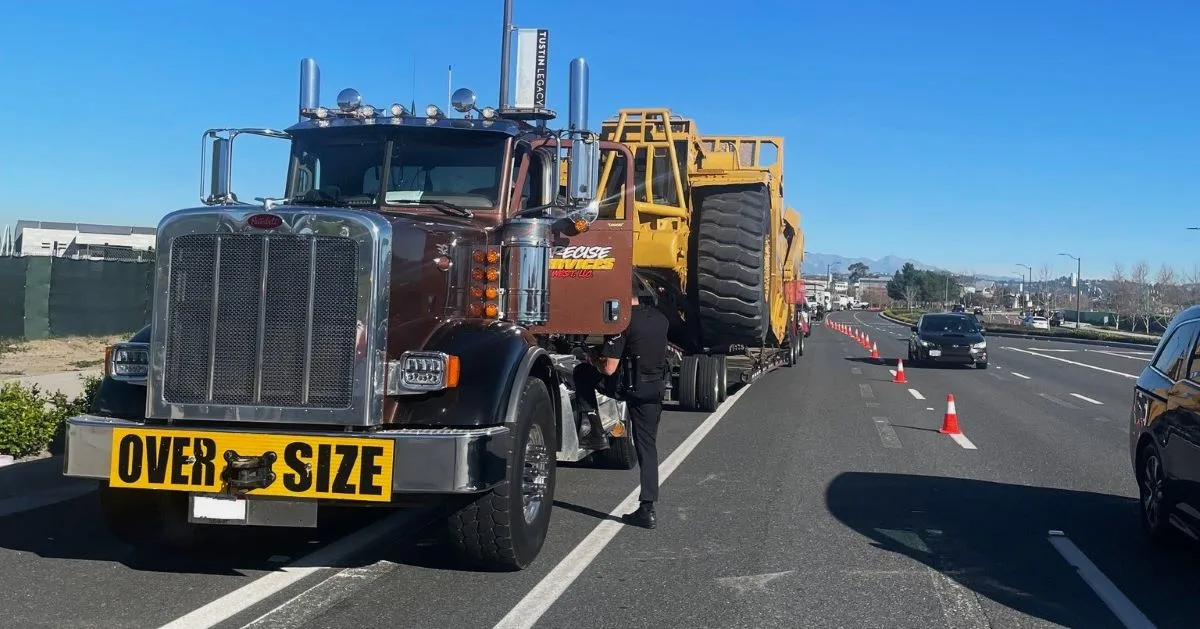
On Tuesday, January 13, 2026, the Tustin Police Department, in partnership with the California Highway Patrol and Commercial Enforcement Officers from Orange, Los Angeles, Riverside, and San Bernardino Counties, conducted fixed and roving commercial vehicle inspections along northbound and southbound Tustin Ranch Road.
The operation focused on identifying violations, enforcing truck route compliance, and removing unsafe commercial vehicles from service when warranted. Through a highly visible presence and strict adherence to statutory checkpoint requirements, participating officers sought to enhance public safety, promote regulatory compliance, and protect the integrity of commercial transportation throughout the region.

A total of nineteen officers and deputies participated in the checkpoint, inspecting sixty-one vehicles. Enforcement efforts resulted in twenty-two citations, two vehicles being placed out of service, and six vehicles being towed, including two pilot vehicles escorting an oversized tractor-trailer transporting a CAT Open Bowl Scraper that weighed over 164,000 lbs.

We would like to thank the task force for successfully advancing safe commercial vehicle operations on Tustin roadways through this coordinated, multi-agency enforcement effort.

Penalties faced by the cited drivers and their companies
Commercial vehicle operators and their companies face immediate legal penalties, long-term operational restrictions, and significant insurance repercussions following enforcement actions like the January 2026 Tustin multi-agency inspection.
Legal and Financial Penalties
- Fines and Citations: Drivers and companies can be issued citations for equipment violations, weight limit breaches, or hours-of-service infractions. In California, common commercial vehicle violations often result in fines ranging from $100 to $1,000 per offense.
- Misdemeanor Charges: Specific violations, such as failing to comply with California Highway Patrol (CHP) rules or failing to stop at a required inspection, are classified as misdemeanors. These can carry penalties of up to six months in county jail and/or additional fines.
- Towing and Impound Fees: Vehicles found to be unsafe or in violation of route compliance may be towed. Towing and storage fees in California can quickly reach hundreds or thousands of dollars, depending on the vehicle size and length of impoundment.
- Out-of-Service (OOS) Orders: Unsafe vehicles are placed out of service immediately, prohibiting them from operating until repairs are verified. Operating a vehicle while under an OOS order is a major violation that can lead to automatic safety audit failure for new entrants.
Insurance Repercussions
- Premium Increases: Insurance underwriters increasingly rely on compliance records and safety scores in 2026 to set rates. A single poor inspection or violation can directly lead to higher premiums as the fleet is perceived as higher-risk.
- Policy Non-Renewal: Severe or repeated violations (such as the two OOS orders and six tows reported) can lead to an insurer’s refusal to renew a policy.
- Long-Term Impact: Inspection history influences insurance rates for years. Consistent patterns of maintenance or safety violations signal inadequate fleet management, which keeps premiums elevated even after initial fines are paid.
Operational Impact (CSA Scores)
- CSA Score Damage: Every violation found during roadside inspections is factored into a company’s Compliance, Safety, Accountability (CSA) score. Higher scores (indicating worse safety) trigger increased scrutiny from the Federal Motor Carrier Safety Administration (FMCSA).
- Increased Inspections: Companies with poor safety ratings are “flagged” for more frequent roadside inspections, creating a cycle of operational delays and downtime.
- Loss of Business: Many brokers and shippers monitor public CSA data and will not contract with carriers that have “alert” status or poor safety records.
We should treat non-commercial drivers the same way with the same penalties and scrutiny. Look at the staggering number of fatalities– over 40,000 per year– and realize only 2% of those involve commercial vehicles. Commercial isn’t the problem. It’s everyone else who– in addition to casually joking about how they “drive with a led foot”– drive on bald tires, worn out brakes, bad suspension components, cracked windshields and everything else that contributes DIRECTLY to accidents. Then realize that CA policymakers simply do not care about this. Unlike many other states, your car never gets a safety inspection. The only inspection we do is SMOG– which has more or less been rendered completely obsolete by electronic engine controls. But CA policymakers run a moneymaking racket with SMOG check business licenses and fees. They don’t care at all about public safety (or the environment)– only making money and hassling commercial drivers over their logbook entries.