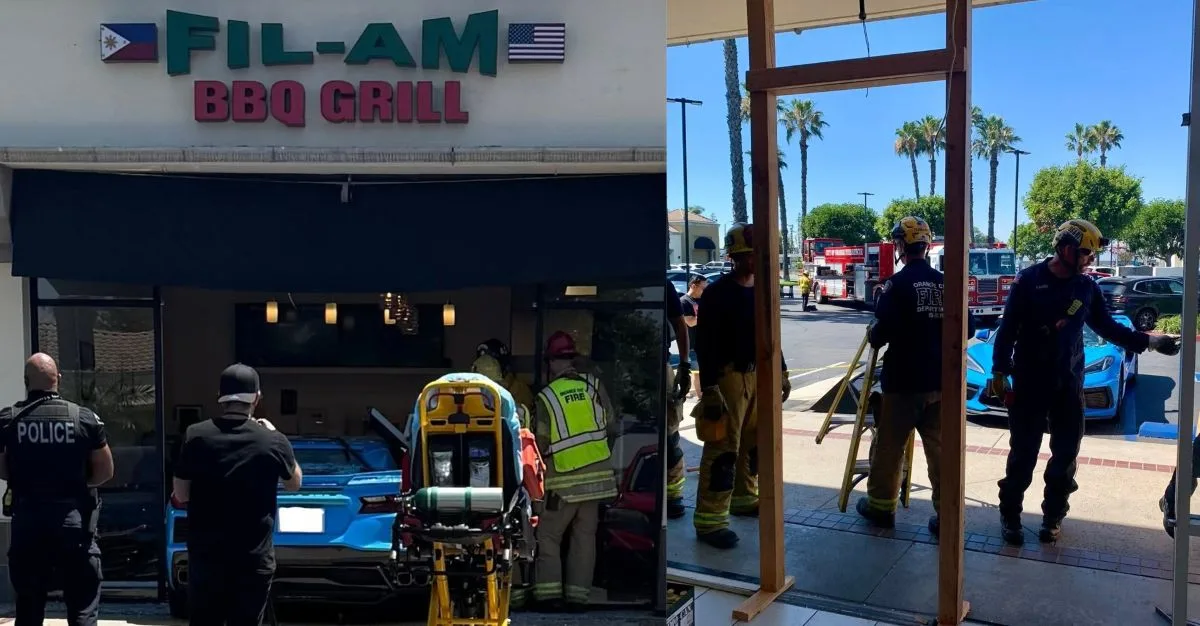
Earlier today, the Orange City Fire Department responded to a striking scene where a vehicle collided directly with a commercial building. The incident took place at the Fil-Am BBQ Grill, a popular local establishment.

Fortunately, authorities confirmed that no injuries were reported from inside the building or the vehicle itself. Emergency personnel from Engine 5 and the Orange Urban Search and Rescue (USAR) 1 crews mobilized quickly to secure the immediate scene, evaluate the structural impacts of the crash, and stabilize the damaged storefront.
In an effort to keep the business operational and protected while permanent structural repairs are arranged, the specialized USAR crews constructed a temporary storefront and door system. This saved the business as much as $2,000 however replacing all the broken glass and repairing damage to the storefront could cost over $5,000.

About Fil-Am BBQ Grill
Fil-Am BBQ Grill is a highly rated, casual Filipino restaurant known for its authentic, flavorful, and budget-friendly comfort food.
Menu Highlights & Highlights
- Signature BBQ: Famous for its perfectly cooked pork BBQ skewers and delicious chicken skewers.
- Traditional Fare: Serves classic dishes like lechon kawali (crispy fried pork belly), bistek (Filipino beef steak), chicken curry, kalderetang kambing (goat stew), and large vegetable lumpia.
- Desserts: Features traditional treats like halo-halo.
- Vibe & Service: Known for a welcoming atmosphere with friendly, polite staff and an owner-operated feel.
Vehicle Identification: A Modern Sports Car Involved
The vehicle responsible for the storefront damage is visibly identifiable as a rapid-mid-engine sports car. Based on the distinctive sharp angular rear fascia, high-set quad exhaust placement tips, and sleek profile, the vehicle is a newer-generation Chevrolet Corvette C8 finished in Rapid Blue.
The current market value of a Chevrolet Corvette C8 Stingray ranges between $60,000 and $80,000, depending on its model year, mileage, and options package (such as the 1LT, 2LT, or 3LT trims).
Because the Corvette C8 features a specialized mid-engine design with composite body panels and an aluminum spaceframe, collision repairs are exceptionally complex. Based on similar real-world incidents, rebuilding this vehicle will carry heavy financial costs and structural hurdles:
Anticipated Vehicle Repair Estimates: $25,000 to $50,000+
- The Frame and Structure: If the aluminum rear structure or the carbon fiber reinforcements are compromised, repair costs easily escalate by $20,000 to $40,000 alone.
- Cosmetic and Mechanical Replacement: Replacing the rear bumper, exhaust tips, rear quarter panels, trunk mechanics, and underlying cooling systems typically requires a base estimate of $14,000 to $30,000.
- The “Total Loss” Threshold: Insurance companies consider a vehicle a “total loss” if the repair costs exceed roughly 60% to 70% of the car’s actual cash value. Given the severe impact required to punch through a storefront storefront, there is a very high probability that this specific Corvette will be declared a total loss rather than repaired.
Hidden Costs of Repairing a C8
- Long Parts Backorders: C8 structural components, like rear frame rails, routinely face severe supply chain delays. Owners often report their vehicles sitting in specialized body shops for 6 months or more awaiting parts.
- Certified Shop Requirements: Standard body shops cannot easily fix this car. General Motors restricts structural parts ordering exclusively to GM Certified Collision Repair facilities, which command much higher labor rates ($125+/hour vs. standard $50/hour insurance allowances).
- Severe Diminished Value: If the vehicle is successfully repaired, the inevitable CARFAX accident report will destroy its resale capability. A severe collision history strips an immediate $10,000 to $15,000 in market value due to diminished value.
A Broad Look at Storefront Crashes and Local Data
While a car breaching a commercial storefront feels like an anomaly, data compiled by the Storefront Safety Council reveals that vehicle-into-building impacts are incredibly common, occurring more than 100 times per day across the United States. These accidents contribute to roughly 16,000 injuries and over 2,600 fatalities annually nationwide.
Within Southern California, Orange County sees thousands of injury-causing road collisions annually, with major municipal hotspots concentrated across high-traffic arteries like Beach Boulevard, Chapman Avenue, and Harbor Boulevard. While comprehensive local databases record overall traffic violence, storefront impacts typically occur due to unique factors localized within strip malls and parking spaces positioned perpendicular to a business entrance. Past regional examples include a dramatic collision where a vehicle flew into the second story of an Orange County medical facility, highlighting how unpredictable these storefront trajectories can be.
What Causes a Driver to Crash into a Business?
According to industry data compiled by the Storefront Safety Council and safety investigators, human behavioral errors account for over 90% of building collisions. The most frequent catalysts behind storefront incursions include:
- Operator and Pedal Error: Accounting for roughly 22% of storefront crashes, pedal error happens when a driver accidentally stomps on the accelerator pedal rather than the brake while trying to park.
- Distracted Driving: Drivers looking down at smartphones, navigation systems, or passenger interactions while navigating tight commercial parking rows.
- Impaired Driving: Operating a vehicle under the influence of drugs or alcohol, which severely limits reaction time and depth perception.
- Medical Emergencies: Sudden physical episodes behind the wheel, such as seizures, strokes, or diabetic shock, causing immediate loss of vehicle control.
Storefront Protection Methods for Commercial Businesses
Property managers and business owners can implement physical safety modifications to substantially mitigate storefront intrusion risks and protect customers inside. Effective measures include:
- Crash-Rated Bollards: Installing steel or concrete-filled posts engineered to meet ASTM F3016 standards. These can absorb low-speed impacts up to 30 mph, stopping a car entirely before it reaches structural glass.
- Reinforced Infrastructure: Integrating heavy concrete barriers, elevated curbs, large architectural planters, or durable perimeter benches into the exterior layout.
- Parking Lot Realignment: Transitioning parking spaces from a head-on perpendicular orientation to an angled configuration to safely redirect runaway vehicles away from the main glass facade.
Insurance Implications for Drivers and Business Owners
A collision of this nature sets off a complex, multi-layered insurance claims process spanning both commercial lines and private auto policies.
- For the Driver: The driver’s personal automobile policy will face severe impacts. The property damage liability portion of their policy will be utilized to cover the extensive structural repairs of the storefront and any damaged inventory inside. Because the driver is at fault, they can anticipate a significant premium increase, typically ranging from 20% to 40%, alongside potential policy non-renewal. If the driver does not carry high enough liability limits to match the structural damage of the building, they face personal exposure to lawsuits or out-of-pocket costs. [
- For the Business and Property Owner: Commercial property insurance policies generally offer standard coverage for structural damage inflicted by outside vehicles. However, to address operational downtime, business owners rely heavily on Business Interruption Insurance to cover lost revenue, employee wages, and ongoing overhead during structural restoration. The commercial property insurance provider will typically subrogate against the at-fault driver’s auto insurance policy to recover the costs paid out for physical repairs.