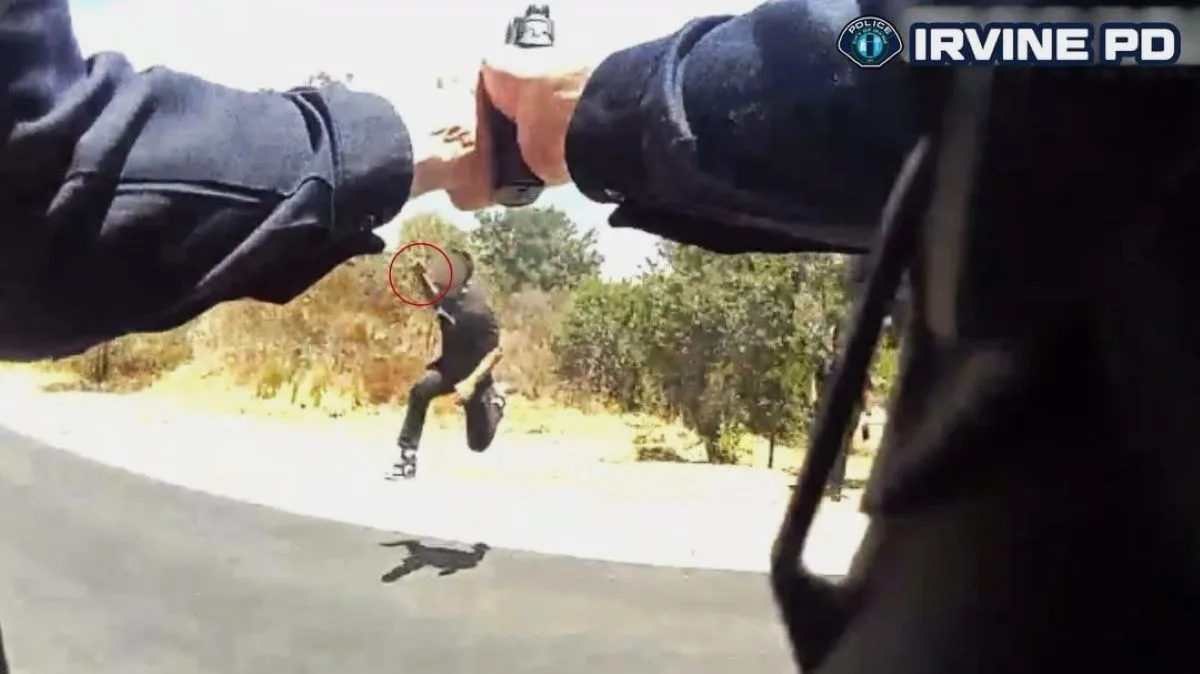
A tragic encounter in Irvine, California, has renewed intense community discussions surrounding law enforcement’s response to individuals experiencing psychological emergencies.
On Tuesday afternoon, July 21, 2026, 20-year-old Daniel Alfons Meltvedt was fatally shot by the Irvine Police Department after calling 911 on himself during an intense mental health crisis.
The official incident update released by authorities confirms Meltvedt explicitly informed dispatchers that he was armed with a knife, intended to harm himself, and was ready to harm others.
Meltvedt then walked onto Sungate in the quiet Turtle Rock community carrying the weapon. Members of the Irvine Police Department’s Crisis Negotiation Team engaged in a standoff that lasted more than an hour, repeatedly pleading with him to drop the knife and surrender peacefully to receive medical care.
However, police stated that the situation escalated when Meltvedt emerged from the bushes and charged directly toward an officer with the knife raised, resulting in an officer-involved shooting. Officers provided immediate life-saving medical aid, but Meltvedt succumbed to his wounds after being rushed to a nearby hospital.
Family Objections and Additional Media Disclosures
Media coverage from local outlets has revealed critical details and profound family grief that contrast sharply with the standard department report.
Meltvedt’s father, Erich Meltvedt, a professional documentary filmmaker, publicly shared that his son was autistic, functioned independently, worked at a local Pavilions grocery store, and held a black belt in tae kwon do.
According to the family, Daniel grew severely agitated after a frustrating interaction with co-workers earlier that morning. His father expressed devastating regret for initially agreeing with his son that calling the authorities for assistance was the right path forward.
Erich Meltvedt watched the entire standoff unfold near their home and alleged that he tried to intervene to soothe his son, but arriving officers explicitly blockaded him and refused to let him near Daniel. He has voiced sharp criticism against the police response, questioning why a heavily equipped team wearing protective vests resorted to lethal force against an autistic young man holding what he described as a simple kitchen or pocket knife.
Law enforcement spokespersons have declined to comment directly on the father’s allegations, emphasizing that the Crisis Negotiation Team took point over unarmed support personnel specifically because Meltvedt was actively brandishing a weapon.
Both the Irvine Police Department and the Orange County District Attorney’s Office are conducting an active investigation, with a comprehensive Critical Incident Debrief video containing the 911 calls and body-worn camera footage expected to be released to the public soon.
National Trends on Law Enforcement and Mental Health Standoffs
The tragic outcome of Daniel Meltvedt’s call underscores a staggering reality concerning how often emergency responses involving psychiatric distress end poorly. National data consistently shows that individuals dealing with a severe, untreated behavioral illness face heightened danger during law enforcement contacts.
- Research from the Treatment Advocacy Center indicates that individuals with untreated mental health issues are roughly 16 times more likely to be killed during an encounter with law enforcement compared to other civilians.
- Studies evaluate that approximately 1 in 4 of all fatal encounters involving law enforcement nationwide involve an individual experiencing a severe mental health crisis.
- Public safety statistics suggest that between 21% and 38% of all emergency 911 calls are directly connected to mental health, substance use, or behavioral crises, making these emergencies a massive portion of the baseline work modern departments handle despite a frequent lack of long-term medical training.
Orange County Mental Health Alternatives Beyond Traditional Police
The Irvine Police update noted that Daniel Meltvedt had been receiving voluntary follow-up services from Irvine’s Community Alternative Response and Engagement (I-CARE) team, a group of unarmed crisis specialists who were standing by with the Orange County Fire Authority during the active negotiation. For families in Orange County seeking to navigate psychological emergencies without immediately involving armed law enforcement, several dedicated regional resources offer support.
- The 988 Suicide & Crisis Lifeline: Dialing or texting 988 connects users directly to free, confidential behavioral health professionals who can de-escalate emergencies over the phone and determine if a mobile response is necessary.
- OC Links Behavioral Health Line: Run by the Orange County Health Care Agency, calling (855) 625-4657 provides 24/7 access to navigators who can deploy specialized county crisis teams directly to a residence.
- Orange County Mobile Crisis Assessment Teams (CAT): These county-operated teams consist of licensed mental health clinicians who deploy directly to homes, schools, or businesses to conduct psychiatric evaluations and facilitate care pathways without standard police intervention.
- Be Well OC Mobile Response: Operating in several Orange County cities, this program dispatches teams of two unarmed mental health specialists directly to community members experiencing emotional distress, substance issues, or psychological breakdowns.
This is a perfect example of why Mental Hospitals need to return big time, otherwise this kind of history will keep repeating itself in the future
[…] The Impact: This adds to a pattern where crisis calls for autistic people end in police violence rather than de-escalation. His father has questioned why armored officers used lethal force on his son, who worked at a grocery store and held a black belt in tae kwon do (New Santa Ana). […]
“He has voiced sharp criticism against the police response, questioning why a heavily equipped team wearing protective vests resorted to lethal force against an autistic young man holding what he described as a simple kitchen or pocket knife.”
Bingo!
A tragic loss for the family. Everyone should be held accountable for threatening a police officer with a weapon. Autism does not excuse anyone from accountability.