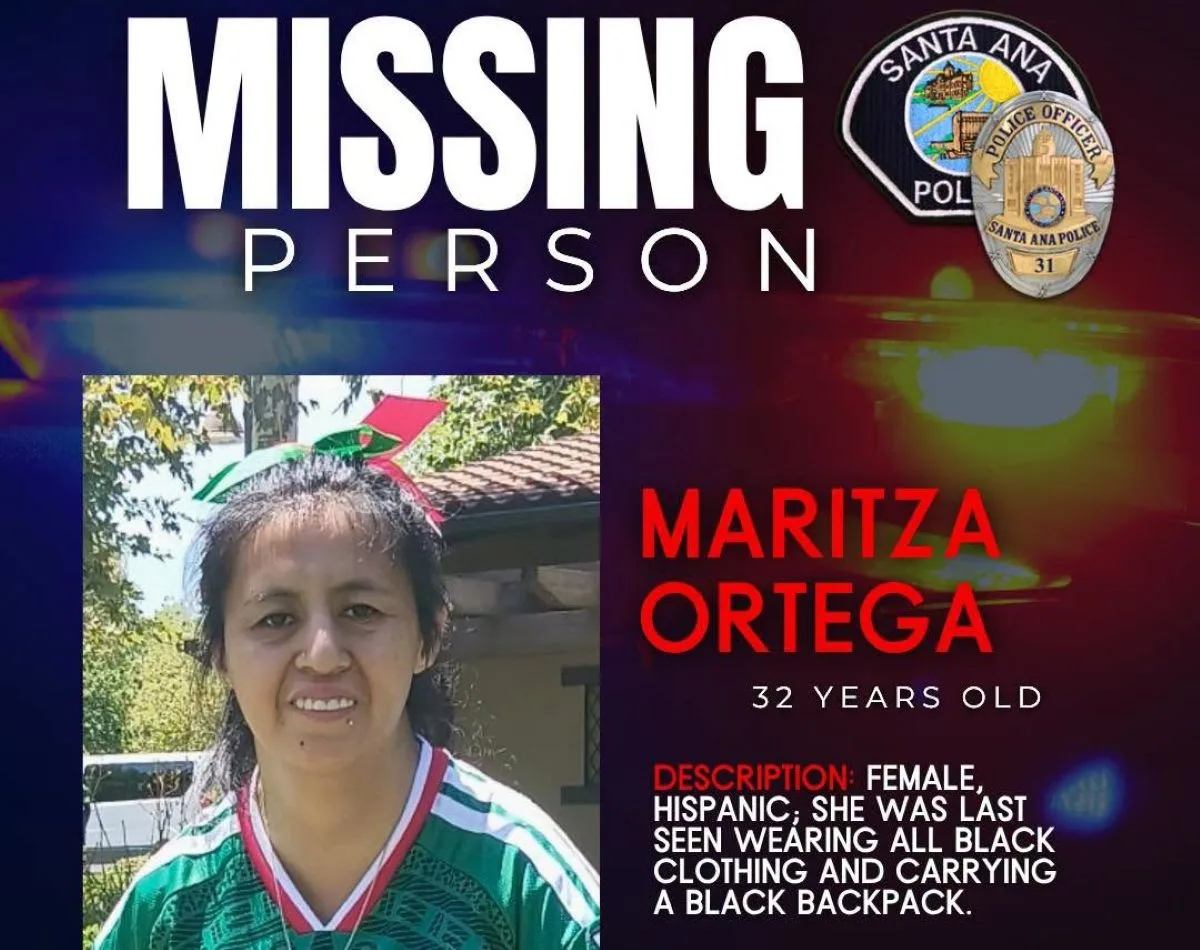
Santa Ana police are urgently searching for 32-year-old Maritza Ortega, who went missing last night near Jackson Street and Hazard Avenue.


Update from the SAPD on 7/31/26 – LOCATED – Thank you to everyone who shared, commented, and called with information about Maritza Ortega, who went missing Wednesday night. She has been safely located and reunited with her family.
Ortega is autistic, has the cognitive capacity of a 12-year-old, is partially nonverbal, and is hard of hearing. She was last seen wearing all black clothing and carrying a black backpack. Her disappearance is considered high‑risk due to her developmental and communication challenges.
Why Her Condition Increases the Danger
Individuals with autism—especially those who are nonspeaking or have limited cognitive capacity—face significantly elevated risks when missing. National data shows that nearly half of children and young adults with autism who go missing are at risk of injury, death, or exploitation, often due to elopement behaviors triggered by stress, sensory overload, or confusion. Key dangers include:
- Water hazards — Drowning is the leading cause of death among missing autistic individuals, with 87% of recovered fatalities in 2025 involving drowning.
- Traffic exposure — Many autistic individuals gravitate toward roadways or areas with flashing lights.
- Communication barriers — Being partially nonverbal or hard of hearing can prevent them from responding to rescuers.
- Hiding behaviors — Some may hide from loud noises or unfamiliar people, complicating search efforts.
How Often Missing Autistic Individuals Are Found
National Center for Missing & Exploited Children (NCMEC) data shows that from 2011–2016, 1,516 autistic children and young adults were reported missing, involving 1,986 incidents. Most cases result in recovery, but the risk of fatal outcomes is significantly higher than in the general population. Additional findings include:
- 67% of cases involve endangered runaways.
- 17% involve individuals who are lost, injured, or otherwise missing.
- Survivability models show that autistic individuals have a 5% chance of survival at 7 days, underscoring the urgency of early search efforts.
Why Autistic People Sometimes Go Missing
Autism-related wandering—also known as elopement—is a well‑documented behavior. According to national research:
- Individuals may wander to escape overwhelming stimuli, such as noise, crowds, or bright lights.
- Some seek comforting environments, including water or quiet enclosed spaces.
- Transitional moments, stress, or confusion can trigger sudden flight responses.
- Limited communication skills may prevent them from asking for help or identifying themselves.
- Some may bolt again even after being located, making rescue efforts more complex.
Contact Information
Anyone with information about Maritza Ortega’s whereabouts is urged to contact the Santa Ana Police Department Watch Commander at (714) 245-8700.