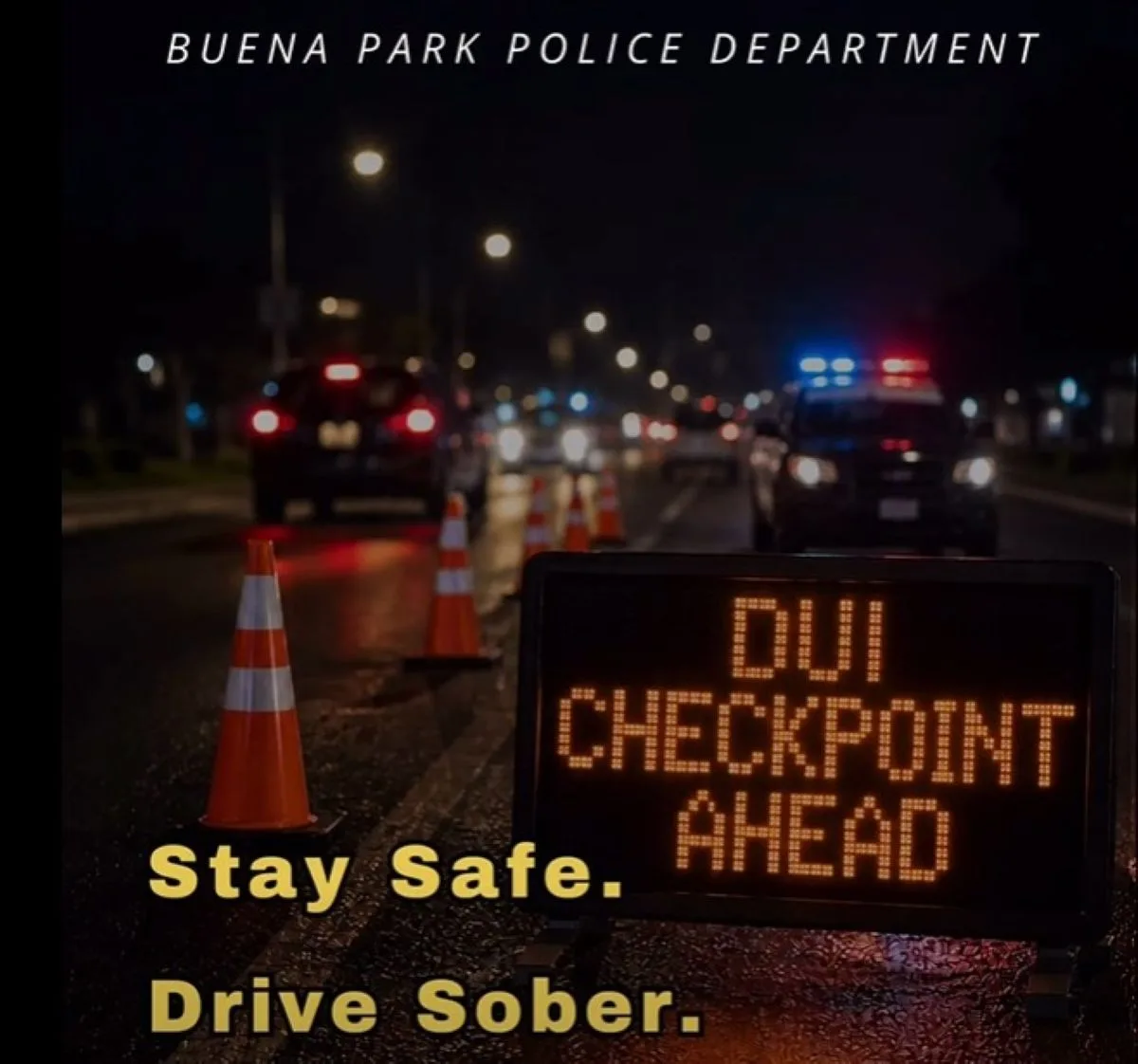
The Buena Park Police Department announced a Driving Under the Influence (DUI) checkpoint scheduled for tonight, Friday, July 31st, from 7:00 P.M. to 2:00 A.M.

While the department publicizes these safety operations to act as a visual deterrent and lower local crash statistics, the specific operational site has been withheld from the initial public media advisory.
Law enforcement officers will be actively screening passing motorists to evaluate sobriety, verify driving privileges, and eliminate dangerous operators from public thoroughfares. Local enforcement campaigns are broadly backed by financial assistance from the California Office of Traffic Safety, operating under the National Highway Traffic Safety Administration.
Buena Park’s Most Frequent DUI Checkpoint Locations
While the Buena Park Police Department relies on historical data regarding impaired driving accidents to choose checkpoint spots, several highly traveled regional corridors see recurrent enforcement. Based on past operational trends, drivers should expect a higher likelihood of stops on major routes near high-traffic retail areas, freeways, or commercial districts.
- Beach Boulevard (State Route 39): Frequently deployed near key intersections such as Beach Blvd. and Stanton Ave., or further north toward Orangethorpe Avenue.
- Orangethorpe Avenue: Heavily patrolled corridor, particularly near the intersections of Dale Street or Knott Avenue.
- La Palma Avenue: Commonly targeted near major shopping centers, arterial crossings, or close to entertainment venues.
- Dale Street and Valley View Street: Often chosen for roving saturation details or targeted operations due to connecting arterial paths.
The Full Spectrum of Criminal Charges at Checkpoints
Passing through a checkpoint can result in multiple separate legal charges depending on your blood alcohol concentration (BAC), the substances present in your system, and your overall level of vehicle control.
- Standard DUI (Vehicle Code 23152a): This misdemeanor charge applies if an officer determines you are physically or mentally impaired by alcohol or drugs while operating a vehicle, regardless of your precise BAC level.
- DUI with a BAC of 0.08% or Higher (Vehicle Code 23152b): This is a per se charge, meaning you are automatically in violation of California law if chemical testing reveals a blood alcohol concentration at or above the 0.08% limit.
- Driving Under the Influence of Drugs / DUID (Vehicle Code 23152f): This covers any driver operating a vehicle under the influence of illegal narcotics, prescription pills, or over-the-counter medication that causes drowsiness or delayed responses. [1]
- Combined Substance DUI (Vehicle Code 23152g): Triggered when an individual is concurrently impaired by a combination of both alcohol and drugs.
- Driving with a Suspended or Revoked License (Vehicle Code 14601): Checkpoints double as driver’s license safety screens. If you are caught driving with a previously suspended driving privilege, your vehicle will be impounded immediately and you will face misdemeanor charges.
Legal Pot and Prescription Meds Can Still Get You Arrested
A very common point of confusion among modern drivers centers around state legalization laws. Medicinal or adult-use recreational marijuana may be legal to buy and possess in California, but driving while under its influence remains strictly illegal. “While medicinal and recreational marijuana are legal, driving under the influence of marijuana is illegal,” as stated directly by the Buena Park Police Department.
The state does not have a precise numerical threshold for cannabis impairment like it does with a 0.08% BAC for alcohol. Instead, officers look closely for clinical indicators of impairment during physical interactions, including sluggish response times, dilated pupils, delayed eye-tracking movements, and distinct vehicle behavior. This strict scrutiny extends directly to prescription medications, sleep aids, and over-the-counter allergy formulations that carry cautionary labels warning against operating machinery.
The Financial Fallout: $13,500 and Premium Auto Insurance Spikes
The financial consequences of a first-time conviction are exceptionally steep, averaging around $13,500 in total out-of-pocket costs when factoring in court penalties, mandated alcohol education courses, bail fees, vehicle impound charges, and legal representation. Beyond the immediate court fines, a conviction severely damages your personal auto insurance profile.
Following an arrest or conviction, your current insurance provider will reclassify you as a “high-risk” operator. In California, your premium rates will typically jump anywhere from 70% to well over 100%, and these high costs stay elevated for several years. Furthermore, you will be forced to file an SR-22 financial responsibility certificate through the California DMV to reinstate your driving privileges, which strips away any safe driver or good driver discounts you previously qualified for. In severe instances, an insurer may drop your policy completely, forcing you to seek high-risk, expensive secondary insurance plans.
Smart Strategy and Proactive Tips for Motorists
The absolute safest and most effective strategy to avoid problems at any law enforcement roadblock is to remain entirely sober behind the wheel. Drivers can seamlessly manage their travel and stay within the bounds of the law by utilizing several practical approaches.
- Leverage Alternative Transit Options: If your plans involve consuming alcohol or using impairing substances, coordinate a reliable alternative ahead of time. Use local rideshare services, schedule a traditional taxi, or establish a designated sober friend to manage the driving duties.
- Understand Your Legal Avoidance Rights: Under California law, it is not illegal to safely turn around or modify your route to completely bypass a checkpoint, provided you do so safely and legally. However, making an illegal U-turn, crossing over solid double lines, or driving erratically to avoid the police lane will provide nearby roving units with immediate probable cause to pull you over for a traffic violation.
- Organize Documents in Advance: If you choose to drive through the queue, keep your interaction brief and organized. Lower your front window and have your physical driver’s license, vehicle registration, and active proof of insurance ready for inspection. Staying polite, clear-headed, and organized helps minimize unnecessary delays and keeps traffic moving smoothly.