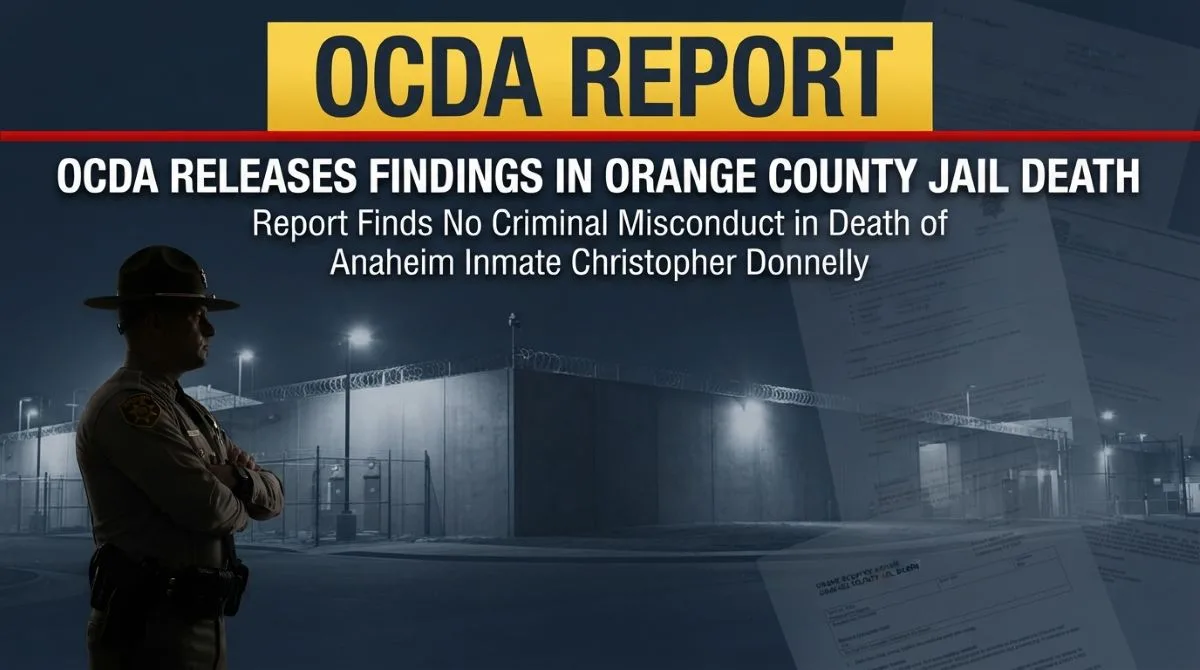
The Todd Spitzer-led Orange County District Attorney’s custodial death investigation has concluded that Orange County jail personnel did not commit any criminal wrongdoing in connection with the February 1, 2025 death of inmate Christopher Joseph Donnelly, a 45-year-old Anaheim man who died inside the Intake Release Center while awaiting court proceedings.

According to the newly released OCDA report, Donnelly was found unresponsive in his cell at approximately 8:26 a.m. on February 1, 2025, after his cellmate noticed he was making unusual “gurgling” sounds and appeared to be in medical distress.
Deputies and jail medical personnel immediately began CPR, administered Narcan, deployed an AED, and continued lifesaving efforts until Orange County Fire Authority paramedics arrived. Despite nearly 30 minutes of emergency treatment, Donnelly was pronounced dead at 8:58 a.m.
The Orange County Coroner ultimately determined that Donnelly died from acute buprenorphine intoxication and classified the death as an accident. Toxicology testing found buprenorphine in Donnelly’s system, despite the fact that he had never been prescribed the drug while incarcerated. Investigators stated they were unable to determine how he obtained it.
Who Was Christopher Donnelly?
The OCDA report paints a picture of a troubled inmate battling significant mental health and substance abuse issues long before his death.
Donnelly was arrested by the Newport Beach Police Department on July 9, 2024, on an outstanding DUI warrant. Investigators found that he also had five additional outstanding warrants, most of them tied to DUI and traffic-related offenses.
During the booking process, Donnelly disclosed:
- A history of depression and anxiety
- Prior suicide attempts
- Ongoing alcohol abuse
- Auditory hallucinations
- Daily alcohol consumption
- Previous mental health treatment
Jail medical staff placed him on suicide watch shortly after booking and housed him in specialized mental health units for much of his incarceration. Records reviewed by prosecutors show he was repeatedly evaluated by psychiatric professionals and prescribed medications including Lexapro, Remeron, Ativan, Hydroxyzine, Gabapentin and other mental health medications.
The report also notes a recurring problem: Donnelly routinely refused medical examinations, diagnostic tests, blood draws, vital sign checks, and other treatment throughout his seven months in custody.
Donnelly’s Criminal History
The report reveals that Donnelly’s criminal history in California dated back to at least 2013. Prior arrests included:
- Driving Under the Influence
- Assault with a Deadly Weapon
- Terrorist Threats
- Rape
- Domestic Battery
- Battery
- Hit and Run
- Public Intoxication
- False Information to a Peace Officer
- Obstructing or Delaying a Public Officer
- Driving on a Suspended License
- Disobeying a Court Order
Not all arrests resulted in convictions, but the record reflects repeated contacts with law enforcement over more than a decade.
What Happened on the Morning of His Death?
Security video reviewed by investigators showed Donnelly eating breakfast and moving normally inside his cell shortly before 4:30 a.m. on February 1.
At approximately 4:31 a.m., deputies collected breakfast trays and spoke with inmates. Donnelly appeared normal and returned to his bunk. Investigators say that was the last time video captured any movement from him.
Deputies conducted required welfare checks approximately every 30 minutes throughout the morning. Neither jail staff nor Donnelly’s cellmate noticed anything unusual until shortly before 8:30 a.m. when the cellmate heard abnormal breathing sounds and summoned help.
The OCDA concluded there was no evidence that deputies ignored distress, delayed treatment, or violated their legal duty to provide medical care.
OCDA: No Evidence of Criminal Misconduct
Senior Deputy District Attorney Marc Rozenberg concluded that the Sheriff’s Department fulfilled its legal duty to Donnelly by:
- Providing ongoing psychiatric evaluation
- Housing him in appropriate mental health units
- Conducting regular safety checks
- Prescribing medications
- Responding immediately once the emergency was discovered
- Summoning medical personnel without delay
The report ultimately found no evidence supporting homicide, involuntary manslaughter, criminal negligence, or any other criminal misconduct by jail personnel.
Inmate Deaths Remain a Major Issue in Orange County
Donnelly’s death comes amid continuing scrutiny of deaths inside Orange County’s jail system.
According to the Orange County Sheriff’s Department, multiple in-custody deaths have been recorded in county jails during 2025 and 2026, triggering mandatory reviews by both the District Attorney and the county’s Office of Independent Review.
A 2026 analysis by the ACLU of Southern California reviewed 119 Orange County jail deaths and found that many involved inmates suffering from mental illness, substance abuse disorders, chronic medical conditions, withdrawal complications, and delayed access to healthcare. The report noted that many deaths occurred shortly after booking, when inmates were experiencing acute medical or psychiatric crises.
Leading Causes of Jail Deaths in Orange County
Reviews conducted by advocacy groups, oversight entities, and public agencies consistently identify several recurring factors:
- Drug overdoses and intoxications
- Withdrawal complications from alcohol or narcotics
- Suicide and self-harm
- Serious untreated medical conditions
- Mental health crises
- Delayed recognition of medical emergencies
- Natural causes involving heart disease and chronic illnesses
In Donnelly’s case, investigators concluded that acute buprenorphine poisoning was the direct cause of death.
Which Orange County Cities Have Seen the Most Arrestees Later Die in Custody?
A review of recent OCDA custodial death investigations, Sheriff’s Department reports, and Office of Independent Review records suggests that the largest concentrations of jail deaths involve arrestees originating from Orange County’s largest cities. While no official county ranking appears to exist, the cities most frequently appearing in recent custodial death reports include:
- Anaheim
- Santa Ana
- Fullerton
- Orange
- Westminster
These cities generate a substantial share of the county’s arrests and jail bookings and appear repeatedly in custodial death investigations released by county oversight agencies.
Bottom Line
The death of Christopher Joseph Donnelly highlights one of the persistent challenges facing correctional systems nationwide: managing inmates with severe mental illness, addiction histories, and chronic health problems. The OCDA’s investigation concluded that Orange County jail staff responded appropriately and that Donnelly’s fatal overdose resulted from a drug he was never prescribed while in custody. What remains unanswered is how the buprenorphine entered the jail and ultimately found its way into Donnelly’s cell.
As Orange County continues to investigate every custodial death through both internal and independent review processes, cases like Donnelly’s underscore the ongoing intersection of mental illness, substance abuse, and jail safety that continues to drive much of the debate over correctional healthcare and inmate supervision.