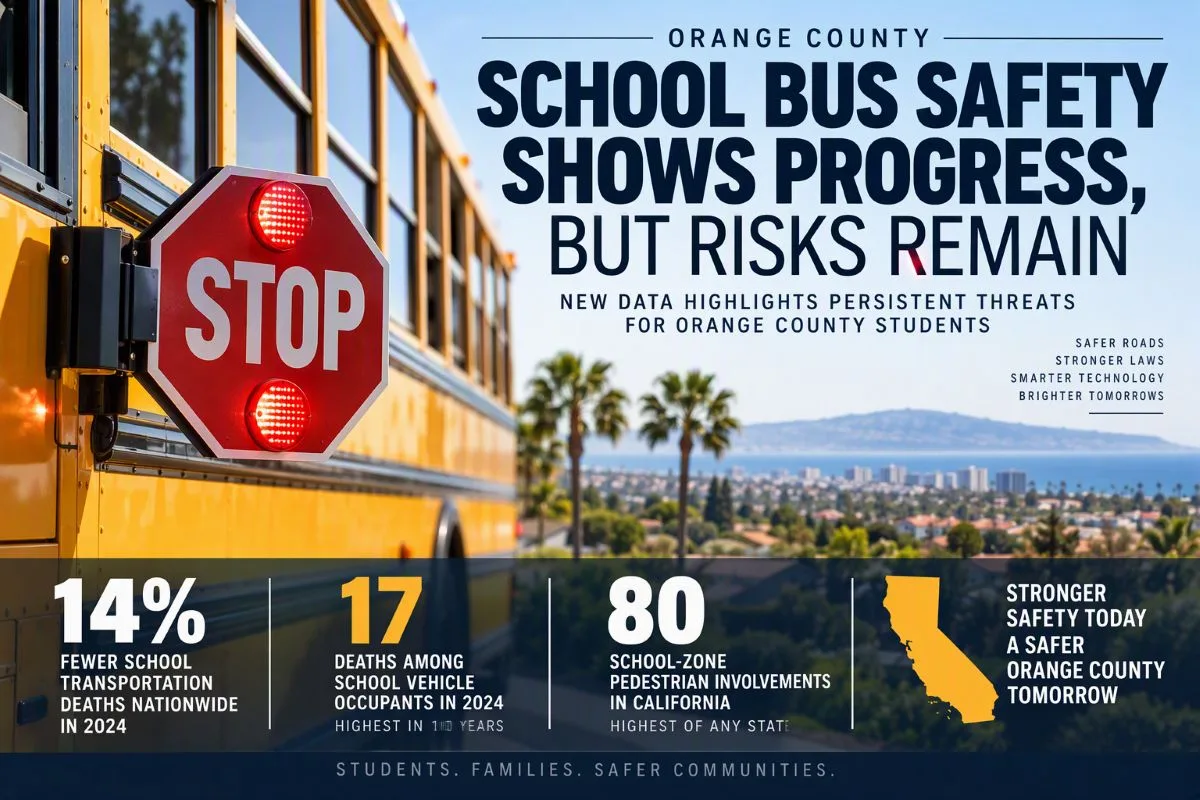
School transportation fatalities declined by 14% nationwide in 2024, falling from 128 deaths to 110, according to federal crash data analyzed by The Millar Law Firm. Yet beneath that encouraging headline lies a more complicated reality: deaths among people riding in school vehicles actually increased to 17, the highest annual total recorded over the past decade.

For Orange County families, school administrators, and transportation officials, the findings are particularly relevant as California continues investing in school transportation safety technology, driver training standards, and stricter pupil transportation regulations.
California Continues to Face Significant School-Zone Risks
Among all states, California recorded the highest number of school-zone pedestrian involvements in the Millar study, with 80 incidents identified during the study period. While California did not rank among the highest-risk states overall, the state’s large student population and heavy traffic volumes make school-zone safety a continuing concern.
The study found that nationwide:
- Occupants of other vehicles accounted for most school transportation fatalities, though those deaths dropped from 85 to 70 in 2024.
- Pedestrian deaths declined from 24 to 19.
- School vehicle occupant deaths increased from 13 to 17.
- Since 2015, 77 children have been killed as pedestrians in school transportation crashes, nearly double the 39 fatalities involving children riding inside school vehicles.
- Occupants of other vehicles represented 70% of the 1,069 school transportation crash deaths recorded over the past decade.
The findings reinforce what transportation safety experts have long argued: the most dangerous part of a student’s trip is often not riding the bus itself, but navigating the area surrounding it.
Orange County Has Seen Its Own School Bus Crashes
While Orange County remains safer than many urban regions, school bus crashes continue to occur locally.
In December 2024, a collision between an SUV and a small school bus near Santiago Canyon Road in Orange County seriously injured three adults and two children. The crash required multiple emergency responses and highlighted the risks school transportation vehicles face when sharing roads with passenger vehicles.
Orange County also maintains a comprehensive traffic crash database containing more than 181,000 reported collisions from 2012 through 2025, demonstrating the region’s ongoing transportation safety challenges.
While most bus-related crashes do not result in fatalities, even a single serious incident can have lasting impacts on students, families, and school communities.
California Has Tightened Student Transportation Safety Rules
Several California policies enacted during the past three to five years reflect growing concern over student transportation safety.
One of the most significant changes was Senate Bill 88, signed into law in 2023. The legislation established stricter requirements for drivers providing pupil transportation services through school districts and contractors. The law requires background checks, medical examinations, drug and alcohol testing, training standards, and vehicle inspections for compensated pupil transportation providers.
The requirements became operational beginning in 2025 for many transportation providers and were designed to strengthen oversight of students transported outside traditional yellow school bus systems.
California also maintains some of the nation’s strictest school bus loading and unloading laws. State law requires motorists to stop for school buses displaying flashing red lights and stop arms and imposes specific procedures for student loading, unloading, and road crossings.
Additionally, the California Highway Patrol continues to require extensive certification, training, background screening, and behind-the-wheel testing for school bus operators.
School Districts Are Increasingly Turning to Dash Cameras and Telematics
Technology is becoming one of the most important tools in modern school bus safety programs.
Across California and nationwide, school districts are deploying onboard cameras, GPS tracking systems, AI-powered video monitoring, and telematics platforms that track speeding, harsh braking, distracted driving, route compliance, and other risk factors.
Transportation officials increasingly use these systems to:
- Monitor driver performance.
- Investigate crashes and near-misses.
- Improve training and coaching.
- Verify route compliance.
- Respond more quickly to parent concerns.
- Document illegal passing incidents near school buses.
Some California districts have transitioned to cloud-based camera systems that allow transportation departments to review incidents almost immediately rather than waiting for buses to return to maintenance yards. [edtechmagazine.com]
The growing adoption of telematics aligns with the core finding of the Millar study: reducing school transportation risk requires attention not only to the bus itself but also to driver behavior, surrounding traffic, and conditions at bus stops.
Illegal Bus Passings Remain a Serious Threat
One of the more alarming findings in the research involves motorists who illegally pass stopped school buses.
A 2026 national survey cited by the study estimated 38.4 million illegal bus passings during the previous school year. Researchers also found that 3.45% of illegal passings occurred on the right side of the bus, where children typically board and exit. That represents one of the most dangerous scenarios for student pedestrians.
As Orange County schools resume fall transportation schedules and communities observe National School Bus Safety Week later this month, these findings serve as a reminder that school transportation safety extends far beyond the bus ride itself.
The Bottom Line for Orange County
The national decline in school transportation deaths is encouraging, but the data suggest caution rather than celebration.
While fewer pedestrians and occupants of other vehicles were killed in 2024, fatalities among school vehicle occupants rose to a decade high. Meanwhile, California continues to report significant school-zone activity and remains focused on new safety regulations, driver qualifications, camera technology, and monitoring systems designed to protect students.
For Orange County communities, the takeaway is clear: school buses remain one of the safest ways for students to travel, but vigilance at bus stops, strict driver standards, improved monitoring technology, and responsible behavior from surrounding motorists remain critical to preventing future tragedies.
Source: The Millar Law Firm’s “America’s School Transportation and School-Zone Risk Index,” based on National Highway Traffic Safety Administration crash data from 2015-2024.