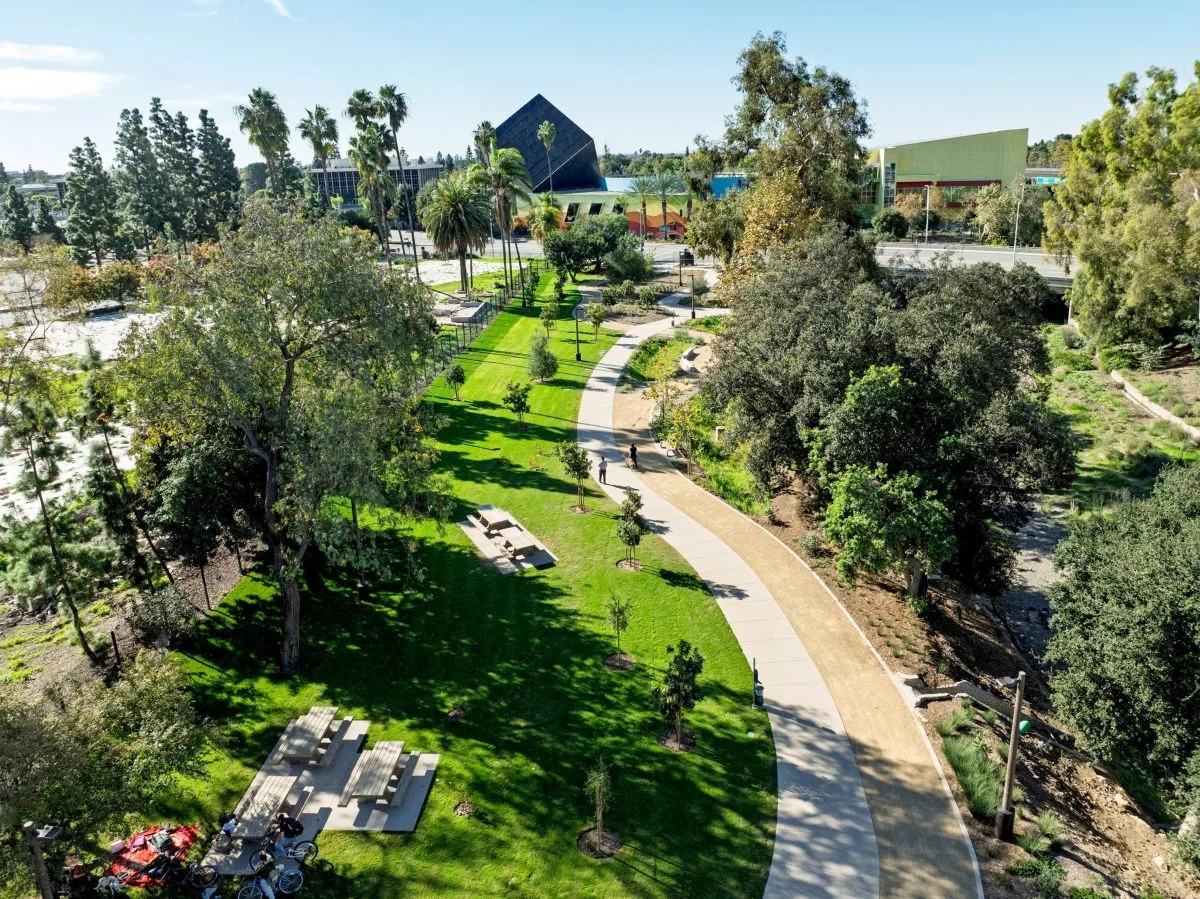
Trust for Public Land announced that Irvine has earned the title of Southern California’s best big-city park system, ranking 2nd nationally on the annual ParkScore® index.

While Washington, DC, retained the national title, and cities like Los Angeles fell to an all-time low of 93rd place, other local municipalities are charting distinct paths forward.By analyzing the data from this release alongside last year’s special report, Creating L.A.’s Park Legacy, we can see exactly how these findings apply to our neighbors in Santa Ana.
How Santa Ana Measures Up Nationally and Regionally
Santa Ana currently ranks 75th nationally on the ParkScore® index. While this places the city in the lower tier of the 100 most populous U.S. cities, a deeper dive into the metrics reveals specific structural strengths and clear opportunities for growth.
1. A Powerhouse for Park Investment
The most encouraging takeaway for Santa Ana is its commitment to funding.
- Above National Average: Santa Ana joined Irvine and Long Beach in outspending the national ParkScore investment average ($154 per person).
- The Exact Numbers: According to the report’s financial data, Santa Ana invests an average of $159 per person annually on its park systems (p. 16).
- Regional Standing: This puts Santa Ana ahead of larger regional peers like Los Angeles ($111 per person) and Anaheim ($89 per person) (p. 16), placing the city in the 52nd national percentile for park investment (p. 16).
2. Strong Walkable Access
Park access is measured by the percentage of residents living within a “10-Minute Walk” (10MW) of a public green space (p. 11).
- 72% of Santa Ana residents can walk to a park in under 10 minutes (p. 11).
- This beats out the city of Los Angeles (62%) (p. 11), as well as nearby Santa Clarita (51%) and Riverside (48%) (p. 11).
3. The Core Challenge: Park Amenities and Acreage
Where Santa Ana struggles significantly is in its actual physical park infrastructure and diversity of features.
- The Lowest Amenity Score: Santa Ana ranks last among all evaluated California cities with an overall Amenity Score of 21.0 (p. 12).
- Critical Feature Deficits: The city sits in the bottom 10th percentile nationally for playgrounds (9th percentile), dog parks (1st percentile), sport fields (9th percentile), and splash pads (1st percentile) (p. 12).
- Acreage Constraints: Only 3% of Santa Ana’s total city area is dedicated to parkland, placing it in the dismal 5th percentile nationally for total acreage (p. 15)
The Roadmap: Turning Investment into Infrastructure
The data shows that Santa Ana does not have a funding problem—it has a space and amenity problem. Because the city is densely populated and geographically constrained, building massive new regional parks isn’t a realistic option.
Instead, local leaders can borrow the exact strategies recommended in the Creating L.A.’s Park Legacy report to maximize their high per-capita spending (p. 5):
- Open Schoolyards to the Public: Partnering with local school districts to open up existing playgrounds and basketball courts on weekends and evenings is the fastest, most cost-effective way to immediately scale up community access without buying new land (pp. 5, 20).
- Maximize Current Footprints: Since Santa Ana already allocates $159 per person, those capital funds should be aggressively targeted toward revitalizing existing parks with underrepresented amenities—specifically dog parks, upgraded sports fields, and splash pads to beat the Southern California heat (pp. 12, 16).
A strong park system delivers measurable health, social, and economic benefits to residents. Extensive research from the Trust for Public Land (TPL) (p. 2) tracks these positive impacts directly across America’s 100 largest cities (p. 4).
How Parks Systems Benefit Residents
Data showing how a high-quality park system directly benefits residents can be viewed across four primary areas:
1. Physical Health & Reduced Inactivity
Access to quality parks is one of the most effective ways to lower public health costs and combat sedentary lifestyles.
19% Lower Physical Inactivity: Residents living in the top 25 ParkScore® cities have a 19% lower rate of physical inactivity compared to those living in the bottom 25 cities.
- 21% Less Inactivity Overall: Studies from TPL’s Health Report confirm that people in top-ranked park systems are 21% less likely to be physically inactive, even after controlling for age, race, and income.
- 25% Exercise Increase: Improving neighborhood park spaces results in a 25% increase in the number of residents who exercise at least three times a week, according to the Centers for Disease Control and Prevention (CDC).
2. Mental Well-being & Stress Reduction
Regular interaction with nature through urban green spaces acts as a powerful psychological buffer. [, 2]
- 9% Lower Poor Mental Health Rates: Residents in top-tier park systems are 9% less likely to suffer from chronic poor mental health.
- Measurable Life Satisfaction: Research in metropolitan areas indicates that every additional acre of parkland within a neighborhood correlates to a direct, mathematical increase in an individual’s self-reported life satisfaction score.
3. Community Cohesion & Civic Engagement
Parks serve as vital community hubs that build “social capital” and bridge socio-economic gaps. [1, 2]
- 26% More Economic Connectedness: Top-ranked park systems foster 26% more friendships across different income groups (cross-group relationships between low- and high-income individuals) compared to lower-ranking park systems.
- 61% More Volunteers: Cities with excellent parks see a 61% higher rate of per-capita volunteering and civic group participation.
- Higher Civic Satisfaction: Proximity to well-maintained parks makes residents 29% more satisfied with their local parks department, 14% more satisfied with local police, and 13% more satisfied with their mayor.
4. Climate Resilience & Environmental Protection
Parks function as essential urban infrastructure that mitigates environmental health hazards (p. 5). [1]
- Mitigating Extreme Heat: Neighborhoods lacking close-to-home parks suffer from higher microclimate temperatures (p. 10). Trees and vegetation in park systems directly lower ground temperatures and counteract urban heat island effects.
- Flood & Pollution Control: High-quality parks feature natural soil systems and engineered wetlands that absorb heavy stormwater torrents, preventing local road flooding and filtering groundwater aquifers (pp. 10, 21).