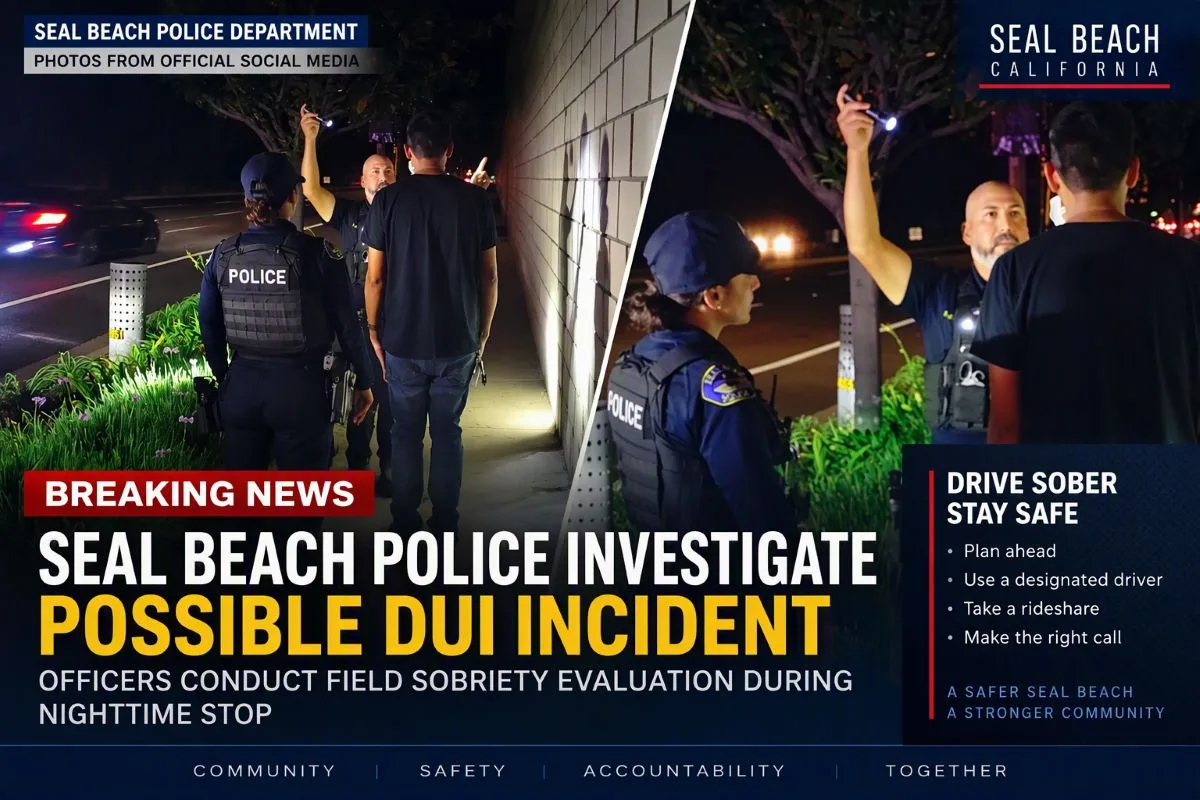
The Seal Beach Police Department recently shared photos showing officers conducting what appears to be a roadside impaired-driving investigation. Based on the images alone, it appears officers were administering eye-movement or field sobriety evaluations to a pedestrian or driver during a nighttime encounter. However, police have released few details, and the circumstances surrounding the contact remain unclear.

What the photos do provide is an opportunity to discuss a topic that impacts thousands of Orange County residents every year: driving under the influence arrests, the consequences that follow, and how to properly handle a police investigation.
Why an Officer Might Suspect Someone Is Under the Influence
Many people believe a DUI arrest only happens after a failed breath test. In reality, officers often begin forming opinions long before any chemical test is administered.
Common indicators officers use include:
- Bloodshot or watery eyes
- Slurred speech
- Difficulty maintaining balance
- Confusion or delayed responses
- The odor of alcohol
- Poor driving behavior such as weaving, speeding, running red lights, or driving without headlights
- Having an open container nearby
- Admissions such as “I only had a few drinks”
- Difficulty following instructions during a traffic stop
Officers frequently use the Horizontal Gaze Nystagmus (HGN) test, which involves tracking eye movement with a flashlight or pen. The images released by Seal Beach police appear consistent with that type of evaluation.
It is important to remember that fatigue, illness, medication, anxiety, allergies, medical conditions, or even poor lighting can sometimes mimic signs of impairment. Nevertheless, officers are trained to document every clue that may support probable cause for an arrest.
How You Should Interact with Police During a DUI Investigation
If you are stopped by police, remaining calm and respectful is almost always the best strategy.
Good practices include:
- Be polite and cooperative.
- Keep your hands visible.
- Provide your driver’s license, registration, and proof of insurance when requested.
- Follow lawful instructions.
- Avoid arguing on the roadside.
Equally important is understanding what not to do.
Avoid:
- Arguing with officers.
- Becoming confrontational.
- Volunteering unnecessary information.
- Guessing how much alcohol you consumed.
- Making jokes about drinking or drugs.
- Posting about the incident on social media.
One of the most common mistakes people make is trying to talk their way out of the situation.
Statements such as:
- “I only had two beers.”
- “I’m fine to drive.”
- “I came from a bar.”
- “I’ve been drinking but I’m not drunk.”
can later become evidence in court.
Many defense attorneys advise limiting responses to identifying information and exercising the right to remain silent regarding potentially incriminating questions.
The Tony Romo Example: How One Arrest Can Change Everything
Former NFL quarterback and CBS sports broadcaster Tony Romo became a national example of how a DUI-related arrest can create career consequences far beyond the courtroom. After a 2026 OWI arrest in Wisconsin, Romo was placed on leave by CBS and ultimately parted ways with the network despite reportedly having more than $70 million remaining on his contract.
Whether someone is a celebrity, executive, teacher, police officer, nurse, commercial driver, or city employee, an arrest can rapidly become public and may affect professional opportunities.
The lesson is simple: what happens during a single night can affect income, reputation, and future employment for years.
Potential California DUI Charges
California prosecutors frequently file one or both of the following charges:
- Vehicle Code 23152(a): Driving under the influence of alcohol or drugs.
- Vehicle Code 23152(b): Driving with a blood alcohol concentration of 0.08% or higher.
Additional charges can apply if:
- A collision occurred.
- Someone was injured.
- The driver had prior DUI convictions.
- Drugs were involved.
- A child passenger was present.
Multiple offenses can elevate a misdemeanor into a felony.
Possible Penalties for a First DUI Conviction
Although every case is different, a first-time Orange County DUI conviction may include:
- Fines and assessments that can exceed $2,000
- Three to five years of probation
- A court-approved DUI education program
- Driver’s license suspension or restrictions
- Ignition interlock device requirements
- Possible jail time
Repeat offenders generally face much harsher consequences, including longer license suspensions and significant custody exposure.
The Real Cost of a DUI
Many people focus on the fine and ignore the secondary costs.
A first-time DUI can easily result in:
- Court fines and assessments: $2,000-$4,000+
- DUI school: $500-$2,000+
- Vehicle towing and storage: $300-$1,500+
- Ignition interlock device costs: $1,000-$2,000+
- Increased insurance premiums: thousands of dollars over several years
- Legal defense costs: often $3,000-$15,000 or more
It is not unusual for the total financial impact of a DUI case to reach $10,000 to $25,000 or higher.
Impact on Auto Insurance
For drivers arrested while behind the wheel, insurance consequences can be severe.
Insurers frequently:
- Dramatically increase premiums
- Reclassify drivers as high-risk
- Require SR-22 filings
- Refuse to renew policies
- Restrict coverage options
Industry reports regularly show premium increases ranging from roughly 40 percent to well over 100 percent after a DUI conviction, depending on the driver’s record, age, insurer, and circumstances.
For many drivers, insurance costs become one of the longest-lasting penalties.
Employment Consequences Can Be Significant
Many employers conduct background checks.
A DUI arrest or conviction may create issues for:
- Law enforcement applicants
- Teachers
- Nurses
- Commercial drivers
- Government employees
- Security professionals
- Military personnel
- Those seeking professional licenses
Current employees can also face disciplinary action, particularly if driving is part of their job.
Jobs requiring company vehicles or commercial licenses are especially vulnerable.
Some employers may view a DUI as a lapse in judgment, while others may regard it as a significant liability concern.
How Common Are DUI Arrests in Orange County?
Orange County continues to record thousands of DUI arrests annually. State DUI tracking systems maintained by the California DMV show DUI arrests remain a significant public safety issue throughout California.
Based on historical Orange County DUI enforcement and collision data, the cities most frequently associated with large numbers of DUI arrests tend to include:
- Huntington Beach
- Santa Ana
- Costa Mesa
- Fullerton
- Anaheim
Historical Orange County rankings have repeatedly identified Huntington Beach, Costa Mesa, Fullerton, Orange, Mission Viejo, Santa Ana, and Newport Beach among cities experiencing substantial DUI activity and enforcement. [orangecoun…erblog.com]
Tips to Avoid a DUI Arrest
The easiest DUI case to beat is the one that never happens.
Consider these simple strategies:
- Designate a sober driver before going out.
- Use Uber, Lyft, or a taxi.
- Stay the night if alcohol is involved.
- Do not assume coffee will sober you up.
- Avoid mixing alcohol and prescription medications.
- Give yourself plenty of time before driving the next day.
- Keep rideshare apps installed on your phone.
- Take vehicle keys away from impaired friends.
The cost of a rideshare trip is almost always insignificant compared to the cost of a DUI arrest.
Final Thoughts
While the Seal Beach Police Department has not publicly released many details about this particular incident, the images serve as a reminder that DUI investigations often begin with observations that may seem minor at first. What starts as a roadside conversation can quickly become an arrest, court case, license suspension, insurance nightmare, and employment challenge.
For Orange County drivers, the best defense remains simple: if there is any doubt about whether you are safe to drive, don’t get behind the wheel. The financial, legal, and professional consequences can last far longer than the evening that started them.