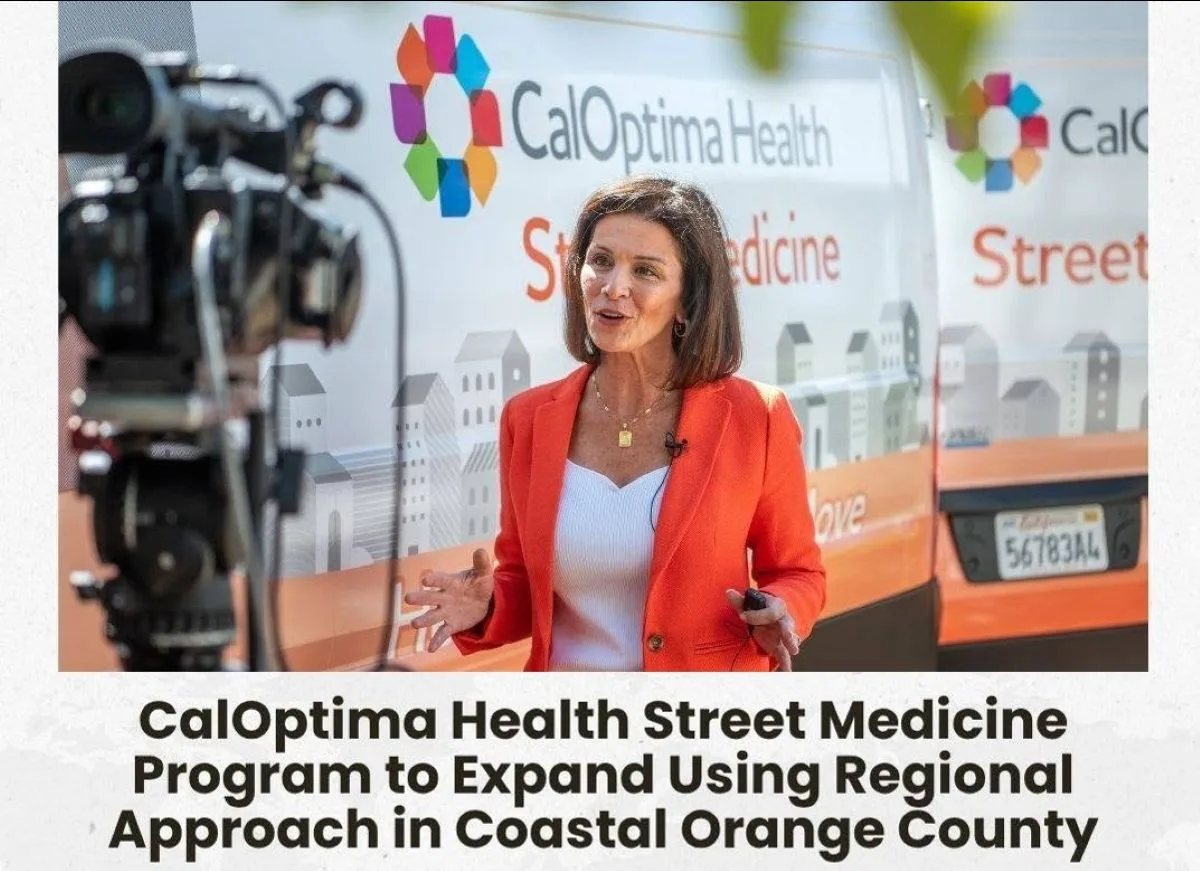
ORANGE, Calif. — CalOptima Health is preparing for its largest Street Medicine Program expansion to date, announcing a new regional partnership that unites Fountain Valley, Huntington Beach, Seal Beach and Westminster under a coordinated continuum of care for the unhoused. Services are expected to launch in mid‑2027, marking a significant shift toward multi‑city collaboration in Orange County’s homelessness response.

CalOptima Health’s Street Medicine teams already operate in Garden Grove, Costa Mesa, Anaheim and Santa Ana, delivering urgent care, primary care, behavioral health, substance‑use treatment and case management directly to people living in parks, encampments and other unsheltered areas. The new Coastal Cities Continuum expands this model to a region with an estimated 500 unsheltered individuals, according to the 2026 Orange County Point in Time Count.
Supervisor Vicente Sarmiento, Chair of the CalOptima Health Board, emphasized the need for cross‑jurisdictional coordination, stating that homelessness “does not stop at city boundaries,” and neither should the response. The expanded network aims to reduce emergency‑department overuse, improve access to whole‑person care and create more consistent pathways into permanent housing.
Why This Expansion Matters: Key Data on Homelessness in Orange County
- Total unhoused population (2026 PIT Count): Approximately 7,600, including sheltered and unsheltered individuals.
- Unsheltered population countywide: Roughly 3,400, with concentrations in Anaheim, Santa Ana and Costa Mesa.
- Emergency‑department utilization: Local hospitals report that unhoused individuals account for up to 10% of all ED visits, often for preventable conditions.
- Street Medicine impact: Programs in Anaheim and Santa Ana have reported 20–30% reductions in repeat ED visits among individuals engaged consistently for 6+ months.
- Housing linkage outcomes: CalOptima Health’s care teams have helped connect hundreds of individuals to interim housing, recuperative care and long‑term supportive housing placements.
These numbers highlight why regional coordination is increasingly seen as essential. Homelessness in Orange County is highly mobile, with individuals frequently moving between cities due to enforcement activity, service availability, weather and transportation access.
How Orange County’s Approach Compares to Other Southern California Counties
Southern California counties have adopted varying Street Medicine and homelessness‑care strategies, and Orange County’s new regional model places it among the most coordinated efforts in the region.
- Los Angeles County LA County operates one of the nation’s largest Street Medicine networks, with more than 60 teams deployed across the county. Their model focuses heavily on medical stabilization, mental‑health crisis response and direct Medi‑Cal enrollment. OC’s expansion mirrors LA’s regional scale but is more tightly integrated with a single health system (CalOptima Health), allowing for more unified care navigation.
- Riverside County Riverside’s Street Medicine teams primarily serve the Coachella Valley and western cities like Riverside and Moreno Valley. Their approach is growing but remains city‑specific, without the multi‑city continuum now emerging in Orange County.
- San Bernardino County San Bernardino has expanded mobile clinics and behavioral‑health outreach but relies more on county‑operated mobile units rather than partnerships with city coalitions. OC’s model is more collaborative and includes broader whole‑person care resources.
- San Diego County San Diego operates several Street Medicine teams and has invested heavily in behavioral‑health crisis stabilization centers. Their model is robust but not yet organized into regional city clusters like OC’s Coastal Cities Continuum.
Orange County’s new regional approach positions it as a leader in cross‑city coordination, blending medical care, behavioral health, housing navigation and long‑term case management under one unified system.
Program Evolution and Long‑Term Strategy
CalOptima Health’s Street Medicine expansion aligns with its broader investments in homelessness‑related health care, including:
- The Care Traffic Control Center, a first‑of‑its‑kind coordinated care hub guiding unhoused residents through every stage of their health journey.
- Housing development investments that increase capacity for supportive‑housing providers.
- Whole‑person care integration, connecting medical treatment with behavioral health, substance‑use recovery and social‑service navigation.
Supervisor Janet Nguyen noted that a unified regional system “removes major barriers” to reintegration by addressing health challenges that often prevent individuals from securing stable housing.
Street medicine, what a concept. Our society is literally in the gutters.
But don’t worry! The wealthy boomer in the picture is going to fix EVERYTHING! Just keep voting Democrat!