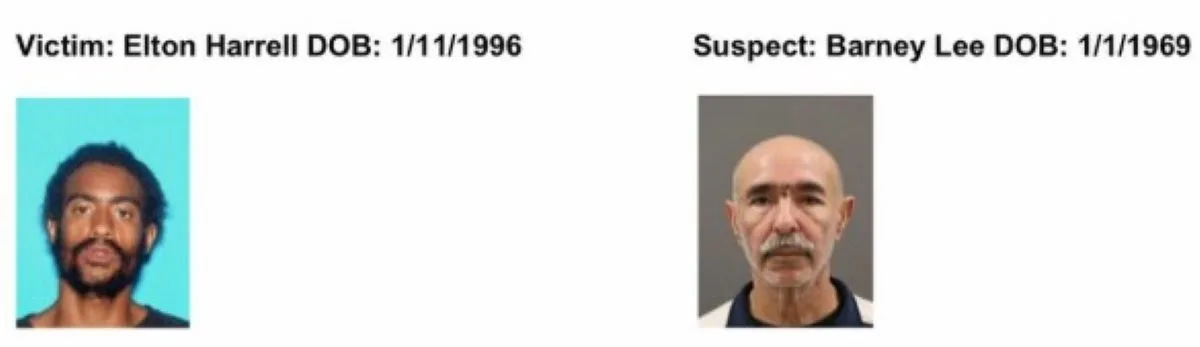
Buena Park, Calif. – On December 29th, 2025, at 9:40 PM, Buena Park police officers were dispatched to the area of La Palma Avenue and Western Avenue in reference to a male subject needing medical attention after being assaulted by an unknown subject.
Upon arrival, officers located a male victim (29-year-old; Elton Harrell), who was down and in need of medical attention. The victim was transported to the hospital and later pronounced deceased.
Buena Park Police Department detectives identified 57-year-old Barney Lee as a suspect.
Buena Park Police Department’s Special Weapons and Tactics team served a search warrant on January 7th, 2026, at approximately 9:00 PM, at 7465 La Palma Avenue (Buena Park Psychic) in the City of Buena Park.
Two individuals were detained, a female who was later released at the scene and Barney Lee. Lee was later booked on the charge of Homicide.
This appears to be an isolated incident, and detectives are asking anyone with information regarding this case to contact Detective Kalagian at 714-562-3985.
Potential Penalties for the Suspect
Buena Park Homicide Investigation (Dec. 29, 2025)
Because the suspect was booked on a charge of “Homicide,” the precise penalties depend on the specific homicide offense ultimately charged by the Orange County District Attorney and, if applicable, the facts proven in court.
Under California law, “homicide” is a broad term that includes several distinct crimes with very different penalties.
1. Murder (Penal Code § 187 et seq.)
A. First-Degree Murder
Applies if prosecutors allege:
- Willful, deliberate, and premeditated killing, or
- Killing during certain enumerated felonies (felony murder)
Penalty:
- 25 years to life in state prison, or
- Life without the possibility of parole in aggravated cases
Sentence enhancements may apply if:
- A weapon was used (Penal Code § 12022)
- The victim suffered great bodily injury
- Prior serious or violent felony convictions exist
B. Second-Degree Murder
Applies if prosecutors allege:
- Intentional killing without premeditation, or
- A killing caused by dangerous conduct showing conscious disregard for life
Penalty:
- 15 years to life in state prison
- Eligibility for parole after serving the minimum term
2. Voluntary Manslaughter (Penal Code § 192(a))
Applies if prosecutors allege:
- Killing occurred in the “heat of passion,” or
- Killing occurred in imperfect self-defense
Penalty:
- 3, 6, or 11 years in state prison
This charge is often pursued if evidence shows provocation or mitigating circumstances.
3. Involuntary Manslaughter (Penal Code § 192(b))
Applies if prosecutors allege:
- An unintentional killing resulting from:
- Criminal negligence, or
- A non-dangerous unlawful act
Penalty:
- 2, 3, or 4 years in state prison, or
- Up to 1 year in county jail (depending on facts and sentencing approach)
4. Additional Consequences Beyond Prison
If convicted of any homicide offense, additional mandatory or likely consequences include:
- Restitution to the victim’s family
- Lifetime firearm prohibition
- Possible civil wrongful-death liability
- Parole or post-release supervision conditions
- Three Strikes Law implications if the offense qualifies as a serious or violent felony
5. Bail and Pretrial Detention
For homicide cases in California:
- Bail is typically very high or denied
- Preventive detention may apply under California’s bail statutes
- The suspect may remain held pending arraignment and bail hearing
6. What Happens Next Procedurally
Based on standard California procedure, the next steps will likely include:
- Arraignment (formal charges announced)
- Charging decision by the Orange County District Attorney
- Potential enhancements or amended charges
- Preliminary hearing or grand jury (depending on charge level)
Important Reminder
At this stage:
- Booking on “homicide” does not equal a conviction
- Charges may be upgraded, reduced, or dismissed
- The exact penalty exposure depends on:
- Prosecutorial charging decisions
- Evidence (autopsy findings, motive, witness testimony)
- Any aggravating or mitigating factors