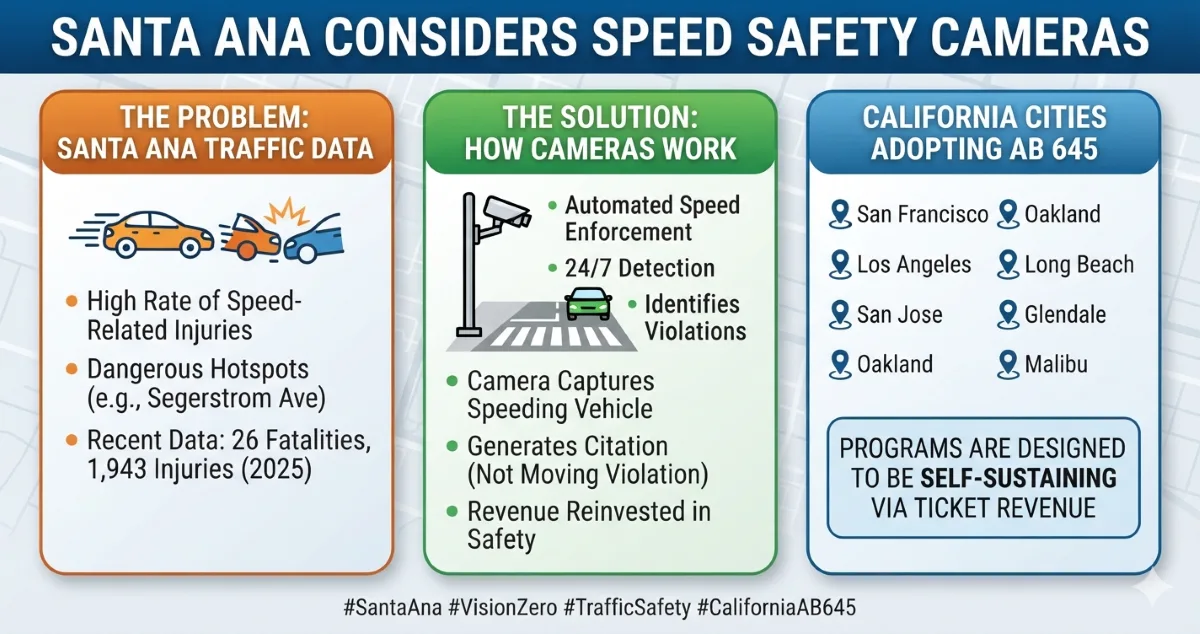
The Santa Ana City Council recently took a decisive, life-saving step by voting 4-2 to petition state leaders to include Santa Ana in California’s automated speed camera pilot program.

Originally established under Assembly Bill 645 in 2023, this pilot program gives local municipalities the authority to deploy automated speed safety systems in high-injury corridors and school zones.
For Santa Ana, this initiative is not just a policy change; it is a critical safety intervention capable of protecting our families, pedestrians, and commuters from the rising tide of reckless driving.
The Urgent Need to Protect Santa Ana Streets
The decision comes at a time when local traffic data paints an increasingly alarming picture. According to the California Office of Traffic Safety (OTS), Santa Ana ranked as the third worst city in the entire state for speed-related fatalities and injuries among cities with populations over 250,000. The numbers on the ground are staggering:
- In 2025 alone, Santa Ana logged 3,487 traffic collisions.
- These crashes resulted in 1,943 injuries and took the lives of 26 people.
- Historic city data highlights a chronic issue, including nearly 270 annual speed-related injury crashes and over 170 hit-and-run incidents that leave victims vulnerable on our roadways.
- Major thoroughfares and intersections—such as Segerstrom Avenue, 17th Street at Fairview Street, and Bristol Street—continue to suffer as hotspots for street racing, red-light runners, and excessive speeding.
Relying solely on traditional police deployments is no longer enough to monitor every racing hotspot every single night. By implementing automated cameras, Santa Ana can maintain constant, unyielding deterrence where it is needed most, forcing drivers to slow down and stay alert.
Proven Success Across California
Opponents often voice concerns over privacy and the effectiveness of automated systems, but real-world data proves that speed cameras completely transform driver behavior. Look no further than the initial wave of California cities utilizing or prepping this technology:
- San Francisco
- Los Angeles
- San Jose
- Oakland
- Long Beach
- Glendale
- Malibu
San Francisco’s initial implementations yielded an incredible 80% decrease in overall speeding, accompanied by exceptionally low repeat-violation rates. Furthermore, the neighboring City of Long Beach is moving forward with installing 18 speed cameras across its high-injury corridors and school zones, recognizing the immense public safety dividend.
Self-Sustaining Infrastructure with Zero Out-of-Pocket Burden
A major financial concern for any city program is long-term viability, but California’s framework is explicitly structured to ensure these systems pay for themselves. Under AB 645, the revenue generated from automated speed citations must first be used directly to recover the program’s equipment and operational costs.
Major cities like Los Angeles have moved forward with their rollouts under explicit forecasts that the programs will fully pay for themselves through ticket revenue. More importantly, state law mandates that any excess revenue generated beyond operational expenses must be funneled back into the community to fund physical traffic-calming measures, such as raised crosswalks, bike lanes, and roundabout infrastructure. Far from being a financial drain, the program creates a self-funding loop that makes streets structurally safer over time.
Council Breakdown: Who Stood for Safety
The push to bring this life-saving pilot program to Orange County was led forward by a clear council majority, though it faced internal pushback.
- Backing the Program: Councilmember Phil Bacerra originally introduced the proposal, strongly advocating for automated enforcement to protect dangerous racing hotspots like Segerstrom Avenue. He was joined by Mayor Valerie Amezcua and the council majority to pass the resolution.
- Opposing the Program: Councilmembers Jessie Lopez and David Penaloza voted against the measure, reflecting community pushback regarding the expansion of automated surveillance and city costs.
Ultimately, the majority made the right call. Prioritizing human lives over political hesitation ensures that Santa Ana is actively working toward its “Vision Zero” goal of eliminating preventable traffic deaths. Joining the state pilot program gives our city the technological support it desperately needs to reclaim our streets from reckless speeders.
A Tragic Irony in the Council Chamber
The opposition from Councilmember David Peñaloza carries a heavy, tragic irony that was not lost on close observers of the council.
Peñaloza, who publicly worried that the city shouldn’t be used as a “test subject” for automated safety tech, lost his own father to a devastating 1991 car accident. For a city leader whose life was permanently reshaped by a sudden vehicular tragedy to block tools engineered to prevent speed-induced collisions feels disconnected.
While Peñaloza’s stated concerns focused on protecting undocumented residents from digital surveillance disparities, advocates point out that automated systems remove the risk of human bias or discretionary traffic stops entirely.
For local families mourning the 26 people killed on Santa Ana streets last year, prioritizing policy hesitation over proven, life-saving street cameras seems a missed opportunity to honor the victims of traffic violence.
Ugh, more dem-crap technology being used in Blue-rundowned cities.
I do not think anyone would appreciate using a family tragedy as a criticism about this vote.
His dad was killed by a DUI driver. He has in fact mentioned this in his campaigns. It is a fair point to bring up.
Again, they intentionally let crime so bad that the people will willingly submit to and praise mass surveillance. It’s not that we;ve defunded police budgets restricting the amount of patrol officers on the street. Nore will we raise penalties to a point that people would actually feel they have something to lose by violating the law. (Think a guy driving a $150k vehicle getting a speeding ticket for $350 has any affect?) No. Instead they’ll stick with a couple hundred dollar fines, and install a network of mass surveillance cameras (that make Big Tech billions of $$$) to monitor your every move.
The real driver here is early retirements for cops and huge pensions and lifetime health care. Cities literally cannot afford to hire cops now.
Very valid point, Art. I think there’s a lot of truth to that too.