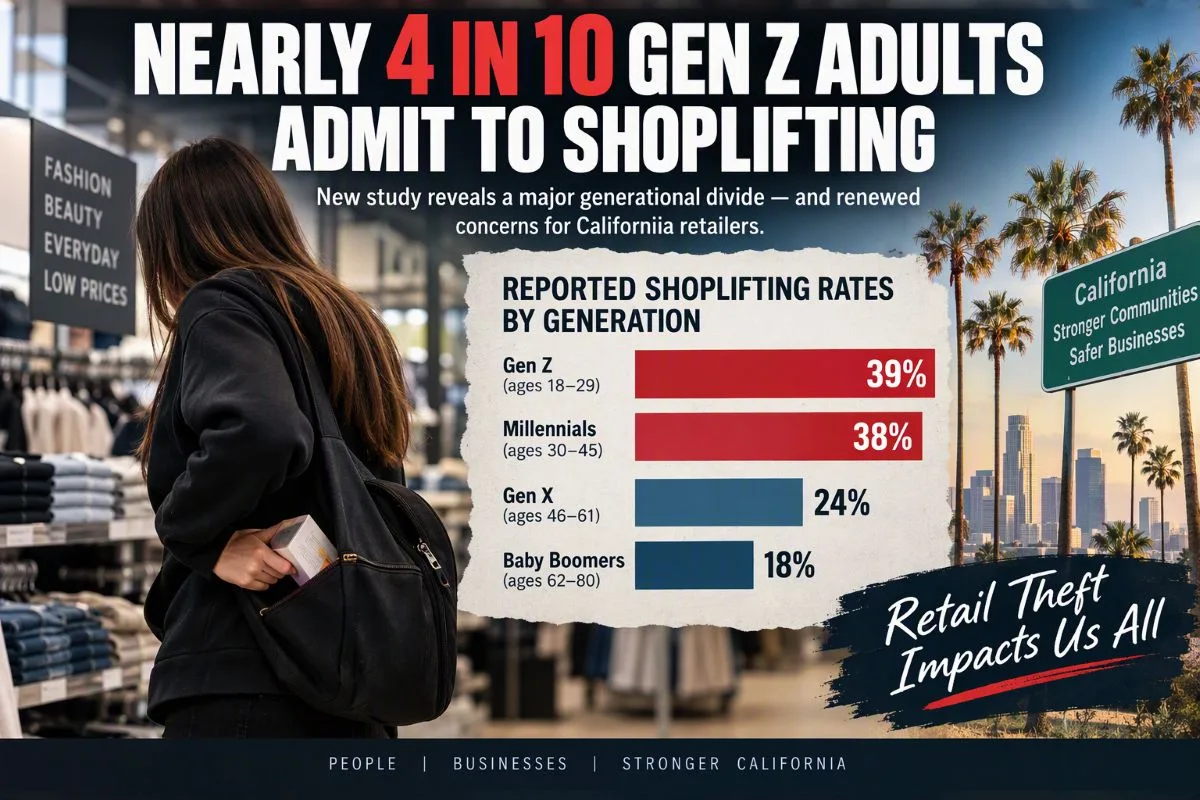
A newly released national study suggests that shoplifting is not only becoming more common, but that attitudes toward retail theft vary dramatically by generation. The findings arrive as California continues to grapple with organized retail crime, retail theft enforcement efforts, and ongoing debates over how best to address crime in shopping centers and commercial districts.

According to consumer research analyzed by Tad Nelson & Associates, 39% of Gen Z adults and 38% of millennials report having shoplifted at some point in their lives. By comparison, only 24% of Gen X respondents and 18% of baby boomers reported the same behavior.
For California retailers already dealing with retail theft losses, the generational divide revealed in the study raises important questions about attitudes toward crime, accountability, and the long-term impact on businesses and consumers.
Shoplifting Rates Drop Sharply With Age
The research found a significant gap between younger and older Americans:
- Gen Z (ages 18-29): 39%
- Millennials (ages 30-45): 38%
- Gen X (ages 46-61): 24%
- Baby Boomers (ages 62-80): 18%
The data suggests the biggest divide is not between Gen Z and millennials, who report nearly identical shoplifting rates, but between younger and older generations. Gen Z respondents were more than twice as likely as baby boomers to report having shoplifted.
Across all age groups, 30% of respondents reported having shoplifted at least once. That figure is significantly higher than a 2024 LendingTree survey, which found that 23% of Americans reported the same behavior.
California Retail Theft Remains a High-Priority Issue
The findings may resonate strongly in California, where retail theft has remained a major public safety and economic concern in recent years.
Large retailers, grocery stores, pharmacies, and small businesses throughout California have reported substantial losses from shoplifting and organized retail crime. In response, lawmakers and law enforcement agencies have directed increased resources toward retail theft investigations, organized crime task forces, and repeat-offender prosecutions.
While the new study is national in scope, California is home to many of the nation’s largest retail markets, making consumer attitudes toward theft particularly relevant for local business owners.
Retail theft costs are ultimately passed on to consumers through higher prices, increased security measures, locked merchandise displays, and reduced store services. In some communities, persistent theft has even been cited as a factor in store closures and reduced business investment.
Orange County Remains a Major Target for Organized Retail Theft
The California Highway Patrol’s Organized Retail Crime Task Force specifically includes Orange County within its Border Division and has repeatedly identified Orange County as one of California’s major retail theft enforcement areas.
In July 2026, Governor Gavin Newsom’s office reported that the task force had recovered more than $76.2 million in stolen merchandise statewide since 2019, conducted 4,718 investigations, and made more than 5,300 arrests. Orange County was highlighted as one of the regions receiving dedicated enforcement resources.
Orange County Cases Often Involve Organized Theft Crews
Rather than isolated shoplifters, many Orange County investigations involve organized theft rings operating across multiple counties.
Examples include:
- An Irvine-based investigation in 2025 tied a suspect to more than 35 theft incidents at Target stores across Southern California.
- A CHP investigation uncovered an Orange County retail theft ring that allegedly generated nearly $400,000 in stolen merchandise.
- A June 2026 enforcement operation at the Outlets at Orange resulted in 13 arrests and the recovery of stolen merchandise.
Younger Adults Report Different Reasons and Attitudes
One of the more striking findings involved attitudes toward retailer losses.
Among Gen Z and millennial respondents, 72% said large corporations can absorb the financial losses associated with shoplifting. Among baby boomers, only 45% shared that view.
This suggests that younger consumers may be more likely to view shoplifting from large retailers as causing minimal harm, while older Americans are more likely to see theft as creating broader consequences.
The survey also found that economic pressures remain a commonly cited factor.
Among respondents who shoplifted within the past year:
- 90% cited inflation or broader economic conditions as contributing factors.
- 28% cited financial struggles.
- 19% said desired items were simply too expensive.
However, the study also found that higher-income households reported shoplifting at surprisingly high rates. Households earning $100,000 or more annually reported a 40% shoplifting rate, compared with 27% among households earning less than $30,000.
That finding suggests that financial need alone may not explain the behavior.
What Are People Stealing?
The types of items reportedly stolen also varied by age group.
Among Gen Z respondents who admitted to shoplifting:
- 32% reported stealing clothing, accessories, or jewelry.
- 28% reported taking food and nonalcoholic beverages.
Among all respondents who had shoplifted:
- Food and beverages ranked first at 30%.
- Clothing, accessories, and jewelry followed at 25%.
- Personal hygiene products came in at 20%.
The results indicate that younger shoplifters may be more likely to target discretionary consumer goods rather than basic necessities.
Men More Likely to Report Shoplifting
Gender differences also emerged in the data.
According to the survey:
- 36% of men reported having shoplifted.
- 23% of women reported having shoplifted.
The findings mirror longstanding criminology research showing that property crime participation tends to be higher among males.
Retailers Continue Facing Renewed Theft Pressures
The study arrives amid reports that shoplifting incidents are once again rising in several major U.S. cities.
Researchers noted that reported shoplifting increased by 4% during the first half of 2026 across 18 U.S. cities and now sits 5% above pre-pandemic 2019 levels.
Combined with the increase in self-reported shoplifting from 23% in 2024 to 30% in 2026, the data suggests that retail theft remains a persistent challenge for retailers and law enforcement alike.
For California businesses, the findings may reinforce concerns that retail theft is not merely an economic issue but also a cultural one. If younger generations are increasingly willing to view shoplifting as acceptable or victimless, retailers and policymakers may face growing pressure to address not only enforcement but also public perceptions about the consequences of theft.
Shoplifting Charges Can Carry Serious Consequences
While some younger Americans may view shoplifting as a low-risk offense, a theft conviction can create problems that last far longer than the value of the merchandise taken.
Under California law, shoplifting generally involves entering a commercial establishment during normal business hours with the intent to steal merchandise valued at $950 or less. The offense is typically charged as a misdemeanor and may carry penalties of up to six months in county jail, fines, probation, restitution orders, and a permanent criminal record.
For repeat offenders or cases involving larger theft amounts, organized retail theft, or other aggravating circumstances, prosecutors may pursue more serious charges that can expose defendants to significantly greater penalties.
The Career Cost May Outlast the Criminal Case
Perhaps the biggest consequence for young offenders is not the court sentence, but the long-term impact on future opportunities.
Employers routinely conduct background checks, and theft-related convictions are often viewed as crimes involving dishonesty or a breach of trust. Even in California, where Fair Chance hiring laws limit when employers can ask about criminal records, theft convictions can become a significant factor after a conditional job offer is made.
A shoplifting conviction may make it more difficult to obtain employment in:
- Retail and loss-prevention positions
- Banking and financial services
- Government employment
- Accounting and bookkeeping
- Healthcare and education
- Jobs involving cash handling, inventory, or access to valuable property
Employers may question whether an applicant can be trusted with money, merchandise, sensitive information, or customer assets. Professional licensing boards may also consider theft convictions when evaluating applicants for certain licensed occupations.
In addition to employment challenges, theft convictions can affect housing applications, professional licenses, educational opportunities, and other aspects of adult life.
The disconnect highlighted in the study is striking. While many Gen Z and millennial respondents said large corporations can absorb the losses from shoplifting, a criminal conviction can leave the individual offender facing consequences that may follow them for years after the stolen merchandise is forgotten.
Why This Matters for California
California has spent the past several years debating how to balance criminal justice reform with public safety concerns. Retail theft has become a recurring issue in elections, legislative debates, and local government discussions across the state.
This new study suggests that attitudes toward shoplifting differ substantially by age and that a significant percentage of younger Americans view theft from large retailers as relatively harmless.
For California retailers, law enforcement agencies, and policymakers, those perceptions could be just as important as the crime statistics themselves.
Why the Study Matters in Orange County
The findings may be particularly relevant in Orange County, where law enforcement agencies continue to devote substantial resources to combating organized retail theft. Recent investigations in Irvine, Anaheim, Newport Beach, and other Orange County cities have uncovered theft crews responsible for tens of thousands, and in some cases hundreds of thousands, of dollars in stolen merchandise. State officials report that organized retail crime task forces have made more than 5,300 arrests and recovered over $76 million in stolen property since 2019, with Orange County remaining one of California’s key enforcement zones.