On March 18, 2026, labor icon Dolores Huerta publicly stated that Cesar Chavez sexually assaulted her twice during the 1960s. This revelation is part of a broader New York Times investigation detailing his pattern of grooming and sexual abuse of young women and minors within the movement.
The family of César Chávez released a statement today expressing that they are “shocked and saddened” by newly surfaced allegations of sexual assault and child abuse against the late labor leader. They commended the courage of those who came forward and expressed a wish for their “peace and healing”.
In the immediate wake of the sexual abuse and grooming allegations revealed on March 18, 2026, a widespread “canceling” of Cesar Chavez’s public legacy has begun across the United States. These actions range from the immediate suspension of annual celebrations to formal moves to rename landmarks and remove his name from public spaces.

Cancellation of National Celebrations
The most immediate impact has been the cancellation of events originally planned for Cesar Chavez Day (March 31):
- The United Farm Workers (UFW) and the Cesar Chavez Foundation have both officially withdrawn from all participation in commemorative activities.
- Major Cities: Official marches, parades, and dinners have been canceled in cities across California (including the Bay Area), Texas (Houston, San Antonio, and Corpus Christi), and Arizona.
- Alternative Focus: The UFW has urged supporters to pivot away from celebrating Chavez personally and instead participate in immigration justice events or acts of service for farmworkers.
Landmark Renaming and Removal
Cities that recently or historically honored Chavez are now taking rapid legislative steps to remove his name:
- Sacramento: Mayor Kevin McCarty has appointed a City Council subcommittee specifically to guide the process of renaming Cesar Chavez Plaza.
- Fresno: Despite having just renamed a 10-mile stretch of road to Cesar Chavez Boulevard in 2024, city officials announced today that the name will be removed, stating they “will not reward people who harmed us”.
- Bakersfield: The City Council has terminated all plans to rename H Street in Chavez’s honor, a project that had been moving forward since late 2025.
- San Francisco: Officials are already reviewing the renaming of streets and schools that bear his name.
State and Federal Reconsideration
- Holiday Status: California Governor Gavin Newsom stated he is “open to the idea” of changing the name of the state’s Cesar Chavez Day, though it currently remains in the state statute.
- Institution Response: Many schools and public facilities named after him are facing immediate questions from local boards about whether these honors align with modern community values.
While many celebrate his contributions to labor rights, a growing number of residents are also pointing to a more complicated and controversial aspect of his history: his stance on undocumented immigration.
Time to Cancel Cesar Chavez in Santa Ana too
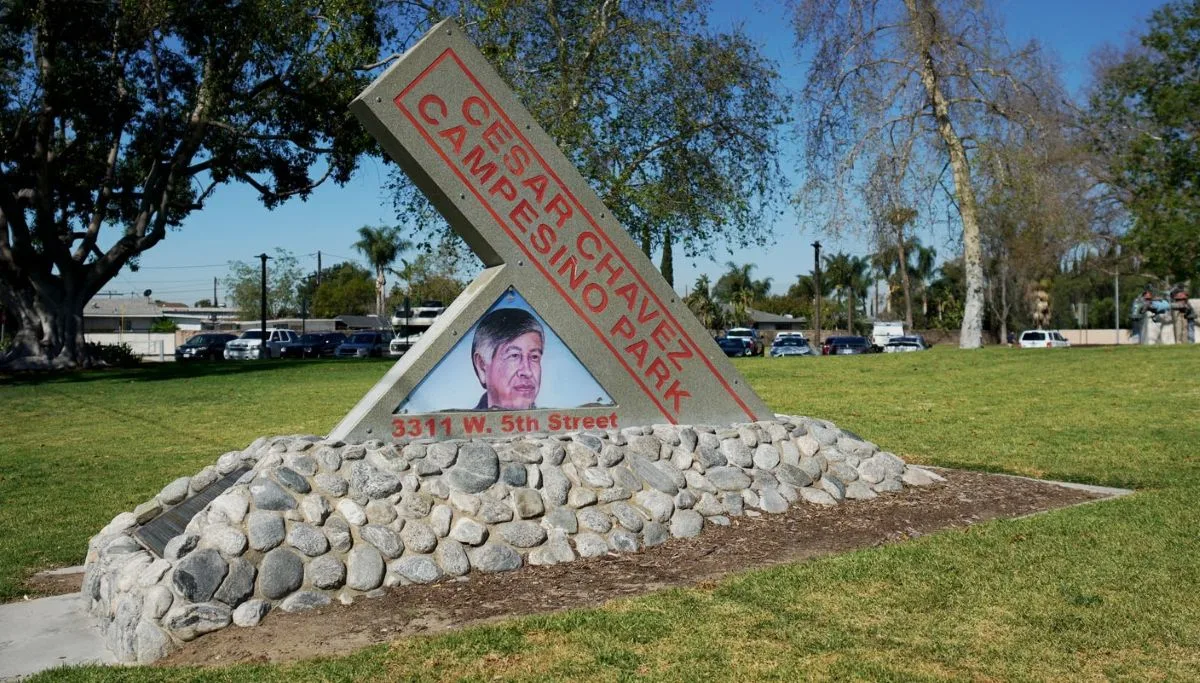
Critics of the current naming of Cesar Chavez Campesino Park argue that maintaining the name is inconsistent with Santa Ana’s identity as a sanctuary for all residents, regardless of their documentation status. The argument for renaming the park and reconsidering city-led celebrations rests on several points:
- Alignment with City Values: Proponents of the change suggest that public monuments should reflect the inclusive and protective values the city currently holds toward its immigrant population.
- Recognizing the Broader Movement: Instead of focusing on a single leader with a polarizing record on immigration, some suggest renaming the park to honor the “Campesinos” (farmworkers) as a collective, or local leaders who fought for the rights of all laborers without exclusion.
- Educational Opportunity: Re-evaluating these celebrations provides a chance for the community to have a transparent conversation about the complexities of labor history and the intersectional struggles of the immigrant community.
As these discussions continue, the Santa Ana City Council and the community at large face the challenge of weighing a leader’s significant labor achievements against a historical record that many find harmful to the very community the park serves today.
City Celebrations: While Santa Ana typically observes Cesar Chavez Day (March 31), the United Farm Workers (UFW) and the Cesar Chavez Foundation—who often partner on such events—have officially canceled all participation in celebrations for this month.
The SAUSD also has a high school named after Chavez. Time to rename that school too!
Regional and State Fallout
The lack of an official statement from Santa Ana stands in contrast to other parts of California and the Southwest where “canceling” is already underway:
- Neighboring Response: Nearby cities and organizations throughout the Orange County and Los Angeles region have begun scrapping planned events.
- State Leadership: Governor Gavin Newsom has stated he will discuss with state legislators whether to officially rename or remove the state holiday observed on March 31.
- Direct Comparisons: Cities like San Jose have already canceled all city-sponsored events to avoid “traumatizing survivors”.

Examining Cesar Chavez’ Historical Record on Immigration
For a city like Santa Ana, which serves as a vibrant home for many immigrant families, certain historical actions taken by Chavez have become a point of contention. Historical records from the 1960s and 70s highlight a “sordid” chapter where the fight for union strength often came at the expense of undocumented workers.
- The “Illegals Campaign”: In the mid-1970s, Chavez and the UFW leadership launched a campaign to report undocumented immigrants to federal authorities. Chavez argued that growers used undocumented labor to break strikes and depress wages, leading him to advocate for strict enforcement of immigration laws.
- The “Wet Line”: Perhaps the most controversial tactic was the establishment of a “wet line” in 1974. UFW members patrolled the Arizona-Mexico border to physically prevent immigrants from crossing, an action that occasionally resulted in reports of violence and intimidation against those seeking work.
- The Use of Rhetoric: In his public speeches and union communications, Chavez frequently utilized derogatory terminology common at the time to describe undocumented laborers, a fact that modern activists find difficult to reconcile with his image as a champion of civil rights.

Mayor Valerie Amezcua responds
Update: Santa Ana Mayor Valerie Amezcua has responded to this scandal with this announcement:
The allegations of abuse against Cesar Chavez are deeply shocking and horrific. My first concern is for the survivors who have come forward and I commend their bravery. No individual, no matter how admired, is above accountability and we cannot ignore these serious reports.
While we must deal with these horrific actions, the farmworker movement is larger than any one person. The fight for justice, dignity and worker rights remains a righteous cause. However, we must ensure our public spaces and commemorations align with core values. I will be working with the City Council to review all local landmarks named after Cesar Chavez to determine appropriate next steps at the April 7th Council Meeting.
The New Left won’t stop until everyone is canceled. They are nihilistic to the core.
The guy’s own family has spoken out against him. There is no dodging these charges.
Yea lets name it the George Floyd Park and the George Floyd School of Learing
Looks like people on the left are turning stones over to find anything, let’s start with Washington, Hamilton, etc. I believe that their are doing this to take the dirt off current Governer Newsome, for robbing the people of California! and his cronies out of billions, if people want to look at the past , and make these statements then they should look at the beginning of history !
I’m NOT buying the rubbish accusations, Chavez has been dead for 33 years & this Me 2 victim “Dolores Huerta” has all of a sudden emerged from thin air mentioning this scandal now out of all the years prior & after the death of C.C ….. How sus is that. She’s only in for the money NOT the accountability of predators.
Easy to prove as he impregnated her twice. I’m sure the offspring were already DNA tested.
It’s a simple coup d’etat. Chavaz did not have contemporary left wing views on open borders. Huerta has overthrown Chavez is now the new Leftist Saint of Latinx Culture.
He clearly had a monstrous side. His own family has disavowed him.