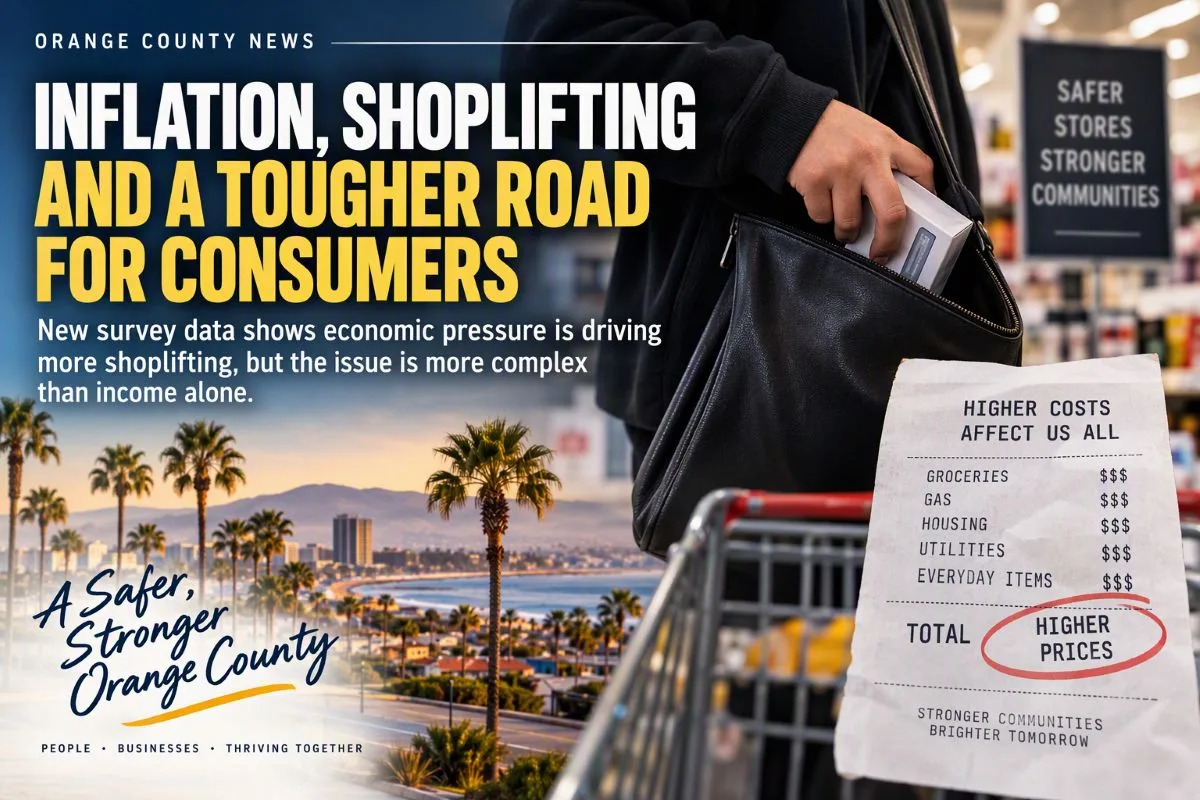
A new national survey suggests that while inflation and economic pressures are playing a significant role in shoplifting behavior, the issue is far more complicated than simply blaming poverty. The findings come from research highlighted by Tad Nelson & Associates using survey data from LendingTree, which found that 90% of respondents who admitted to shoplifting within the past year said inflation and broader economic conditions contributed to their actions.

The study arrives at a time when many California families continue to struggle with high grocery prices, elevated housing costs, expensive utility bills and gasoline prices that remain among the nation’s highest. Yet the survey also found that shoplifting is not confined to lower-income households.
Among respondents who acknowledged ever shoplifting, 40% of those from households earning $100,000 or more annually said they had done so, compared to 27% of respondents earning less than $30,000 per year.
Shoplifting Appears to Be Increasing
The survey found that:
- 30% of consumers surveyed said they had shoplifted at some point, up from 23% in a similar 2024 survey.
- Among those who had shoplifted, 37% said they had stolen merchandise within the previous year, up from 23% in 2024.
- 12% described themselves as regular shoplifters rather than one-time offenders.
- 80% of all respondents believe inflation has made people more likely to shoplift.
- Food and nonalcoholic beverages were the most commonly stolen items at 30%, followed by clothing, accessories and jewelry at 25%.
Perhaps most notably, 61% of consumers surveyed said shoplifting should carry stricter legal consequences, suggesting many Americans simultaneously recognize economic hardship while still supporting tougher enforcement.
Why People Say They Shoplift
Survey respondents cited several reasons for stealing merchandise:
- Much younger at the time: 33%
- Financial struggles: 28%
- Items were too expensive: 19%
- Making ends meet: 17%
- Saving money: 17%
While youth and poor decision-making remained the most common explanation, financial concerns clearly featured prominently throughout the results.
Orange County Has Not Escaped the Problem
Orange County has experienced a significant increase in shoplifting and retail theft in recent years. According to analyses of California Department of Justice crime data, reported shoplifting incidents in Orange County increased by more than 55% between 2021 and 2025.
Property crime researchers report that shoplifting is now one of the fastest-growing theft categories in the county and throughout California. Statewide, California recorded more than 121,000 reported shoplifting incidents in 2025.
Based on available California Department of Justice crime reporting trends, the Orange County cities generating the highest numbers of shoplifting arrests are generally:
- Santa Ana
- Anaheim
- Irvine
- Huntington Beach
- Fullerton
These cities account for some of the county’s largest retail corridors, shopping centers and concentrations of major retailers, which naturally generate both greater sales volume and greater theft activity.
The Hidden Costs for Businesses and Insurance Carriers
Retail theft losses extend far beyond the value of the items taken from store shelves.
The National Retail Federation has estimated nationwide retail shrink, which includes shoplifting, organized retail crime, employee theft and inventory errors, in the tens of billions of dollars annually. California remains one of the states most heavily impacted by retail theft.
Using Orange County’s population of roughly 3.2 million and statewide retail theft patterns, it is reasonable to estimate that annual direct retail theft losses in Orange County likely reach tens of millions of dollars each year. Once security costs, investigations, loss-prevention staffing, insurance claims, prosecution expenses and inventory replacement costs are included, the total financial impact may easily exceed $100 million annually across the county.
Insurance carriers ultimately absorb part of these losses through commercial crime coverage and business insurance claims. Over time, those costs can contribute to higher premiums for retailers, particularly those operating in high-theft locations.
Consumers Ultimately Foot the Bill
Retail theft is often portrayed as a victimless crime, but economists and retail industry experts have long argued that the costs eventually get passed along to consumers.
When stores experience persistent theft, they frequently respond by:
- Raising prices
- Increasing security spending
- Locking up merchandise
- Reducing store hours
- Closing underperforming locations
- Limiting inventory selection
The result is that law-abiding shoppers often pay more and receive less convenience.
For Orange County families already coping with years of inflation, rising housing expenses and elevated fuel prices, even modest price increases can have a meaningful impact on household budgets.
The LendingTree survey highlights that many consumers believe inflation is contributing to retail theft. However, the income data suggests the issue cannot be fully explained by financial hardship alone. Higher-income respondents reported shoplifting rates that exceeded those reported by lower-income households, indicating that factors such as opportunity, attitudes toward crime, risk perception and social norms may also play substantial roles.
What’s Driving Inflation?
While inflation has cooled from the historic highs seen in 2022 and 2023, prices for many necessities continue to climb faster than many consumers would like. Economists point to several factors that may be contributing to ongoing price pressures.
One factor is continued global instability in the Middle East. Conflict involving Iran and regional security concerns have periodically pushed oil prices higher and created uncertainty in energy markets. Because fuel costs affect trucking, shipping, manufacturing and food production, increases in energy prices can ripple throughout the economy, eventually showing up in grocery aisles and retail stores.
Trade policy may also be playing a role. The Trump administration’s tariff policies, particularly those affecting imported goods and materials, have generated debate among economists. Supporters argue tariffs protect American industries and workers, while critics contend that import taxes often increase costs for businesses, which may then pass those expenses on to consumers through higher prices.
Other factors include persistent housing shortages, rising labor costs, elevated insurance premiums, growing government spending, supply chain disruptions and continued increases in food costs. In California, residents also face some of the nation’s highest gasoline prices, utility bills and housing expenses, placing additional strain on household budgets.
For families struggling to make ends meet, these economic pressures can create frustration and anxiety. However, the survey’s findings suggest that economic hardship alone does not explain the rise in shoplifting. While many respondents cited inflation and financial challenges as factors, self-reported theft was actually more common among higher-income households than among the lowest-income households surveyed. That suggests retail theft is influenced by a combination of economic conditions, personal choices, perceived risk and social attitudes toward crime.
Whether policymakers focus on reducing inflation, strengthening enforcement, or both, the survey highlights a growing concern: when prices rise and shoplifting increases, businesses, consumers and entire communities often end up sharing the cost.
A Complicated Challenge
The new survey offers a reminder that shoplifting is neither a simple economic issue nor purely a law-enforcement issue. Financial stress appears to influence behavior for some offenders, particularly when it comes to necessities such as food and personal-care products. At the same time, a significant portion of self-reported shoplifters come from relatively affluent households.
As Orange County retailers continue investing in anti-theft technology, security personnel and cooperative law-enforcement operations, the challenge will be balancing accountability with a deeper understanding of the economic and social factors driving theft.
What appears clear is that retail theft affects far more than store owners. The losses ripple through insurance markets, supply chains and consumer prices, ultimately impacting every shopper who walks through the door.