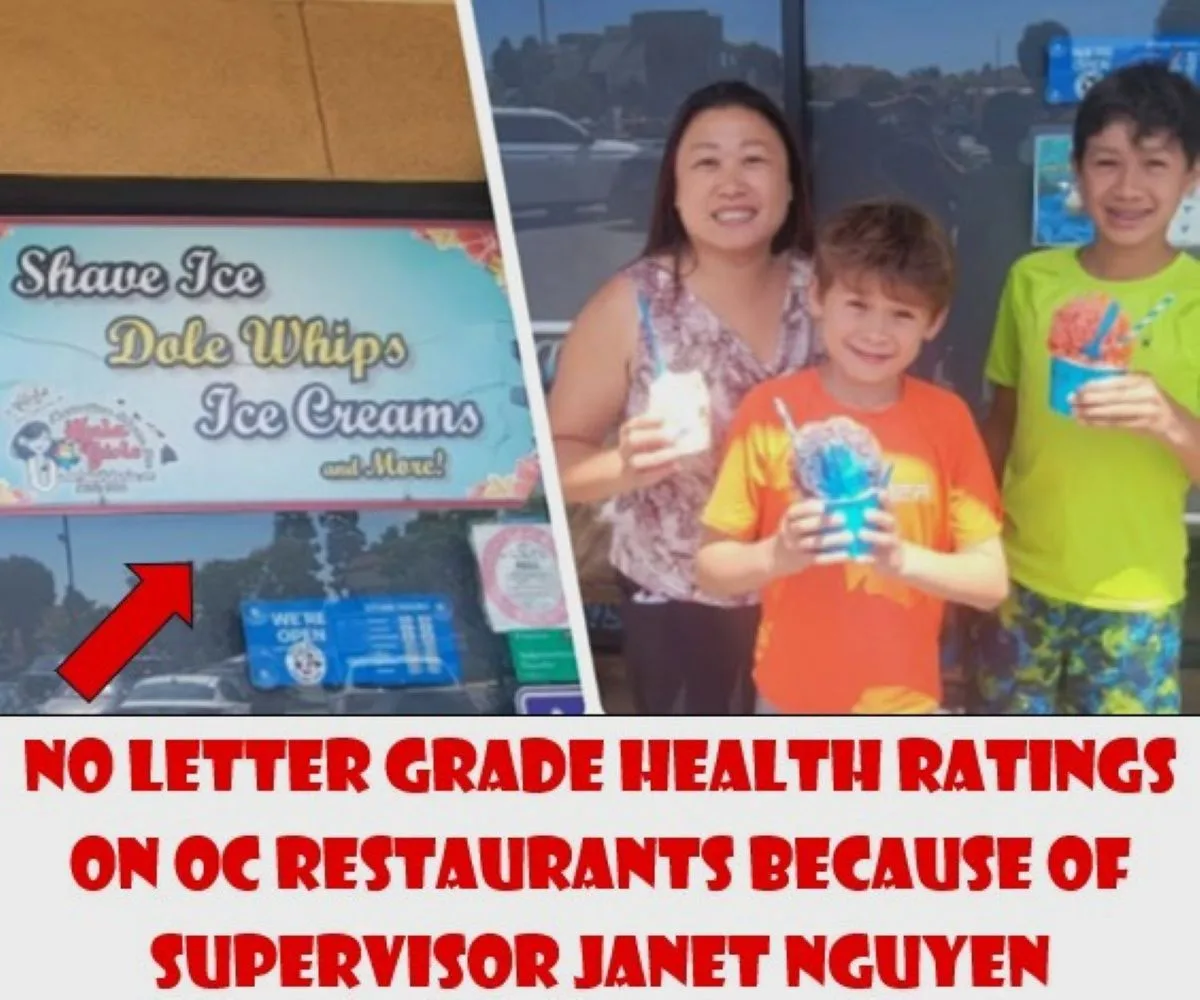
The Orange County Board of Supervisors must finally vote to pass and enforce standard letter grade health ratings for all restaurants and food establishments.

Orange County remains a glaring exception in Southern California, keeping its diners completely in the dark regarding food safety. Every single county surrounding Orange County—including Los Angeles, San Diego, Riverside, and San Bernardino—utilizes a highly visible, universal A, B, or C letter grading system.
Meanwhile, Orange County relies on an opaque system of hidden certificates and vague online reports. This regulatory failure forces local consumers to play Russian roulette with their health every time they eat out.

A History of Political Conflicts and Hidden Interests
The push to establish restaurant letter grades in Orange County is not a new battle, but its failure is rooted in political self-interest and backroom shielding.
In 2008, the Orange County Grand Jury strongly urged the county to mandate highly visible letter grades. However, a key vote against consumer transparency came from current First District Supervisor Janet Nguyen. At the time of the vote, Nguyen fiercely defended restaurant owners against public grading while actively concealing a massive conflict of interest.
It was later revealed that her husband, Thomas Bonikowski, and her chief of staff—the now-convicted former supervisor Andrew Do—were the hidden co-owners of a Lee’s Sandwiches franchise in Stanton. This exact establishment suffered an atrocious health violation record, heavily disincentivizing Nguyen from backing open inspection metrics.
To worsen the corruption, public records showed that Nguyen had pocketed thousands of dollars in campaign contributions directly from various local restaurant owners who possessed documented, poor health inspection records. Decades later, with Andrew Do currently serving a federal prison sentence for public corruption and bribery, the Board of Supervisors must explicitly distance itself from this legacy of self-dealing by putting public safety above dirty campaign dollars.
Rising Risks to Public Health
Failing to implement transparent letter grade ratings directly impacts human health. Outbreaks of foodborne illnesses from dangerous pathogens like Salmonella, E. coli, and Norovirus have seen steady escalations. Restaurants operating with subpar sanitation practices, improper holding temperatures, and unhygienic food preparation spaces serve as breeding grounds for these preventable diseases.
A visible letter grade posted directly in a storefront window serves as an immediate deterrent to negligence, forcing restaurant management to maintain basic compliance. Peer-reviewed data across neighboring counties proves that the introduction of mandatory letter grades rapidly forces restaurants to improve cleanliness, leading to a direct and measurable decrease in local foodborne illness hospitalizations. Orange County residents deserve the exact same layer of public health security that travelers and diners enjoy across the county borders.
Major Recent Restaurant Outbreaks
- Taco Bell (2026): A massive, multistate outbreak of Cyclospora (a microscopic parasite that causes severe, prolonged, and explosive diarrhea) was directly linked to contaminated shredded iceberg lettuce served at several Taco Bell locations. As of mid-2026, the parasite sickened more than 4,100 people across multiple states and forced at least 140 hospitalizations. The outbreak triggered a wave of high-profile consumer lawsuits against the chain and its produce supplier.
- McDonald’s (2024): A deadly E. coli outbreak swept through multiple states, directly tied to slivered onions used on McDonald’s Quarter Pounder hamburgers. The outbreak sickened over 100 people, left four individuals suffering from hemolytic uremic syndrome (a severe condition that causes kidney failure), and resulted in at least one death.
- Wendy’s (2022): A regional E. coli outbreak sickened dozens of customers across four Midwestern states. Investigators traced the source of the bacteria to contaminated romaine lettuce used on the restaurant chain’s sandwiches, forcing the company to pull lettuce from its supply chain in the impacted region.
- Chipotle Mexican Grill (2015–2018): Chipotle was at the center of a series of cascading, severe food safety failures over multiple years. In 2015, separate outbreaks of E. coli and Norovirus across multiple states sickened hundreds of customers, with one Boston outbreak alone sickening 91 people due to a sick worker. In 2018, over 600 people were sickened at an Ohio location by Clostridium perfringens, a bacteria that multiplies rapidly when food is left sitting at unsafe holding temperatures. The company ultimately paid a record $25 million federal criminal fine to resolve charges related to serving tainted food.
Notable Historical Fatal Outbreaks
- Jack in the Box (1993): This remains one of the most infamous food safety disasters in U.S. history. The restaurant chain served undercooked hamburger patties contaminated with a deadly strain of E. coli O157:H7. The outbreak sickened over 700 people across four states, left dozens of children with permanent kidney damage, and killed four children. This tragedy completely revolutionized federal meat inspection and food safety standards.
- Chi-Chi’s Restaurant (2003): A popular Mexican restaurant chain location in Pennsylvania caused the largest Hepatitis A outbreak in U.S. history. Contaminated green onions imported from Mexico and poor kitchen oversight sickened more than 650 diners and killed at least four people. The resulting lawsuits and public distrust completely bankrupt the chain, forcing it to permanently exit the United States.
Take Action: Contact Your Supervisor Today
The current Orange County Board of Supervisors has the legislative authority to pass a consumer protection ordinance. Use the direct contact details provided below to demand that your representative schedules a vote to enforce mandatory, visible letter grade health ratings:
- Janet Nguyen (District 1)
- Email: Janet.Nguyen@ocgov.com
- Phone: (714) 834-3110
- Vicente Sarmiento (District 2)
- Email: Vicente.Sarmiento@ocgov.com
- Phone: (714) 834-3220
- Donald P. Wagner (District 3)
- Email: Don.Wagner@ocgov.com
- Phone: (714) 834-3330
- Doug Chaffee (District 4)
- Email: Doug.Chaffee@ocgov.com
- Phone: (714) 834-3440
- Katrina Foley (District 5)
- Email: Katrina.Foley@ocgov.com
- Phone: (714) 834-3550
Sample Letter to send to your Orange County Supervisor
Subject: Demand for Transparency: Pass Mandatory Letter Grade Health Ratings for O.C. Restaurants
Dear Supervisor,
As a constituent and regular diner in Orange County, I am writing to urge you to introduce, vote for, and enforce a mandatory letter grade health rating system (A, B, C) for all local food establishments.
Orange County remains a glaring exception in Southern California. Every single one of our surrounding neighbors—Los Angeles, San Diego, Riverside, and San Bernardino counties—uses highly visible letter grades to protect consumers. Our current opaque system leaves residents and visitors completely in the dark regarding food safety and sanitation compliance.
Public health data shows a concerning rise in foodborne illnesses. Visible letter grades are a proven, effective deterrent against kitchen negligence, forcing immediate compliance and measurably reducing foodborne hospitalizations.
For too long, political self-interest, campaign contributions, and historical conflicts of interest have shielded failing restaurants at the expense of public safety. It is time for this Board to prioritize the health of Orange County families over backroom political shielding.
Please protect your constituents by bringing Orange County into alignment with the rest of Southern California. I urge you to schedule a vote to implement mandatory storefront letter grade health ratings immediately.
Thank you for your time and your service to our community.
Sincerely,
[Your Name]
[Your City/Zip Code]
[Your Contact Information]