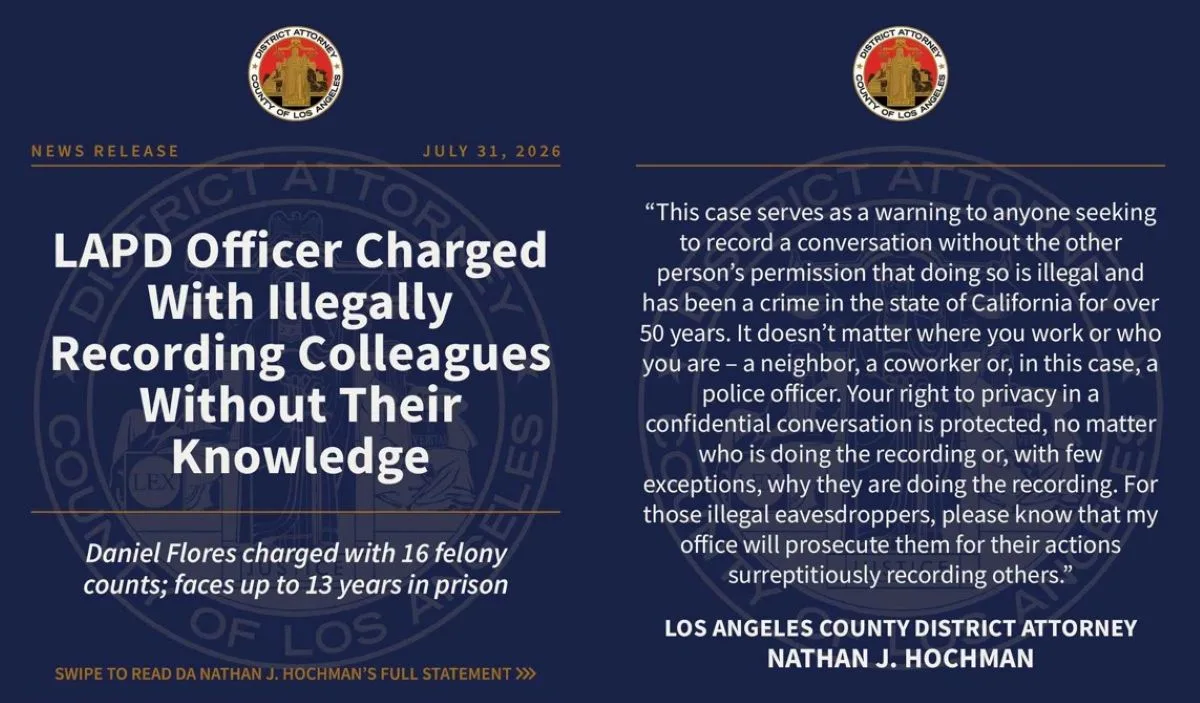
On July 31, 2026, the Los Angeles County District Attorney’s Office announced 16 felony counts of eavesdropping and recording confidential communications against Los Angeles Police Department (LAPD) Officer Daniel Flores.

Assigned to a vital recruitment background investigation unit, Flores secretly recorded colleagues over the course of 2024. His legal defense argues he acted as a whistleblower to document instances of blatant bigotry, including vile sexist, homophobic, and racist slurs within the department. Despite these arguably noble intentions to expose workplace toxicity, his methods explicitly violated California’s strict all-party consent laws, putting him at risk of up to 13 years in state prison.
The legal error in this situation involves the bypass of foundational privacy protections established by state law. While addressing systemic bias is a critical organizational goal, utilizing methods that violate statutory protections can undermine the legal standing of a whistleblower’s claims. In California, individual privacy rights in confidential settings have been strictly protected for over 50 years. District Attorney Hochman emphasized that the “all-party consent” rule is a cornerstone of state privacy law, and personal motivations do not grant an exemption from these requirements.
Legal Channels and Institutional Accountability
This prosecution highlights the complexities of documenting workplace misconduct within government agencies. Legal experts suggest that institutional reform is most effective when conducted through established oversight mechanisms. Instead of independent recordings, personnel often have several legal avenues to address problematic behavior:
- Filing a formal complaint with the LAPD’s Internal Affairs Division to initiate an authorized administrative investigation.
- Reporting concerns to the Los Angeles Police Commission or the Office of the Inspector General for independent oversight.
- Consulting with legal counsel to navigate whistleblower protection laws, which can provide a safe path for reporting evidence without violating privacy statutes.
When individuals deviate from these protocols, it can complicate the prosecution of the original bad behavior and shift the legal focus toward the methods used to gather evidence.
Precedents in Privacy Law Enforcement
The prosecution of law enforcement personnel for privacy violations is not without precedent in California. Other cases have demonstrated that even those in positions of authority must adhere to eavesdropping statutes.
For example, an Orange County Sheriff’s Department sergeant faced felony charges for recording confidential communications between inmates and their attorneys, highlighting that these laws apply to all department members regardless of their rank or assignment.
Criminological research often explores why misconduct persists in high-stress environments. Common factors identified in organizational studies include:
- Internal Cultures: Environments that prioritize group loyalty over transparency can sometimes discourage the reporting of inappropriate behavior through traditional channels.
- Occupational Stress: High levels of stress in administrative or recruitment units can lead to decreased morale and a breakdown in professional workplace standards.
How much Daniels Flores was making at the Los Angeles Police Department
Data from Transparent California shows that veteran LAPD officers command significant compensation packages.
Based on records for officers with similar tenure to Flores—who joined the department around 2013—typical total annual compensation, including base pay, overtime, and benefits, often ranges from $150,000 to $200,000.
The current legal proceedings place this career and its associated benefits at significant risk, underscoring the importance of following established legal procedures when attempting to expose institutional misconduct.
If Flores is convicted of a felony, his law enforcement career is permanently over, and his prospects in the private security industry will be severely legally restricted.
Immediate Career Impacts
- Decertification: A felony conviction triggers an automatic, permanent revocation of his police officer certification under California POST (Peace Officer Standards and Training) rules.
- Employment Bar: He will be legally barred from ever working as a sworn peace officer anywhere in the United States.
- Firearm Ban: A felony conviction comes with a lifetime ban on owning, possessing, or operating firearms under both California and federal law.
Impact on Security Guard Work
He will not be able to get standard, licensed security guard work in California if convicted of a felony.
- BSIS Licensing Denied: The California Bureau of Security and Investigative Services (BSIS) requires a criminal background check for all guard cards. Under California Business and Professions Code, a felony conviction—especially one involving a crime of moral turpitude or privacy violations—is grounds for immediate denial of a Guard Card.
- No Armed Security: Because of the lifetime firearm ban, he is completely disqualified from any high-paying armed security or executive protection roles.
- Rare Exceptions: The only way he could legally obtain a guard card is if the felony is later reduced to a misdemeanor (unlikely given the nature of 16 counts) or if he receives a formal Certificate of Rehabilitation and pardon, which takes years after completing his sentence.
Alternative Career Paths for Flores
With a felony record, his career options will pivot toward industries that do not require state-issued licenses, firearm access, or strict background checks:
- Consulting: He could potentially work as a private, unlicensed consultant for defense attorneys, analyzing police procedures or training materials.
- Whistleblower Advocacy: Given the nature of his defense, he could find employment or speaking engagements with civil rights organizations, police accountability groups, or whistleblower advocacy non-profits.
- General Labor: He would be limited to standard private-sector employment in fields like logistics, construction, or transportation that frequently hire individuals with background barriers.