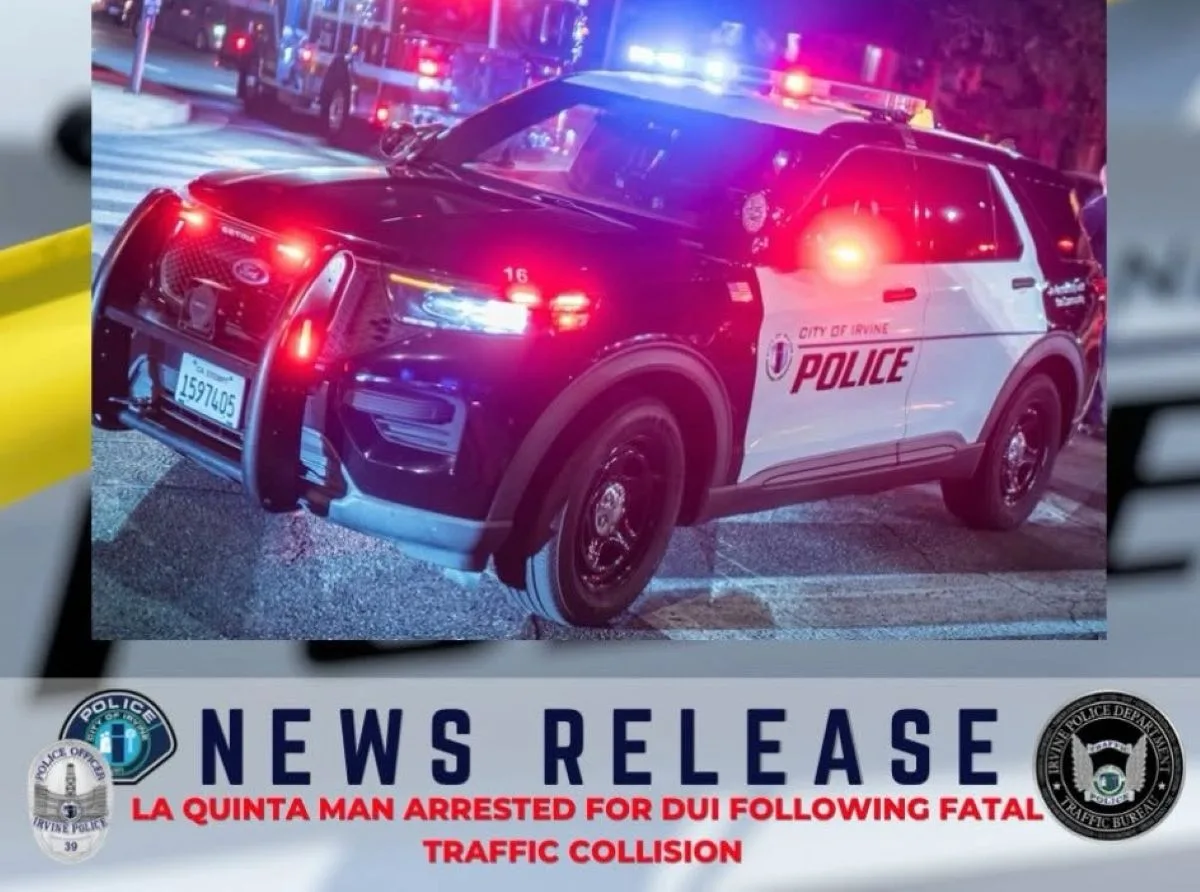
A suspected DUI crash in Irvine has left an Orange County family mourning and could expose the arrested driver to some of the most serious alcohol-related criminal charges available under California law.

According to the Irvine Police Department, officers and firefighters responded at approximately 9:06 p.m. on October 15 to a major traffic collision at Harvard Avenue and Paseo Westpark involving a 2009 Toyota Corolla and a 2023 Mercedes S680.
Police reported that 83-year-old Tustin resident Effat Setayeshgar Tinoosh, the driver of the Toyota, was transported to Orange County Global Medical Center, where she later died from her injuries.
The driver of the Mercedes, identified by police as 28-year-old Adam Gabriel Canchola of La Quinta, was arrested on suspicion of driving under the influence.
The Irvine Police Department’s Major Accident Investigation Team continues to investigate the collision, and authorities have indicated additional charges may follow.
Potential Charges the Driver Could Face
At this stage, Canchola has only been arrested on suspicion of DUI and has not been convicted of any crime. However, because the collision resulted in a death, prosecutors could consider substantially more serious charges than a standard misdemeanor DUI.
Potential charges may include:
- DUI causing injury or death.
- Gross vehicular manslaughter while intoxicated.
- Vehicular manslaughter while intoxicated.
- Second-degree murder under California’s “Watson murder” theory if prosecutors believe the facts support implied malice.
The actual charges will depend on toxicology results, crash reconstruction evidence, witness statements, vehicle data, and whether investigators determine impairment was a substantial factor in causing the collision.
Possible Criminal Penalties
If prosecutors file a felony DUI death case and obtain a conviction, the penalties could be severe:
- State prison rather than county jail.
- Multi-year prison sentences that can extend well beyond a decade depending on the charge.
- Formal felony probation in some circumstances.
- Permanent felony record.
- Restitution to the victim’s family.
- Driver’s license suspension or revocation.
- Court-ordered DUI education programs.
- Installation of an ignition interlock device.
In California, DUI fatalities are often among the most aggressively prosecuted vehicular crimes because a death has occurred and because impaired driving is considered a preventable offense.
Financial Costs Can Easily Reach Tens of Thousands of Dollars
In addition to criminal penalties, DUI defendants frequently incur substantial financial consequences, including:
- Court fines and penalty assessments.
- Attorney fees.
- DUI school costs.
- Ignition interlock device installation and monitoring fees.
- DMV administrative expenses.
- Restitution claims.
- Increased insurance premiums.
- Potential civil wrongful-death lawsuits.
For a fatal DUI case, the overall financial impact can easily reach tens of thousands of dollars and, in some cases, much more when civil litigation is involved.
Auto Insurance Consequences
The insurance ramifications may outlast any criminal sentence.
A DUI conviction often leads to:
- Dramatically higher insurance premiums.
- Requirement to file an SR-22 certificate with the DMV.
- Loss of preferred insurance status.
- Non-renewal or cancellation by some insurers.
- Difficulty obtaining affordable coverage for years.
When a crash involves a fatality, insurers may view the driver as a particularly high-risk motorist. Premium increases can persist long after any criminal case has concluded.
Employment Consequences
A DUI fatality case can also be career-changing.
Potential impacts include:
- Loss of employment involving commercial driving.
- Difficulty obtaining professional licenses.
- Disqualification from jobs requiring company vehicles.
- Challenges passing background checks.
- Reduced future employment opportunities.
Employers in transportation, government, public safety, education, healthcare, and financial services often conduct extensive background reviews that can reveal felony convictions.
Potential Civil Liability Could Last Long After the Criminal Case Ends
While much of the public attention will focus on the criminal investigation, the civil consequences could ultimately prove just as significant. If investigators determine that impaired driving caused the collision, the family of Effat Setayeshgar Tinoosh could pursue a wrongful death lawsuit against Adam Gabriel Canchola seeking compensation for their losses.
In California, wrongful death claims can seek damages for:
- Funeral and burial expenses.
- Loss of financial support.
- Loss of companionship, comfort, care, and guidance.
- Medical expenses incurred before death.
- Property damage and related losses.
Depending on the facts of the case, the driver’s insurance coverage, and the assets available, a successful wrongful death claim can result in a judgment ranging from hundreds of thousands to potentially millions of dollars.
The financial exposure may not end with insurance. If damages exceed available policy limits, plaintiffs may seek recovery from a defendant’s personal assets, including bank accounts, investments, real property interests, and future earnings, subject to California law and applicable exemptions.
Attorneys representing the victim’s family may also explore whether punitive damages are appropriate. Unlike ordinary compensation, punitive damages are intended to punish and deter particularly reckless conduct. In some California DUI cases, plaintiffs have argued that choosing to drive while impaired demonstrated a conscious disregard for the safety of others.
A criminal conviction is not required for a wrongful death lawsuit to proceed. Civil cases operate under a lower burden of proof than criminal prosecutions, meaning liability can sometimes be established in civil court even when criminal proceedings are still pending or produce a different outcome.
For the family of Effat Setayeshgar Tinoosh, the civil justice system may ultimately become another avenue for seeking accountability, while for Adam Gabriel Canchola, any criminal penalties imposed by the court could represent only a portion of the legal and financial consequences arising from the fatal Irvine collision.
Which Orange County Cities See the Most Fatal DUI Crashes?
State DUI crash data is maintained through California’s Statewide Integrated Traffic Records System (SWITRS) and the Transportation Injury Mapping System (TIMS). ]
Based on Orange County population, roadway volume, and recurring DUI collision trends reported through SWITRS datasets, the cities that historically tend to record the highest numbers of fatal DUI collisions are:
- Anaheim
- Santa Ana
- Huntington Beach
- Orange
- Costa Mesa
Why Do DUI Drivers Still Get Behind the Wheel?
The Irvine collision raises a question that has frustrated law enforcement officials for years: why do people still drive impaired when rideshare services are available almost everywhere in Orange County?
Researchers and traffic safety experts commonly point to several factors:
- Alcohol impairs judgment, causing intoxicated individuals to overestimate their ability to drive.
- Some drivers underestimate their level of impairment.
- A desire to avoid rideshare costs.
- Overconfidence based on prior occasions when they drove after drinking without being arrested.
- Concerns about leaving a vehicle behind.
- Poor planning before consuming alcohol.
The irony is that the availability of Uber, Lyft, taxis, designated drivers, and public transportation alternatives has never been greater. Yet alcohol-related crashes continue to claim lives throughout California. California continues to track alcohol- and drug-related crashes through statewide DUI monitoring systems because impaired driving remains a major contributor to traffic deaths and serious injuries.
The Irvine Police Department is asking anyone who witnessed the collision or has additional information to contact Detective Gallegos at HGallegos@cityofirvine.org.
The investigation remains ongoing, and any criminal charges ultimately filed against Adam Gabriel Canchola will be determined by prosecutors after reviewing the evidence collected by investigators.