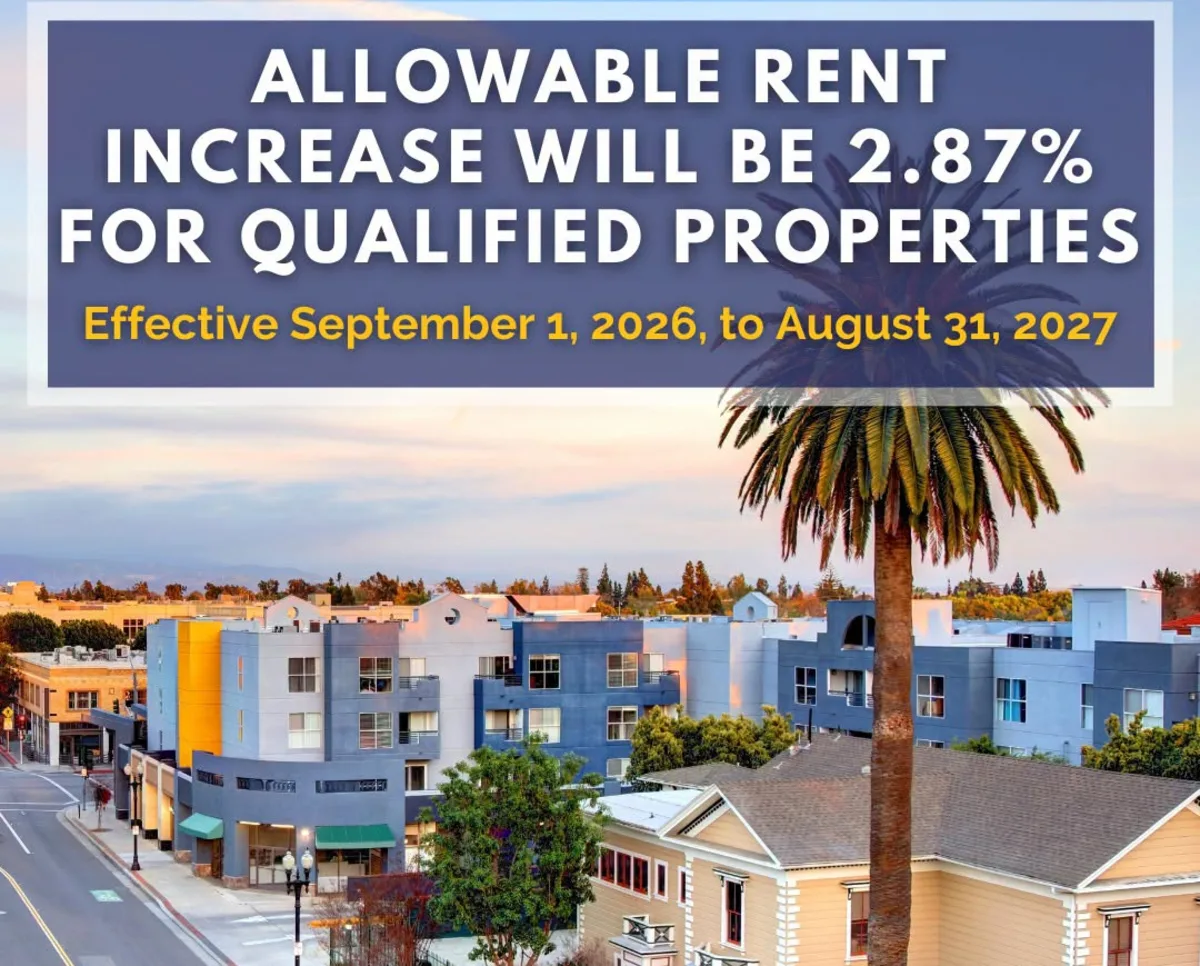
The City of Santa Ana has officially announced the maximum allowable rent increase under its Rent Stabilization and Just Cause Eviction Ordinance (Ordinance No. NS-3027). Starting September 1, 2026, through August 31, 2027, landlords can increase rent by a maximum of 2.87% for qualifying residential units and mobilehome spaces. Calculated strictly using a local formula capped at the lesser of 3% or 80% of the Consumer Price Index (CPI), this new cap is a slight increase from the previous year’s limit of 2.42%.

The enforcement of this cap introduces strict operational hurdles for property owners. Landlords are prohibited from enacting an increase unless the property is completely compliant with city codes, all required repairs are documented as complete, and the rental unit is accurately registered with the city. Furthermore, landlords are restricted to a single increase within any 12-month period and must issue an explicit written notice detailing tenant rights under the local law. For official questions, community members can reach out directly to the Rent Stabilization Division at (714) 667-2209 or via email at rso@santa-ana.org.
Is the Ordinance Actually Helping Housing Costs?
Local data indicates that while the Rent Stabilization Ordinance shields specific, existing tenants from sudden price spikes, it is not lowering the broader cost of housing across Santa Ana. Since the law primarily applies to older multi-family structures built before February 1, 1995, a large portion of the city’s housing stock remains entirely unaffected.
Market metrics show that overall average asking rents in Santa Ana have historically stayed high, driven by standard supply-and-demand metrics rather than legislative caps. To prevent landlords from navigating around these price limits, the Santa Ana City Council recently had to pass a secondary ordinance on March 3, 2026, banning the use of algorithmic rent-setting software. This secondary intervention highlights that landlords continue to maximize market rates where gaps exist, proving that rent control acts more as a localized safety net for specific individuals than a tool to lower market-wide housing costs.
Southern California Rental Market Trends
The implementation of this cap comes at a fascinating time, as broader Southern California housing trends are shifting without the help of government intervention. According to recent market reports, landlords trimmed rents in 60% of Southern California cities. A cooling regional economy, stagnant population growth, and a modest local construction boom have collectively driven up multifamily vacancy rates.
As a result, median regional rents have softened slightly, dropping 0.4% over the past year to sit at a median of $1,921 for a one-bedroom and $2,359 for a two-bedroom. While Orange County has seen a tiny 0.4% gain, neighboring areas like San Diego County (-1.3%) and the Inland Empire (-1.1%) have experienced notable, market-driven rent cuts.
Which Southern California Cities Have the Lowest Rents?
For renters looking for the lowest baseline housing costs in the region, the Inland Empire, high desert, and Central Valley borders offer the most competitive numbers. According to rental market statistics from platforms like Apartment List and Apartments.com, the cities with the lowest median rents include:
- Bakersfield: Consistently ranks as the lowest-priced major rental market in the state, with median rents hovering around $1,124.
- Moreno Valley: One of the most affordable options inside the Inland Empire, with a typical one-bedroom unit tracking at $1,632.
- Riverside & San Bernardino: These primary Inland Empire hubs feature a wave of move-in incentives and negative rent growth, bringing average one-bedroom units to roughly $1,702.
Why Economists Warn That Rent Control Backfires
While Santa Ana’s 2.87% cap aims to protect vulnerable communities, mainstream economists heavily warn that long-term rent control policies ultimately backfire and worsen housing crises. Historical studies published by institutions like the National Bureau of Economic Research (NBER) show that strict caps intentionally disrupt the natural housing supply. When profit margins are compressed below inflation, developers routinely redirect capital away from municipalities with rent control, halting new construction projects.
Furthermore, empirical evidence demonstrates that rent control incentivizes landlords to reduce property maintenance, accelerating the decay of older housing stock. Over time, landlords frequently attempt to pull their properties off the traditional rental market entirely by converting units into luxury condos or tenancies-in-common. This contraction of available inventory forces un-capped market-rate units to spike drastically in price, leaving future renters with fewer, more expensive choices.