Yesterday evening, police officers responded to a report of a disabled vehicle in the roadway, according to the Fountain Valley Police Department.
As the responding police officers began investigating, the situation quickly turned into much more than just car trouble.
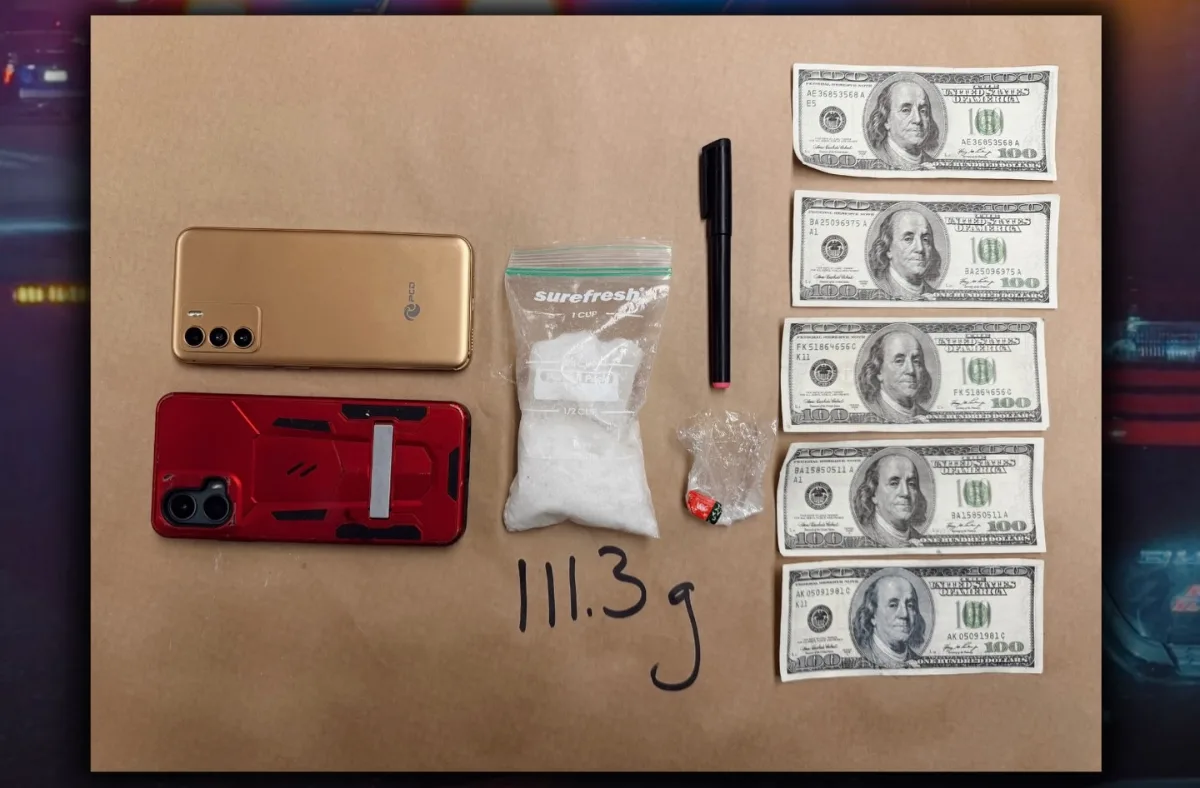
A female subject was ultimately found to be in possession of over 100 grams of suspected methamphetamine and several counterfeit $100 bills.
She was arrested and booked for narcotics sales, along with additional drug and fraud-related charges.
This serves as a reminder that there’s truly no such thing as a “routine” call for police service. Great work .by the FVPD night shift crew!
In Southern California, including Orange County, illegal drugs like methamphetamine and fentanyl primarily originate from Mexico, where they are manufactured by major transnational criminal organizations (cartels).
Primary Sources
- Mexican Cartels: According to the DEA’s 2024 National Drug Threat Assessment, nearly all methamphetamine sold in the U.S. today is manufactured in Mexico. The Sinaloa and Jalisco cartels are the primary suppliers.
- Global Precursors: These cartels partner with companies in China to obtain the precursor chemicals and equipment (such as pill presses) needed to produce synthetic drugs.
- Inland Production: While large-scale “super labs” are now rare in the U.S., smaller conversion laboratories still exist in California, where liquid methamphetamine smuggled from Mexico is processed into crystalline form.
Trafficking Routes to Orange County

- Land Borders: Most drugs enter the U.S. through Ports of Entry (POEs) along the southwest border, often concealed in passenger vehicles, tractor-trailers, or on pedestrians.
- The “LA Hub”: Los Angeles and its surrounding areas (like Orange County) serve as a primary distribution hub. Cartels use local “trusted lieutenants” and established networks to broker deals and move products across the country.
- Distribution Networks: Once across the border, drugs are handed off to wholesale distributors who then supply local street gangs and independent dealers responsible for retail sales.
Common Concealment Methods
Traffickers use highly creative methods to evade detection:
- Liquid Form: Meth is often smuggled as a liquid dissolved in gasoline or disguised as household products to pass through border checks.
- Hidden Compartments: Drugs are frequently stashed in gas tanks, air bag compartments, and quarter panels of vehicles.
- Digital Platforms: Modern dealing has increasingly moved to social media and encrypted apps like Snapchat and Telegram, allowing dealers to arrange deliveries and pickups with less street visibility.
The suspect arrested by the Fountain Valley Police Department on March 7, 2026, faces significant felony charges related to narcotics sales and counterfeit currency. Based on the quantity of drugs seized (over 100 grams) and the nature of the charges, here is a breakdown of the potential penalties and estimated street value:
Potential Penalties
The suspect was booked for narcotics sales, drug possession, and fraud-related charges. Under California law, these typically carry the following penalties:
- Possession of Methamphetamine for Sale (HS 11378): This is a felony. A conviction typically results in 16 months, two years, or three years in county jail and fines up to $10,000.
- Narcotics Sales or Transportation (HS 11379): If charged with actual sale or transportation for sale, the penalty increases to two, three, or four years in state prison.
- Counterfeit Currency (Penal Code 470/476): Possession or use of counterfeit bills is a “wobbler” in California, meaning it can be charged as a misdemeanor or a felony. Felony forgery or possession of completed counterfeit notes can lead to up to three years in jail.
- Weight Enhancements: While 100 grams is a significant amount, mandatory prison enhancements for weight usually trigger at much higher levels (e.g., 1 kilogram or more).
Estimated Street Value
The “street value” of narcotics fluctuates based on purity and how it is sold (bulk vs. individual doses). For 100 grams of methamphetamine in California:
- Retail Value: If sold by the gram, the value is estimated between $2,000 and $4,000, based on a street price of approximately $20 to $40 per gram.
- Wholesale/Mid-level Value: If valued by the ounce (approx. 3.5 ounces), the total value might be lower, ranging from $500 to $1,000 depending on regional pricing.
- Counterfeit Value: The several counterfeit $100 bills mentioned add at least several hundred dollars in “face value” to the total seizure, though their actual criminal value depends on their quality.