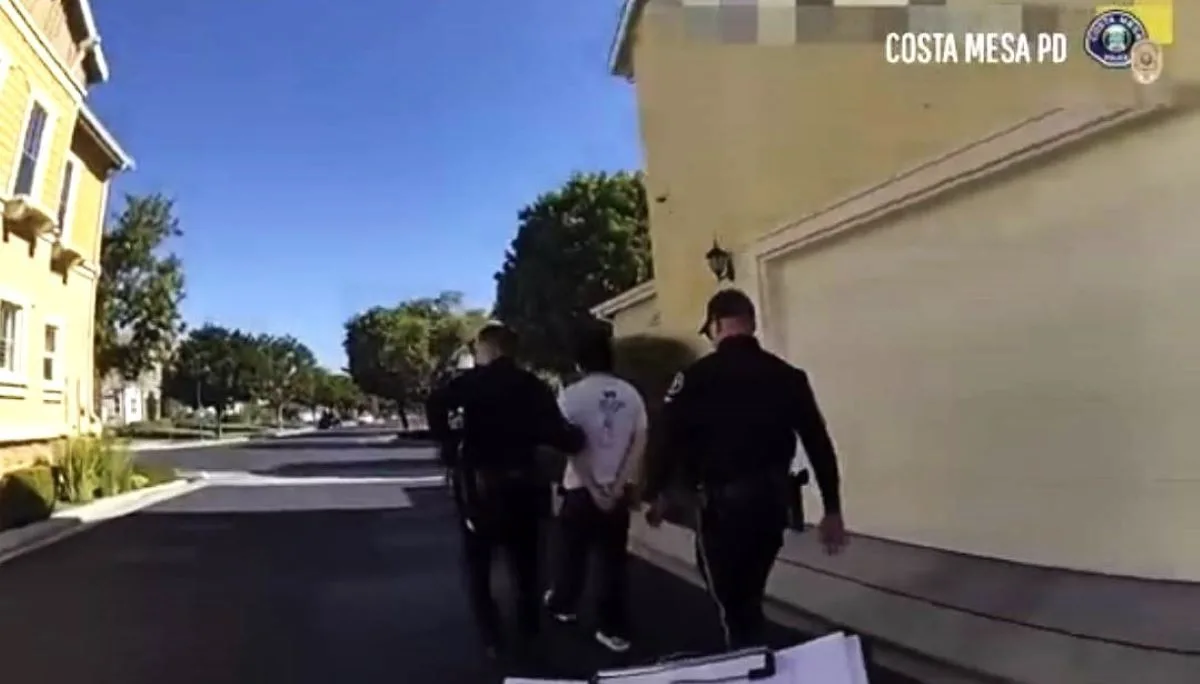
On a foggy morning this past November, vehicle sped off after police officers attempted a traffic stop, according to the Costa Mesa Police Department.
The vehicle dangerously exceeded over 120mph.
Despite the early morning hour, the officers did not want to endanger anyone and although the pursuit was terminated, the investigation was not.
Through the diligent work of the CMPD’s Traffic Safety Bureau investigator, the vehicle and suspect were identified.

Last week, the male suspect was arrested in a neighboring city and his vehicle was impounded.
Driving recklessly and evading police doesn’t mean you get away with it. Putting other drivers, cyclists, and pedestrians at risk like this means you get arrested.
Legal Penalties Faced by the Suspect
Based on the details of the incident—evading police at speeds exceeding 120 mph—this individual likely faces a charge of Felony Reckless Evading under California Vehicle Code 2800.2.
This specific charge applies when a driver willfully flees a peace officer with a “willful or wanton disregard for the safety of persons or property.” Under California law, committing three or more point-count traffic violations (such as speeding, running red lights, or unsafe lane changes) during a pursuit is legally sufficient to prove this disregard.
Potential Penalties
Because “reckless evading” is a wobbler in California, it can be prosecuted as either a misdemeanor or a felony depending on the suspect’s criminal history and the severity of the pursuit.
| Penalty Type | Misdemeanor Conviction | Felony Conviction |
|---|---|---|
| Incarceration | 6 months to 1 year in county jail | 16 months, 2 years, or 3 years in state prison |
| Fines | Up to $1,000 | Up to $10,000 |
| Vehicle | 30-day impoundment | 30-day impoundment |
| License | Possible suspension/revocation | Suspension or revocation |
| DMV Record | 2 points on driving record | 2 points on driving record |
Additional Consequences
- Impoundment: As noted in the CMPD report, his vehicle has already been impounded. Under Vehicle Code 14602.7, a vehicle used to evade police can be held for up to 30 days.
- Civil Liability: If any property damage occurred during the high-speed flight, the suspect may also be liable for restitution.
- Enhanced Sentencing: If the investigation reveals the suspect was also under the influence (DUI) or if the pursuit resulted in injury, the prison time could increase significantly (up to 7 or 10 years under VC 2800.3).
How this Might Affect the Suspect’s Auto Insurance
In short: the suspect’s auto insurance is likely headed for a total wreck. Between the 120 mph speed, the felony evading, and the arrest, he’s looking at a financial “perfect storm.”
Here is how this specifically hits his wallet and driving status:
1. Immediate Policy Cancellation
Most standard carriers (like Geico, State Farm, or Progressive) have “moral hazard” or “material change in risk” clauses. A felony arrest for evading police at 120 mph is grounds for immediate mid-term cancellation or a non-renewal notice. He will be flagged as a “high-risk” driver.
2. The “Double Whammy” of DMV Points
In California, reckless evading (VC 2800.2) and reckless driving are 2-point violations.
- Most “Good Driver” discounts require having no more than 1 point.
- Losing this discount alone can spike premiums by 20% to 30%.
3. Massive Premium Hikes (The “High-Risk” Tax)
If he can find a new policy, it will likely be through a “surplus” or “non-standard” carrier that specializes in high-risk drivers.
- Average Increase: For a reckless driving conviction in California, premiums typically jump by 80% to 150%.
- SR-22 Requirement: The court or DMV will likely require him to file an SR-22 Certificate of Financial Responsibility. This is a “red flag” to insurers that stays on his record for 3 to 10 years, depending on the final conviction.
4. Loss of Coverage for the Incident
If he crashed or damaged his own car during the pursuit:
- Intentional Acts Exclusion: Most policies will not pay for damage to his own vehicle (collision coverage) if the damage occurred during the commission of a felony or an intentional criminal act. He’s likely on the hook for the full value of his impounded car.
5. California Assigned Risk Plan (CAARP)
If every private company refuses to cover him, his only option might be the California Assigned Risk Plan, which is a state-mandated program for drivers who can’t get insurance elsewhere. It is notoriously expensive and offers only minimum liability limits.
Bottom Line: This guy isn’t just looking at jail time; he’s looking at thousands of dollars in extra insurance costs every year for the next decade.
Good job CMPD. The last thing OC needs is more wealthy dirtbags in $100k cars acting like they’re above the law. But consider this: Driving is a privilege, not a right; It’s not a matter of civil liberties constitutional freedoms. So why do we permit automakers to make cars that can go dangerously fast when, if I’m not mistaken, 80MPH is the highest speed limit on any road anywhere in the country. We permit automakers to openly market vehicles on the basis of top speed and acceleration that is objectively and quantifiably unsafe for public roads. Makes no sense on face value– and becomes downright psychopathic when we consider annual fatalities on American roads hovers around 40,000 souls per year.
Many of these articles never give us the name(s) of the suspect(s). Please try to (legally) post the suspects name(s) so that they and their family might feel some degree of shame.
Unfortunately the police often leave out those details…