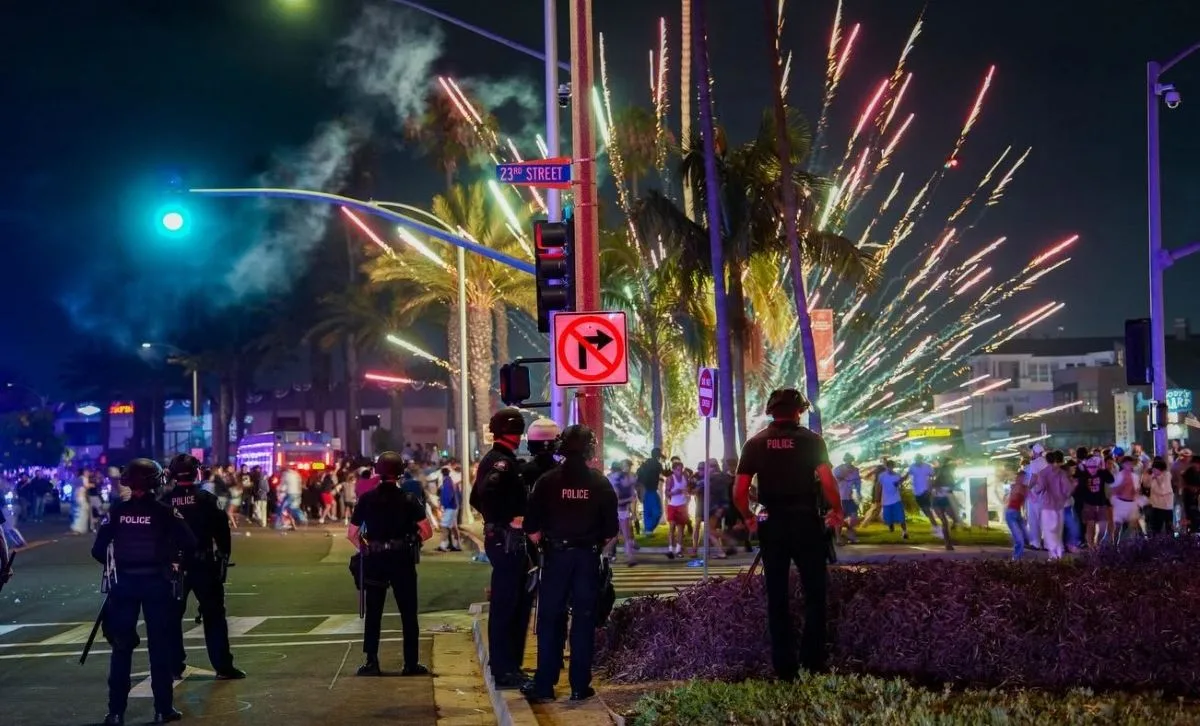
A chaotic public safety crisis unfolded on the Balboa Peninsula over the Fourth of July weekend, culminating in 402 arrests after thousands of teenagers and young adults swarmed the Newport Pier area. The Newport Beach Police Department declared an unlawful assembly late Saturday evening as crowds quickly escalated into a near-riot, blocking roadways, starting fires, and clashing with emergency responders.

A coordinated response of more than 350 officers from 17 regional law enforcement agencies moved in to disperse the unruly crowd and restore emergency access routes. In addition to the hundreds of arrests, the Newport Beach Fire Department responded to 102 emergency incidents, including 10 distinct fires. Local officials confirmed that roughly 200 of the arrests occurred at a single location near 28th Street, where individuals repeatedly refused lawful dispersal orders.
Possible Charges Faced by the Suspects
With hundreds of individuals—many of them minors from outside the local area—taken into custody, prosecutors are reviewing video footage and police reports to file formal charges. Suspects involved in the Balboa Peninsula mayhem could face a variety of serious misdemeanor and felony charges under California law:
- Refusal to Disperse / Unlawful Assembly: Violating California Penal Code 409 and 416 by remaining at the scene after an official order to clear the area was announced.
- Inciting a Riot: Under Penal Code 404.6, individuals who actively encouraged, urged, or instigated others to commit acts of violence and destruction.
- Assault on a Peace Officer: Multiple officers sustained injuries, including one struck directly by a mortar firework, which can bring felony assault charges.
- Commercial Looting and Burglary: A nearby Pavilions grocery store on West Balboa Boulevard was vandalized and looted during the height of the unrest.
- Arson and Unlawful Possession of Fireworks: Charges related to the 10 distinct fires lit throughout the area and launching dangerous commercial fireworks into crowded public spaces.
- Vandalism and Property Destruction: Aimed at individuals caught on video climbing traffic structures, shattering windows, or damaging public infrastructure.
The Trend of Social Media-Fueled “Takeovers”
The Newport Beach Police Association and Mayor Lauren Kleiman heavily attributed the sudden, overwhelming influx of out-of-town youth to viral TikTok and Instagram posts. Law enforcement experts note that social media has fundamentally altered the mechanics of civil unrest by transforming minor gatherings into massive, spontaneous “flash mobs” or “teen takeovers” within minutes.
Algorithms on platforms like TikTok push localized, high-engagement content to thousands of nearby users simultaneously, creating an intense fear of missing out (FOMO) that incentivizes youth to travel long distances to participate. When thousands of juveniles assemble without parental supervision or structured activities, anonymity in the crowd frequently lowers inhibitions, rapidly escalating peaceful beach-going into widespread lawlessness. This trend has forced Southern California law enforcement agencies to pivot from traditional reactive policing to aggressively monitoring public social media channels for early indicators of civil unrest.
Contextualizing Crime Data in Orange County
While this weekend’s events felt unprecedented to witnesses, the incident mirrors a growing local friction with social media-driven youth behavior. Newport Beach experienced a similar, albeit smaller, disruption during previous holiday weekends, prompting city leaders to pass stricter municipal codes, triple fines in “Safety Enhancement Zones,” and enact a zero-tolerance policy called “Not in Newport”. The extreme escalation this year is starkly highlighted by historical comparisons: during the exact same holiday window last year, Newport Beach police recorded only 60 arrests.
The visual magnitude of the Balboa Peninsula incident contrasts sharply with broader criminal justice trends. According to data from the California Department of Justice OpenJustice Portal, overall youth arrests across the state have declined by more than 80% over the last two decades. However, localized violent juvenile offenses in Orange County tell a different story. In early 2026, the Orange County District Attorney’s Office highlighted that violent crime arrests among local youth had doubled over a multi-year period, driving the county to secure an $8 million grant to expand juvenile diversion and parent empowerment programs. The transition from traditional juvenile delinquency to organized, viral flash-mob crime continues to challenge local budgets and regional safety strategies.
Apparently, it was trash from AZ and NV.
Now they get to return home with a criminal record!
Entitled rich kids? Sure. Anti-social TikTok trend followers? Yes. The perils of youth boredom? Absolutely. But at the same time, are we surprised? This is what happens to kids who had years of social-emotional development stolen from them by elite policymakers (who didn’t obey their own rules) to make sure nobody got covid. The repercussions of the disastrously misguided lockdown policies, especially on this lost generation, will be felt for decades. It’s no excuse, but it is an explanation that most will overlook.