For years, distracted driving campaigns have focused heavily on smartphones, texting and in-car technology. New research suggests drivers may also want to pay closer attention to something far more common: the music playing through their speakers.

Two recent studies examining the relationship between music and driving behavior found that both volume and song characteristics may influence how motorists respond behind the wheel. One study found that louder music slowed reaction times, while another identified high-energy, high-tempo songs that may encourage drivers to travel at higher speeds.
Loud Music Linked to Slower Reaction Times
A reaction-time study highlighted by Wettermark Keith found that participants consistently reacted more slowly when music was playing than when sitting in silence.
Researchers used a tactile reaction-time device rather than an actual driving simulator, allowing them to isolate the effect of volume while keeping the same song playing throughout the experiment. The goal was to determine whether loudness itself could affect response time.
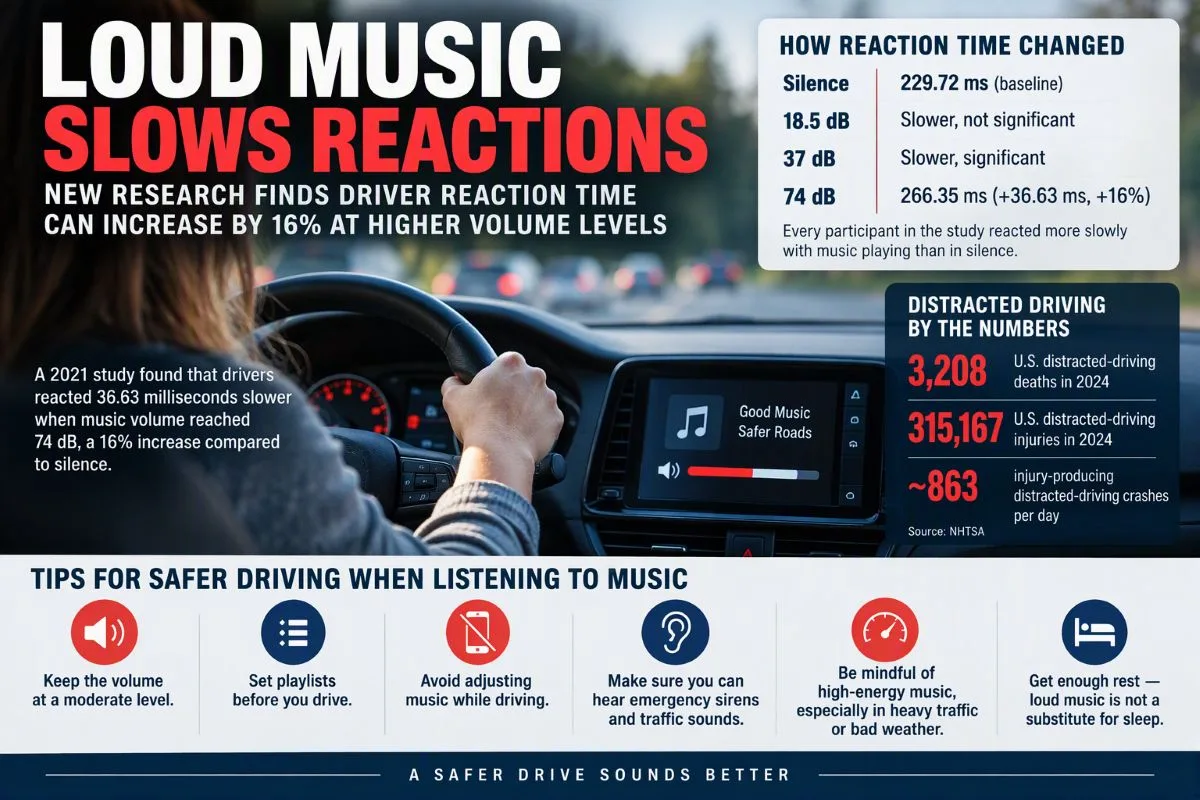
The results showed a clear pattern:
- Average reaction time in silence: 229.72 milliseconds
- Average reaction time at 74 decibels: 266.35 milliseconds
- Increase in reaction time: 36.63 milliseconds
- Overall slowdown: approximately 16%
Researchers found that reaction times increased gradually as volume rose. While music at 18.5 dB produced slower responses, the result was not statistically significant. Statistical significance emerged at 37 dB and became even stronger at 74 dB.
Reaction Time Results
- Silence: 229.72 ms
- 18.5 dB: Slower response, not statistically significant
- 37 dB: Slower response, statistically significant
- 74 dB: 266.35 ms, statistically significant, 16% slower than silence
Perhaps most notably, every one of the study’s 20 participants reacted more slowly when music was playing than when it was not.
Researchers also observed a gender difference. Female participants experienced an approximately 40-millisecond slowdown as volume increased, roughly twice the increase measured among male participants. However, the sample size was small and researchers cautioned against drawing broad conclusions from the finding.
Interestingly, the study found no consistent relationship between music volume and choice reaction time, which involves more complex decision-making. That suggests loud music may affect basic response speed more than higher-level judgment and decision-making processes.
Why Emergency Responders Are Paying Attention
The findings arrive as law enforcement agencies grapple with a growing challenge: getting drivers to notice emergency vehicles.
The Los Angeles Police Department recently began deploying Federal Signal’s low-frequency “Rumbler” siren system after officers reported that drivers were increasingly failing to detect traditional sirens in newer, better-insulated vehicles. The department has reportedly equipped 20 vehicles with the technology and plans to expand the system to approximately 100 additional vehicles.
Unlike conventional sirens, the Rumbler produces low-frequency vibrations designed to be felt as well as heard, helping warnings penetrate soundproofed vehicle cabins.
While the reaction-time study did not examine emergency vehicle detection, it points toward the same fundamental concern. If loud music delays a driver’s response to stimuli, it may further complicate the ability of police officers, firefighters and paramedics to gain motorists’ attention during emergencies.
The issue is particularly relevant given federal crash statistics. According to the National Highway Traffic Safety Administration, distracted driving was linked to 3,208 traffic deaths and more than 315,000 injuries nationwide in 2024. That equates to roughly 863 injury-producing distracted-driving crashes every day.
NHTSA’s definition of distracted driving includes not only cellphone use but also adjusting a vehicle’s stereo or entertainment system.
The Songs Most Likely to Encourage Speeding
A separate 2026 report from The Law Firm of Aaron A. Herbert examined 45 popular songs and ranked them according to factors associated with speeding behavior.
Researchers evaluated:
- Song tempo (beats per minute)
- Spotify energy ratings
- Song length
- Popularity indicators such as chart performance and YouTube views
The report concluded that Mr. Brightside by The Killers ranked as the song most likely to encourage speeding. The track combines a high-energy profile with a fast 148-beat-per-minute tempo and has amassed hundreds of millions of online views.
The study’s top 10 songs included:
- Mr. Brightside – The Killers
- Beat It – Michael Jackson
- Drop Dead – Olivia Rodrigo
- Smells Like Teen Spirit – Nirvana
- Die With a Smile – Lady Gaga & Bruno Mars
- Locked Out of Heaven – Bruno Mars
- Choosin’ Texas – Ella Langley
- September – Earth, Wind & Fire
- Bad Habit – Steve Lacy
- Feel Good Inc. – Gorillaz
Several songs on the list feature tempos exceeding 140 beats per minute, with Steve Lacy’s Bad Habit leading the group at 169 BPM.
According to the report, songs above 130 BPM have long been associated with increased driver arousal, while music closer to 120 BPM tends to correspond with steadier driving speeds.
Aaron Herbert argued that modern streaming platforms may amplify the issue by grouping high-energy tracks together in playlists, potentially creating extended periods of elevated stimulation during commutes.
Music, Mood and Driving Behavior
Taken together, the two studies point toward a broader conclusion: what drivers hear and how loudly they hear it may influence behavior behind the wheel.
The reaction-time research suggests loud volume alone can measurably slow a person’s response speed, even when the song itself never changes. Meanwhile, the speeding study points to tempo and energy as factors that could influence how fast drivers travel.
Neither study proves that a specific song or volume level directly causes crashes. The reaction-time research did not involve real-world driving, and the speeding report measured risk factors rather than actual collision outcomes. Even so, both studies add to a growing body of research suggesting that the in-car listening environment deserves more attention from traffic-safety experts.
For drivers, the takeaway may be simple: the playlist making a commute more enjoyable could also be subtly affecting reaction times, awareness and driving behavior in ways many people never consider.
Tips for Safer Driving When Listening to Music
While the studies do not suggest that drivers should stop listening to music altogether, they do highlight ways motorists can reduce potential distractions behind the wheel:
- Keep the volume at a moderate level so you can hear emergency sirens, vehicle horns and other traffic sounds.
- Avoid constantly adjusting playlists, streaming apps or stereo controls while driving.
- Consider using preset playlists before starting a trip rather than searching for songs on the road.
- Be mindful of high-energy music on busy roads, in heavy traffic or during poor weather conditions.
- Lower the volume when approaching intersections, construction zones or areas with pedestrian activity.
- If you’re feeling tired, recognize that loud music is not a substitute for rest and may create a false sense of alertness.
- Use steering-wheel audio controls or voice commands when available to minimize distractions.
- As a general rule, if passengers have to raise their voices to hold a conversation, the music may be too loud.
The Bottom Line
Drivers spend countless hours selecting the perfect soundtrack for their commute, but research suggests that volume and song selection may influence more than just mood. With distracted driving continuing to claim thousands of lives each year, experts say keeping music at a reasonable volume and minimizing in-car distractions may be one of the easiest steps motorists can take to stay safer on the road.