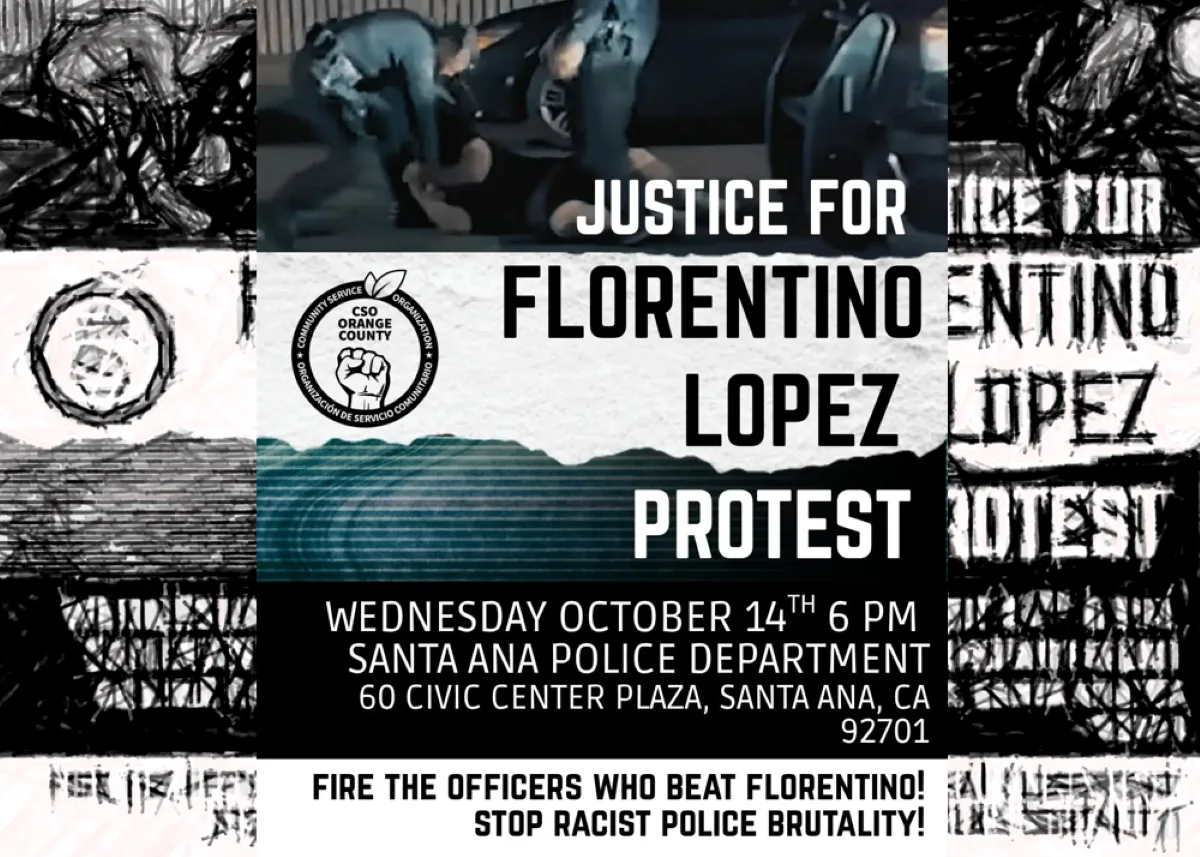
A local activist organization, Orange County CSO (Community Service Organization Orange County), has announced a protest outside the Santa Ana Police Department and is demanding the immediate firing of officers involved in the recent arrest of Florentino Lopez, an incident that was captured on video and has already prompted an internal investigation by the Santa Ana Police Department.

The group’s social media post alleges that Lopez was “complying with officers” when he was tackled and struck multiple times. The organization further characterizes the incident as part of a “pattern of racist police brutality” and is demanding that the officers involved be terminated immediately.
Those are serious allegations. They deserve serious scrutiny.
What they do not deserve is a rush to judgment before all the facts are known.
Due Process Matters for Everyone
The central problem with demands to immediately fire police officers before a formal investigation is completed is that such demands reject the very concept of due process.
In America, due process is not reserved only for criminal defendants. It is a principle that applies broadly whenever serious accusations are made against individuals. Police officers, like anyone else, are entitled to a fair review of the evidence before punishment is imposed.
The viral video that sparked public outrage captures only a portion of the encounter. Investigators must review all available evidence, including:
- Body-worn camera footage
- Dash camera video
- Witness statements
- Police reports
- Dispatch records
- Medical reports
- Any evidence regarding suspect actions before the video began
A short video clip circulating on social media rarely tells the entire story.
History provides countless examples where initial public perceptions changed dramatically after investigators reviewed complete evidence. That is precisely why professional investigations exist.
The Danger of Trial by Social Media
Social media activism often rewards speed rather than accuracy.
Organizations seeking to mobilize supporters frequently present complex incidents as clear-cut cases of villain versus victim. The result is that public opinion can become hardened before investigators have even begun gathering evidence.
When activists declare officers guilty before an investigation has concluded, they create expectations that may be impossible to satisfy if the evidence later reveals a more nuanced reality.
If investigators ultimately find that officers acted within policy, many people who have already been told that a racist assault occurred may conclude the system is corrupt rather than reconsider their assumptions.
That dynamic damages public confidence in institutions while making constructive dialogue increasingly difficult.
Claims of Racism Require Evidence
Orange County CSO’s statement characterizes the incident as “racist police brutality.”
Such accusations should never be made lightly.
Racism is a serious allegation that requires evidence. At present, there has been no public finding by investigators that race played any role in this incident.
Making definitive claims about racial motivation before an investigation is complete risks inflaming community tensions and encouraging people to reach conclusions unsupported by verified facts.
If evidence ultimately supports allegations of racial bias, that evidence should be presented publicly and acted upon decisively. If no such evidence exists, then premature accusations may unfairly damage reputations and community relationships.
Activism and Public Perception
Community advocacy organizations play an important role in a free society. They can bring attention to potential abuses, advocate for transparency, and demand accountability from government agencies.
However, there is a distinction between calling for an investigation and declaring guilt.
Calls for transparency and accountability are reasonable.
Calls for immediate termination before investigators have completed their work raise legitimate questions about whether the objective is fact-finding or political mobilization.
Organizations that consistently frame police encounters through a predetermined ideological lens may generate public attention, recruit supporters, and strengthen their own visibility. Yet such approaches can also deepen divisions between communities and law enforcement agencies.
When rhetoric assumes misconduct before facts are established, it becomes more difficult to distinguish genuine cases of misconduct from incidents where officers acted lawfully under challenging circumstances.
Why Public Confidence in Law Enforcement Matters
Public trust in law enforcement is essential to community safety.
Police officers rely on community cooperation to investigate crimes, locate suspects, identify witnesses, and protect neighborhoods. When confidence in law enforcement is unnecessarily eroded, everyone suffers.
That does not mean police departments should be shielded from criticism.
To the contrary, public trust is strengthened when departments conduct thorough investigations, release facts when appropriate, and hold officers accountable if wrongdoing occurred.
But confidence is undermined when public campaigns assume guilt before evidence has been thoroughly reviewed.
Communities benefit from accountability.
They also benefit from fairness.
Both principles can coexist.
The Better Approach
The appropriate response to the Santa Ana incident is neither blind support for the officers nor automatic acceptance of activist allegations.
The better approach is straightforward:
- Allow the investigation to proceed.
- Review all available evidence.
- Release findings to the public when appropriate.
- Hold anyone accountable if misconduct occurred.
- Avoid conclusions unsupported by verified facts.
The viral video involving Florentino Lopez raises legitimate questions that deserve answers. The Santa Ana Police Department’s investigation should provide those answers.
Until then, demands to fire officers based solely on partial information risk replacing due process with public pressure and speculation. In a society governed by facts and fairness, neither should determine the outcome before the investigation is complete.
Sybau they don’t give people due process so why should we give the cops due process? We should start treating cops how they treat regular people.
Yeah this one’s pretty bad no matter the context. Release the body cam immediately maybe then I’d side with you. Those two are gonna get paid leave for a long time, what a shame. I think the racism is a woke stretch assuming all 3 are hispanic.