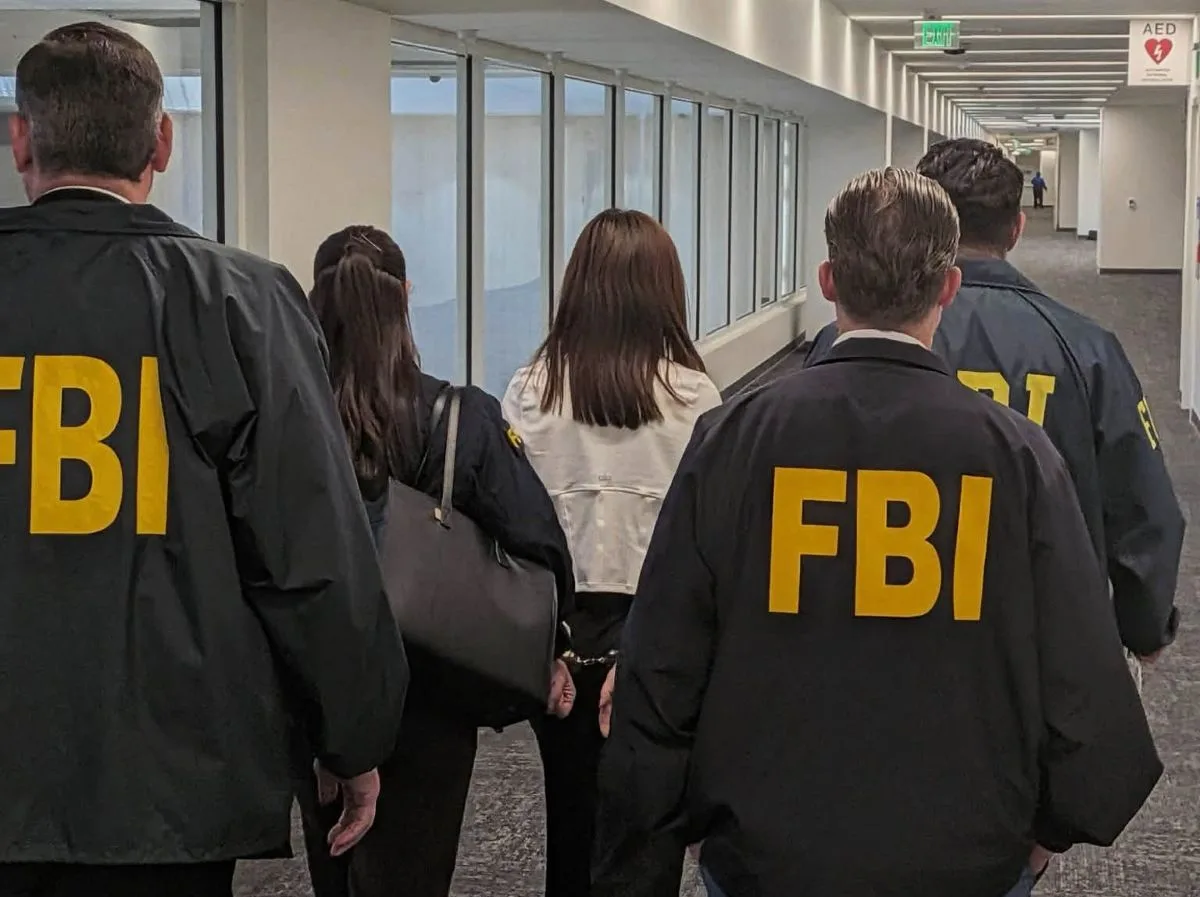
The FBI’s arrest of Wanying “Heather” Zhang, a 34-year-old Irvine real estate agent, is the latest in a growing series of national security cases involving alleged Chinese government influence and intelligence operations in California.

Federal authorities arrested Zhang at Los Angeles International Airport on October 4, 2026, as she allegedly attempted to board a flight to Shanghai.
Prosecutors accuse her of acting as an unregistered agent of the People’s Republic of China and conducting surveillance on a close relative of Taiwanese President Lai Ching-te while that individual was living in the United States.

According to the criminal complaint, Zhang allegedly traveled to the Seattle area in September 2025 at the direction of individuals she understood to be Chinese government officials.
Investigators claim she collected photographs, video footage, and vehicle license plate information relating to President Lai’s son and his family and transmitted that information to contacts connected to the Chinese government.
The FBI says it recovered communications from Zhang’s iCloud account and WeChat messages that allegedly demonstrate coordination with Chinese officials.
What Charges Is Wanying Zhang Facing?
At this stage, Zhang has been charged with acting as an unregistered agent of a foreign government under federal law. Prosecutors allege she operated under the direction or control of Chinese officials without notifying the U.S. Attorney General as required by law.
It is important to note that she has not been charged with traditional espionage statutes involving classified information. Rather, the government’s current allegation is that she conducted intelligence-related activity on behalf of a foreign government while failing to register properly.
Like all criminal defendants, Zhang is presumed innocent unless and until proven guilty in court.
What Sentence Could She Face?
The federal statute commonly used in these cases, 18 U.S.C. § 951, carries a maximum penalty of 10 years in federal prison, plus fines, if a defendant is convicted. Actual sentences often depend on factors such as:
- The sophistication of the operation
- Whether the defendant knowingly worked for a foreign intelligence service
- The extent of coordination with foreign officials
- Obstruction of justice considerations
- Criminal history
- Whether additional charges are later filed
Federal judges are not required to impose the statutory maximum. If convicted solely on the currently reported charge, the sentence could be substantially lower than 10 years, though the maximum exposure remains significant.
The Last Five Major China-Related California Arrests and Cases
While cases vary widely in seriousness and facts, the following California-based matters have received substantial attention:
- Wanying Zhang (2026): Arrested at LAX and accused of surveilling the Taiwanese president’s son on behalf of Chinese officials.
- Eileen Wang, former Arcadia mayor (2026): Pleaded guilty to acting as an illegal agent for the Chinese government and promoting pro-Beijing messaging inside the United States, according to federal authorities.
- San Gabriel AI chip smuggling case (2026): Federal authorities charged an individual with helping export advanced artificial-intelligence chips to China in violation of U.S. restrictions. While not a classic spy case, officials viewed the matter as a significant national security concern.
- John Wayne Airport passport fraud arrests (2026): Two Chinese nationals were arrested in Orange County and accused of using stolen U.S. passports. Authorities treated the matter as a separate federal security investigation.
- Numerous Southern California technology-theft and foreign-agent investigations (2025-2026): Federal authorities continue to pursue cases involving alleged export-control violations, technology transfer schemes, and undisclosed foreign-government activities tied to China.
Why Does California See So Many Chinese Espionage Cases?
California occupies a unique position in the strategic competition between the United States and China.
Several factors make the state particularly attractive to intelligence services:
- Silicon Valley contains many of the world’s most advanced technology companies.
- Southern California hosts major aerospace and defense contractors.
- Multiple research universities conduct cutting-edge scientific work.
- California has extensive trade and business ties with China.
- Large international travel flows provide opportunities for intelligence collection.
- Significant Chinese-language business and community networks create opportunities for both legitimate engagement and, in some cases, influence operations.
Federal agencies have repeatedly warned that Chinese intelligence services do not rely solely on traditional spies. They often seek information through business relationships, academic partnerships, technology acquisition efforts, talent recruitment programs, influence operations, cyber activity, and surveillance of dissidents or political targets.
Is Chinese Espionage Actually Increasing?
There is strong evidence that U.S. officials believe Chinese intelligence activity has become a larger counterintelligence challenge during the past decade. FBI directors from both political parties have repeatedly described China as one of the most significant long-term espionage threats facing the United States. The growing focus on semiconductors, artificial intelligence, defense technology, and Taiwan has heightened concerns.
However, it is important to distinguish between two possibilities:
- There may be more espionage and influence activity occurring.
- Law enforcement may also be detecting and prosecuting more cases than in previous years.
Both factors can contribute to the appearance of an increasing trend. The exact amount of undetected espionage is impossible to measure publicly.
What Should Politicians Be Doing?
A practical policy response should focus on national security while avoiding discrimination against people based on ethnicity or national origin.
Potential policy priorities include:
- Expanding FBI and counterintelligence resources.
- Strengthening enforcement of foreign-agent registration laws.
- Increasing scrutiny of foreign-government influence campaigns.
- Protecting universities and research institutions from intellectual-property theft.
- Tightening export controls involving advanced technologies.
- Enhancing cybersecurity requirements for critical industries.
- Improving state and local government training on foreign influence operations.
- Expanding protection for dissidents and foreign political targets living in the United States.
- Coordinating more closely with allies such as Taiwan, Japan, Australia, and South Korea.
The challenge for policymakers is balancing security with civil liberties. Aggressive enforcement against unlawful foreign-government activity must be paired with protections for lawful business, academic exchange, immigration, and free speech.
Final Thoughts
The arrest of Wanying Zhang represents another high-profile example of the growing confrontation between the United States and China in the intelligence arena. Prosecutors allege that what appeared to be an ordinary California real-estate professional was actually conducting surveillance for Chinese officials targeting a family member of Taiwan’s president. Whether those allegations are ultimately proven remains for the courts to decide. What is beyond dispute is that California has become one of the primary battlegrounds in the broader competition among technology, politics, national security, and foreign influence operations.