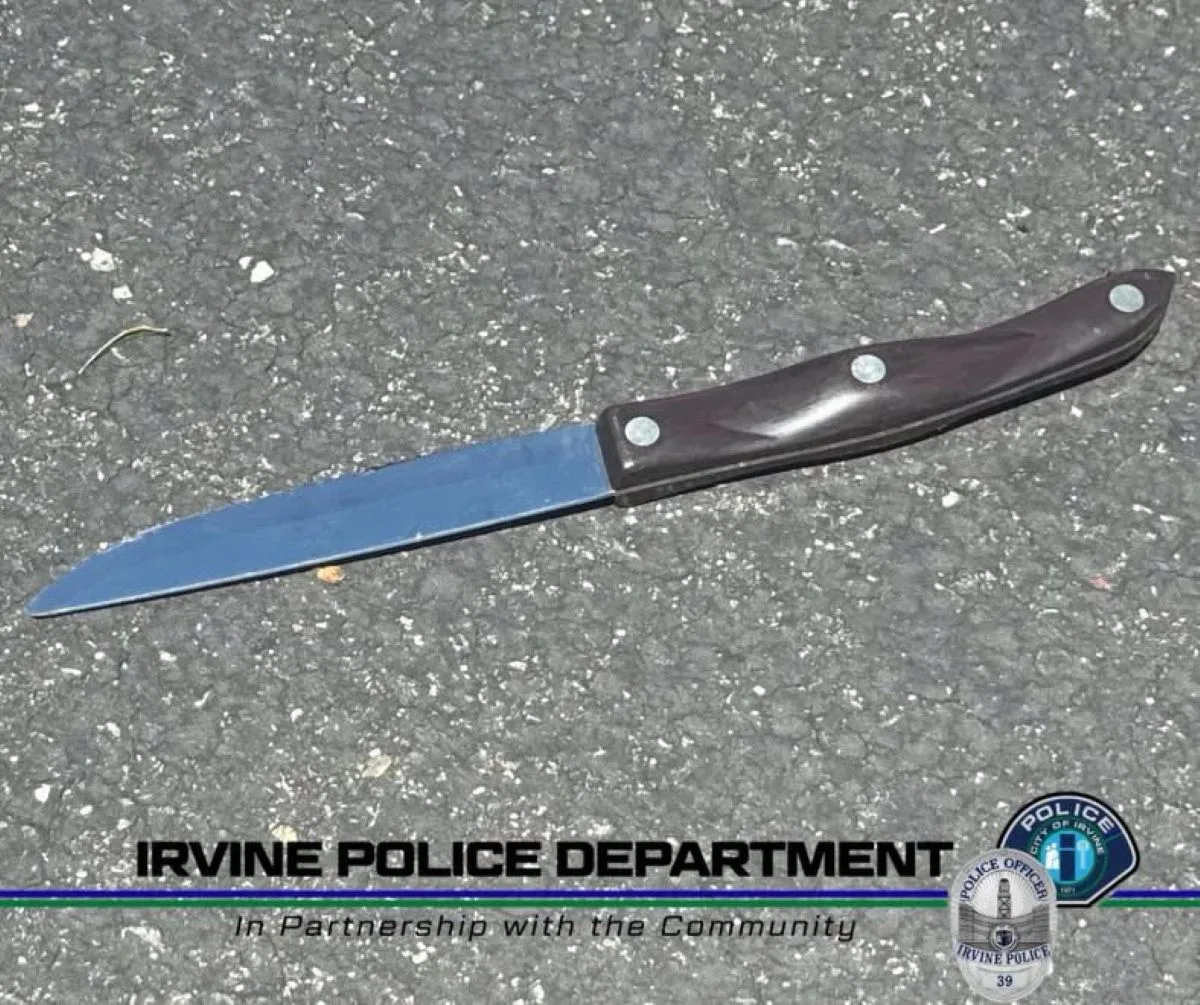
A psychiatric crisis turned fatal in Irvine when a man armed with a knife was shot and killed by law enforcement. The Irvine Police Department (IPD) confirmed that the incident began around 11:45 a.m. after receiving a 911 distress call from a local resident on Evening Breeze.

The caller stated he was experiencing a severe mental health crisis and was armed with a knife outside his home. Officers from the department’s Crisis Negotiation Team (CNT) quickly located the 20-year-old man near the intersection of Sungate and Silkwood, where a tense standoff lasted for over an hour.
Despite extensive efforts by the Crisis Negotiation Team to encourage a peaceful surrender, the situation escalated rapidly. Positioned nearby were emergency personnel from the Orange County Fire Authority (OCFA) alongside the Irvine Community Alternative Response and Engagement Team (I-CARE)—a specialized mobile unit designed to deploy immediate medical and mental health support. According to officials, the negotiation dissolved when the young man suddenly charged at officers while holding the knife. An officer opened fire, striking the man. Law enforcement personnel immediately administered life-saving measures at the scene before paramedics transported him to a local hospital, where he was later pronounced dead. The identity of the deceased resident is being withheld pending family notification, and a concurrent investigation is being led by the Orange County District Attorney’s Office.
Contextualizing Officer-Involved Shootings in Orange County
While Irvine is frequently recognized as one of the safest cities in America, officer-involved shootings (OIS) linked to psychological distress are an ongoing challenge across Southern California. Historically, the Orange County District Attorney’s Office Officer-Involved Shooting Reports processes roughly 10 to 15 law enforcement shooting investigations annually, varying across different municipal departments. Nationwide trends compiled in the Police Violence Report reveal that a notable percentage of individuals killed during police interactions exhibit clear indicators of mental illness or substance dependency. Recent local examples further underscore the frequency of these high-stakes escalations:
- A deadly encounter occurred when a pursuit involving an armed domestic violence suspect culminated in a fatal shooting by police.
- In another incident, a man wielding a sharp object or knife was fatally shot by officers in Glendale following a failed de-escalation attempt.
- Law enforcement handled a separate tragic outcome in Fullerton, where a highly erratic suspect was fired upon near a public station.
Evaluating the Justification and the Dilemma of Split-Second Standoffs
Determining whether this officer-involved shooting was legally justified relies on the established legal doctrine of “objective reasonableness.” Under California law, law enforcement officers are legally permitted to utilize deadly force if they possess an honest and reasonable belief that they or nearby bystanders face an imminent threat of death or serious bodily injury. From the initial facts reported by the Irvine Police Department, the shooting appears to align with standard criteria for a justified action. Officers explicitly spent more than an hour attempting non-lethal de-escalation alongside mental health professionals. When an individual armed with a deadly weapon actively charges at personnel, the window for non-lethal options closes instantly, leaving officers with virtually no alternative to protect their own lives.
However, public scrutiny often arises from grieving loved ones. In this specific case, local coverage from the Orange County Register noted that the young man’s father expressed deep pain, believing the pocket or kitchen knife his son carried did not pose an existential threat to heavily protected officers. This highlights the immense difficulty police face during specialized containment operations. Officers must make life-or-death decisions in fractions of a second. A knife can close a 21-foot distance in less than two seconds, meaning a blade remains a highly lethal instrument regardless of its precise manufacturing or size. Balancing public safety, personal survival, and compassion for an individual trapped in a psychological break places a profound emotional and tactical burden on first responders.
Alternative Crisis Options for Families Experiencing Mental Health Emergencies
When a family member undergoes a severe behavioral or psychological emergency, calling 911 often introduces an authoritative presence that can inadvertently escalate panic. Families looking to bypass a standard police dispatch have several dedicated, healthcare-centric alternatives available:
- The 988 Suicide & Crisis Lifeline: Dialing or texting 988 Lifeline connects individuals immediately to trained mental health professionals who specialize in verbal de-escalation and emotional support.
- Mobile Crisis Response Teams (MCRT): Most regions throughout Southern California feature county-funded, non-law-enforcement medical teams that can be dispatched directly to a residence to assess and stabilize a psychiatric emergency safely.
- National Alliance on Mental Illness (NAMI) Programs: Utilizing peer support networks and guidance via NAMI Orange County can help families map out preventative crisis intervention plans before a breakdown escalates to violence.
- Direct Emergency Room Transport: If a loved one is cooperative but highly unstable, transporting them directly to a county behavioral health facility or hospital emergency room ensures immediate medical containment without police involvement.