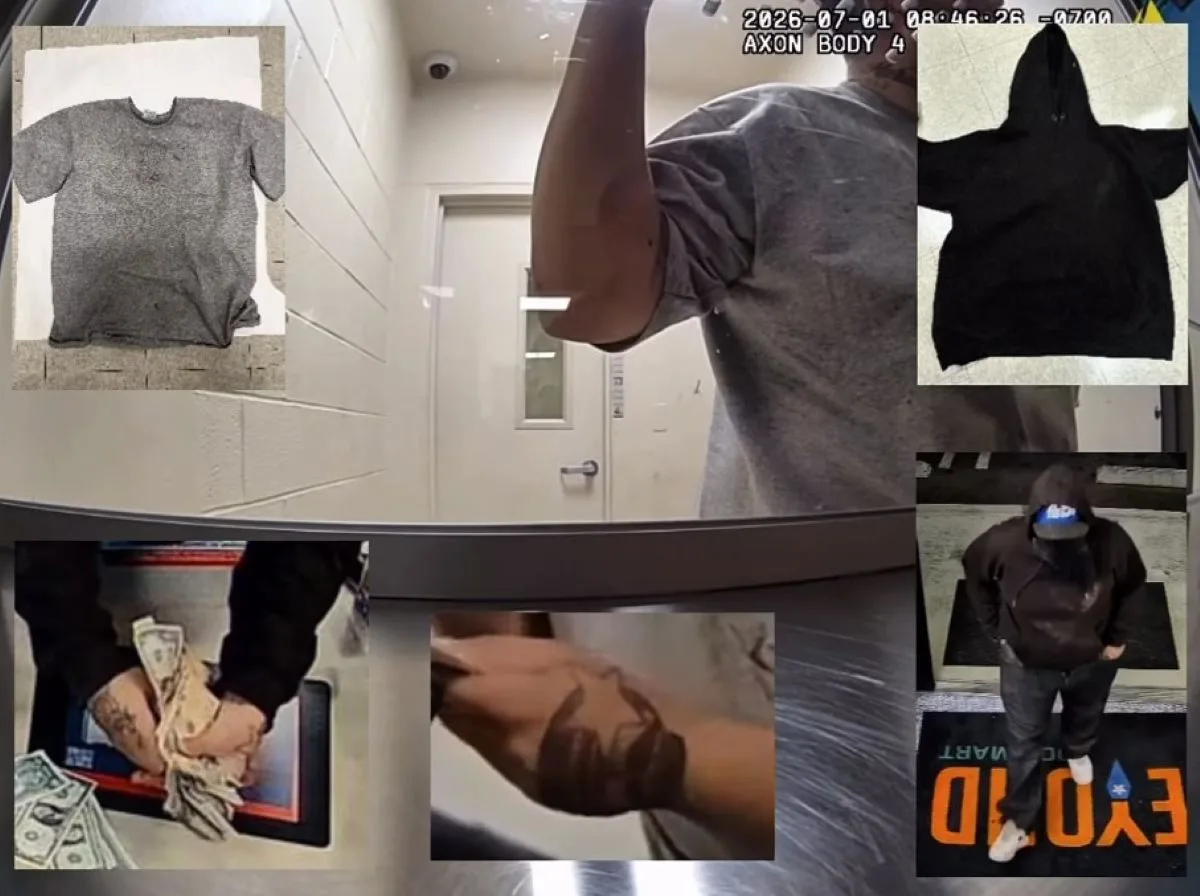
A local gas station robbery came to a swift conclusion after the Orange Police Department capitalized on distinct visual evidence to track down and apprehend a suspect within a matter of hours.

The incident began when Isaac Montoya allegedly targeted a neighborhood fuel station. Unbeknownst to the suspect, multiple surveillance and police body worn cameras captured his physical build, matching garments, and distinctive ink markings.
Officers recognized his unique hand tattoos from the visual logs, allowing the department’s dedicated Bike Team to trace his whereabouts quickly and place him under arrest.
The District Attorney’s Office has officially filed robbery charges against Montoya, who currently remains in law enforcement custody.
Potential Legal Charges and Heavy Penalties
Suspects who pull off gas station hold-ups face serious prosecution under state regulations. In California, a gas station stick-up is prosecuted as a felony under California Penal Code Section 211 (PC 211). Because the offense takes place at a commercial business rather than an inhabited dwelling or public transit vehicle, it is classified as second-degree robbery.
- State Prison Sentence: Under California Penal Code Section 213, a conviction for second-degree robbery carries a standard prison sentence of two, three, or five years in state custody.
- Maximum Fines: Convicted individuals face substantial court-ordered restitution penalties and government fines reaching up to $10,000.
- The Three Strikes Law: Robbery is designated as both a serious felony and a violent crime under California law. A conviction permanently adds a “strike” to the individual’s record, which severely doubles future sentencing guidelines.
- Loss of Constitutional Rights: Felony convictions result in a lifetime prohibition against owning or possessing firearms in the state.
- Sentencing Enhancements: If a suspect brandishes or uses a deadly weapon, or targets multiple locations, they face separate commercial burglary charges under California Penal Code Section 459 and weapon enhancements that add up to 10 additional mandatory years to the prison term.

Orange County Retail Crime and Robbery Trends
While Orange County generally maintains lower violent crime figures than neighboring metropolitan regions, local businesses remain frequent targets for commercial theft. Regional gas stations and late-night convenience storefronts are uniquely vulnerable to quick-strike burglaries, cash-box grabs, and ATM smash-and-grabs. State monitoring groups, including the Public Policy Institute of California (PPIC), report that commercial robbery and organized retail thefts have faced an upward trajectory across multiple parts of the state over the last several years.
This shifting dynamic has caused the Orange County Sheriff’s Department and local police units to pool resources, crack down on serial multi-city offenders, and strengthen direct communication partnerships with commercial retail managers.
Hardening Gas Stations to Prevent Commercial Heists
Service stations can implement several layout and infrastructure modifications to minimize their appeal to criminals.
- Maintain interior and exterior illumination systems to eliminate blind spots near pumps, dumpsters, and alleyways.
- Angle high-resolution security lenses at cash registers, entrance thresholds, and vehicle lanes to record facial features and license plate combinations clearly.
- Minimize large storefront advertisement decals to keep the cash wrap area completely visible from passing patrol cars outside.
- Drop cash into a time-delay secure drop box frequently to ensure registers hold minimal paper currency at any given time.
- Place clear decal signs at doors stating that employees cannot open safes and that surveillance networks are streaming to remote servers.
Essential Safety Training for Convenience Staff Members
Store operators must provide specialized situational training to keep frontline personnel safe during emergency events.
- Teach cashiers to comply immediately with commands during a dynamic robbery rather than arguing or attempting a physical intervention.
- Instruct staff to prioritize personal safety and observe physical markers, including speech patterns, apparel brands, distinct scars, and tattoos.
- Train workforce teams to handle cash drawers calmly and minimize unexpected movements that a desperate suspect could mistake for a counter-attack.
- Mandate proper cash-handling procedures, ensuring workers know how to use drop-safes and never count bulky currency stacks near open counters.
- Establish clear immediate-reporting protocols so that employees contact dispatch lines immediately after a suspect flees, protecting physical evidence until officers arrive on scene.