California Attorney General Rob Bonta announced a major settlement agreement with Paramount that resolves the antitrust concerns at the center of the state’s case and secures binding, court‑enforceable guardrails to protect competition, consumer choice and California’s film workforce.

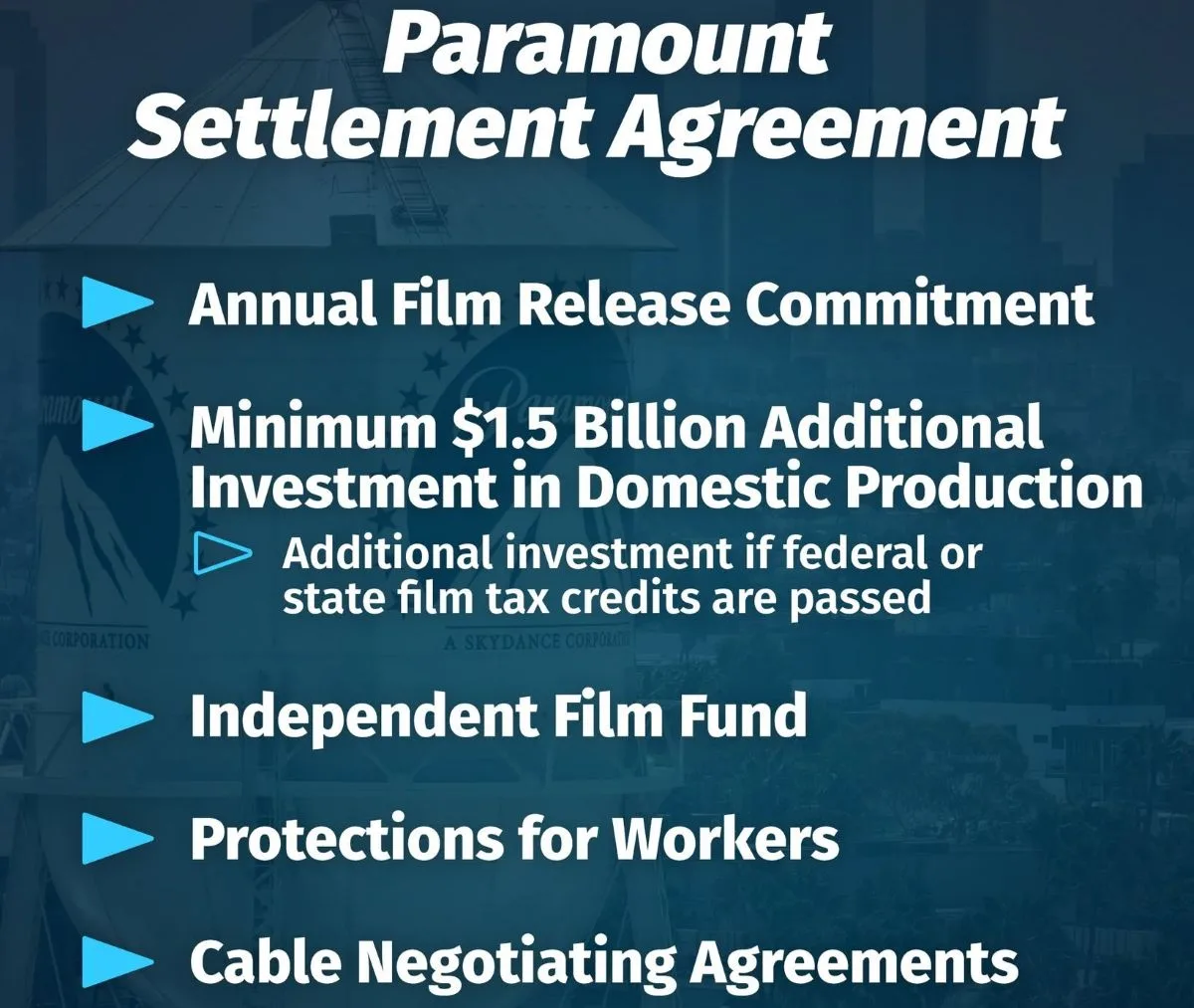
The agreement requires Paramount to maintain consistent annual film output and invest a minimum of $1.5 billion in domestic film production, with additional investment triggered if federal or state film‑tax‑credit expansions pass. Bonta said his office repeatedly heard from the people most affected by the proposed merger that what mattered most was predictable film output, domestic production and job protection. The settlement directly addresses those concerns and prevents the kind of consolidation‑driven production decline that could have harmed workers across the state.
Key Terms of the Settlement
- Annual film release commitment to stabilize output for theaters, streamers and workers.
- Minimum $1.5 billion additional investment in domestic film production.
- Additional investment if federal or state film‑tax‑credit legislation passes.
- Independent film fund to support non‑studio creators and expand job opportunities.
- Worker‑protection provisions to prevent offshoring and safeguard below‑the‑line jobs.
- Cable negotiating agreements designed to preserve consumer choice and competitive distribution.
How Many California Jobs Were at Risk
Paramount’s California footprint is large enough that any reduction in film output or shift of production out of state would have had statewide consequences. Industry data shows that each major studio film supports roughly 300–500 crew jobs, plus thousands of vendor and contractor roles. California’s film and TV sector supports more than 700,000 jobs statewide when counting direct, indirect and induced employment. If Paramount had reduced its California production slate, the ripple effects could have jeopardized tens of thousands of jobs across unions, freelancers, vendors and small businesses that rely on consistent studio spending. The settlement’s guardrails are designed to prevent that outcome by locking in film output and domestic investment.
Orange County Impact
Although the major studios sit in Los Angeles County, Orange County carries a significant share of Southern California’s film‑adjacent workforce. Thousands of OC residents work in lighting, grip, set construction, costuming, transportation, post‑production and location services.
A major studio reducing output can eliminate hundreds of crew jobs per film, and those losses would be felt directly in OC’s labor pool. OC cities such as Santa Ana, Anaheim, Huntington Beach, Laguna Beach and Newport Beach regularly host film shoots. Each shoot injects tens of thousands of dollars into local hotels, restaurants, equipment rentals, security services and city permitting.
A sustained drop in Paramount’s California production could have reduced this spending and harmed local businesses. The settlement’s requirements for consistent film output and domestic production stabilize the pipeline that OC workers depend on. It protects OC‑based crew members, preserves location‑shoot revenue for OC cities and prevents a slow shift of production spending to other states.
Political Stakes for AG Bonta
Because Bonta himself brought the antitrust case, any negative economic fallout tied to the merger would have been politically attributed to him. A Paramount pullback or exit would have created a high‑visibility jobs crisis that opponents could have used to argue that the AG’s actions “drove production out of California.” The risk was especially acute during a reelection cycle. Losing a major studio’s production spending would have been a headline‑level embarrassment for the state, and entertainment unions have become increasingly vocal about runaway production.
If Paramount shifted work to Georgia, New Mexico or Canada, unions and industry groups would likely have blamed state leadership for failing to protect jobs. The settlement neutralizes that risk by securing court‑enforceable guardrails, a $1.5 billion domestic‑production commitment, worker‑protection provisions and an independent film fund. These elements give Bonta a pro‑jobs, pro‑competition accomplishment to highlight while avoiding a “Hollywood exodus” narrative.
Why This Settlement Matters
The settlement protects workers, jobs and Hollywood by ensuring that Paramount maintains a robust domestic production slate. It prevents consolidation‑driven reductions in film output, preserves competition in theatrical and streaming markets and maintains consumer choice in cable and digital distribution.
For Southern California — and especially for Orange County’s large film‑adjacent workforce — the agreement provides stability, investment and protection against job loss. For Bonta, it also eliminates the political risk of a studio‑driven production decline during a reelection campaign.