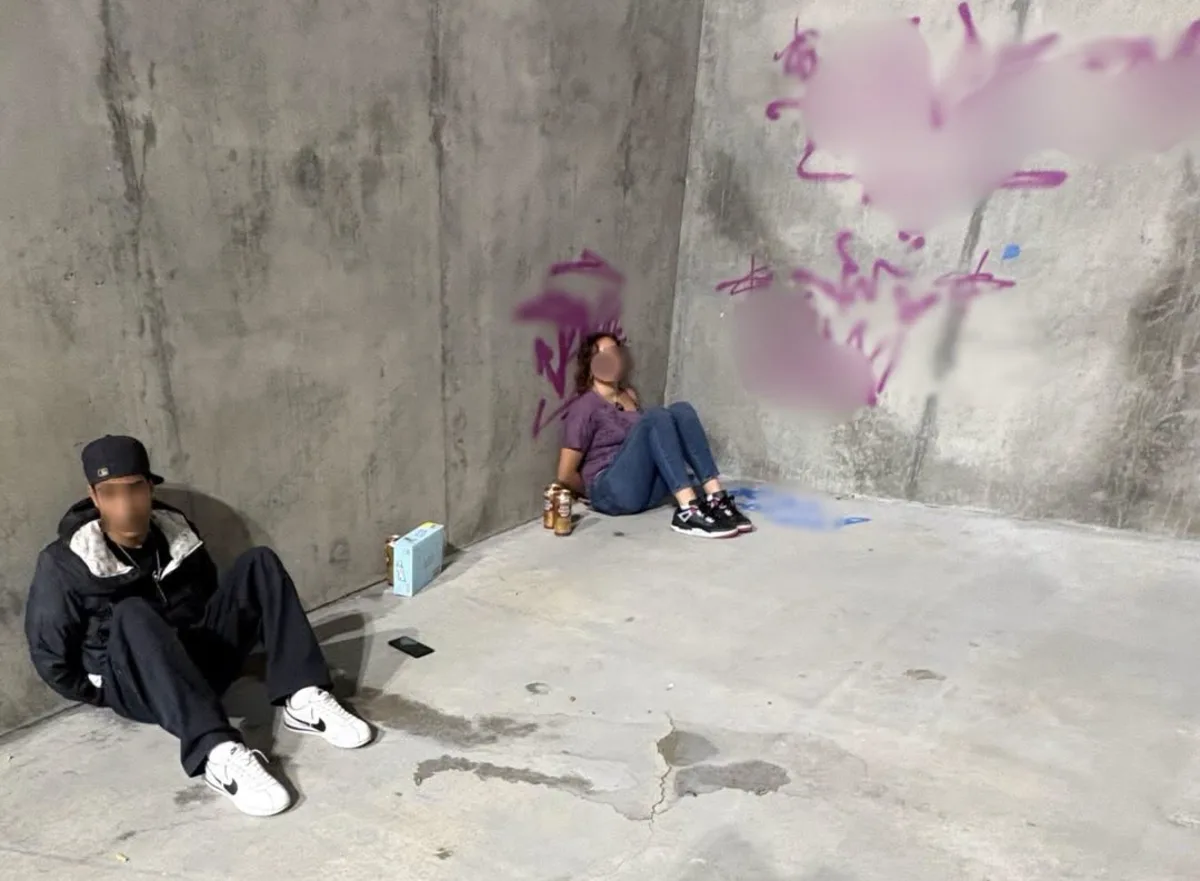
Irvine’s famously uniform neighborhoods—what locals jokingly call the “sea of beige”—were briefly interrupted last weekend when officers responded to vandalism at the handball courts on Lake.

According to the Irvine Police, officers arrived to find a freshly spray‑painted wall and two individuals sitting nearby.
The woman had a can of spray paint in her bag, and the man had one in his pocket. Juliet Angelina Bailey, 19, of Tustin, and Emiliano Aaron Pina, 22, of Irvine, were arrested at the scene for vandalism.
Possible Criminal Charges and Penalties Under California law, vandalism involving graffiti is typically charged under Penal Code §594. Depending on the value of the damage, suspects may face:
- Misdemeanor vandalism — If damage is under $400, penalties can include up to one year in county jail and fines up to $1,000.
- Felony vandalism — If damage exceeds $400, penalties may include up to three years in prison and fines up to $10,000.
- Graffiti-specific enhancements — Courts may impose additional restitution, community service, or mandatory graffiti cleanup programs.
Because both suspects were found with spray paint and next to fresh tagging, prosecutors could also pursue charges related to possession of vandalism tools if intent is established.

Impact on Career Prospects A vandalism conviction—especially a felony—can have long-term consequences. Employers routinely conduct background checks, and crimes involving property damage or disregard for public spaces can raise concerns about reliability and judgment. Young adults entering fields that require licensing, security clearance, or public trust may face additional hurdles. Even misdemeanor vandalism can appear on background checks for years, affecting job applications, rental screenings, and professional certifications.
Property Damage Trends in Orange County Graffiti remains a costly problem across Orange County. Public agencies estimate that taggers cause millions of dollars in damage annually, with Irvine alone spending hundreds of thousands each year on cleanup and repainting. Countywide, estimates often place graffiti-related damage and removal costs between $5 million and $10 million per year, depending on the volume of incidents and the cost of rapid abatement programs.
Despite the financial impact, only a fraction of taggers are ever prosecuted. Based on regional law enforcement data and municipal reporting, roughly 10–15% of graffiti incidents lead to an arrest or prosecution. The majority go unsolved due to the speed of tagging, lack of witnesses, and the difficulty of identifying individuals behind masks or hoodies.
Why People Resort to Tagging Graffiti vandalism has a mix of motivations, and understanding them helps explain why it persists:
- Identity and expression — Some taggers view graffiti as a form of artistic expression or a way to build a reputation within tagging subcultures.
- Territorial marking — Certain groups use graffiti to claim space or signal presence.
- Thrill-seeking — The risk of getting caught can be part of the appeal for younger offenders.
- Social influence — Friends or tagging crews often encourage participation.
- Lack of community connection — Individuals who feel disconnected from their surroundings may be more likely to damage property.
In Irvine—where neighborhoods are meticulously maintained and HOAs enforce strict aesthetic rules—graffiti stands out sharply. That contrast may be part of the appeal for taggers seeking visibility or rebellion.
Community Impact Incidents like this disrupt the sense of order Irvine is known for. Rapid response from Irvine Police and swift cleanup efforts help maintain community standards, but the financial and social costs of vandalism remain significant. As the case against Bailey and Pina moves forward, prosecutors will determine the level of charges based on the damage assessment and the circumstances of the arrest.
What group(s) tag “PSV” and “TERK” in south Orange County
Records indicate the primary group(s) that tags in South Orange County is idiots, morons, and losers who suck at life.
LOL. That’s about right!