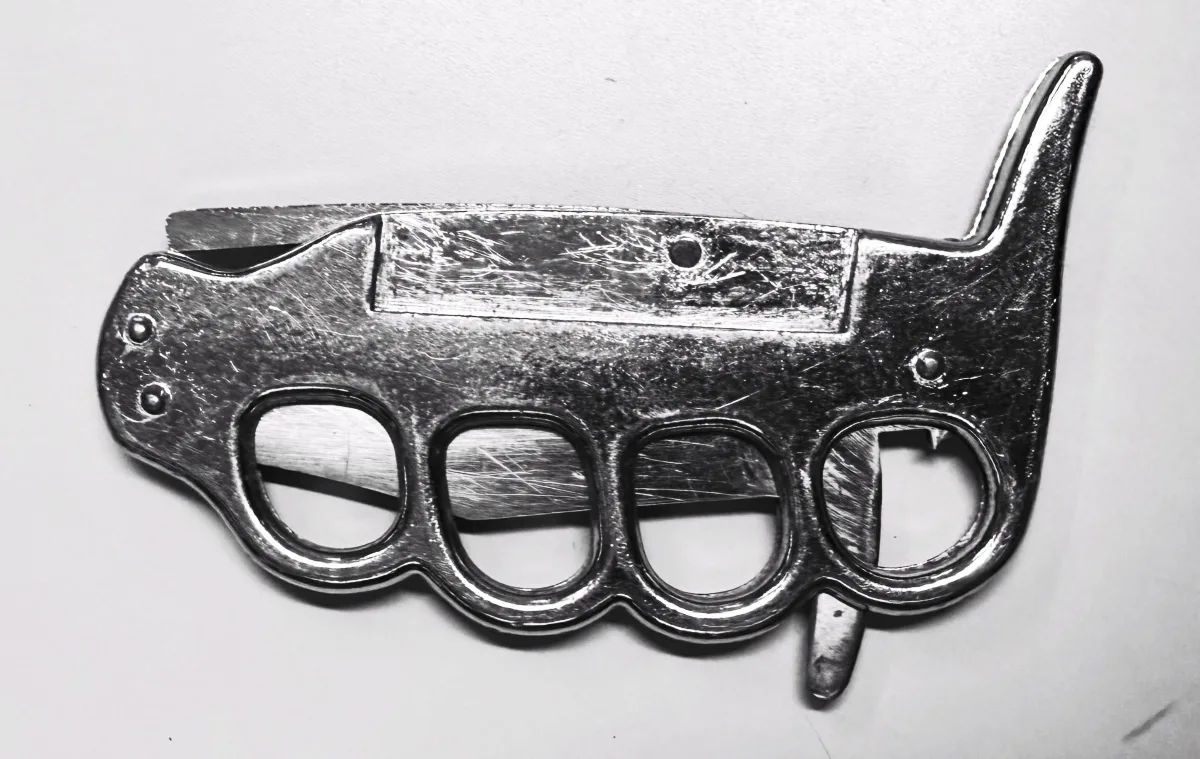
A proactive enforcement stop by the Orange County Sheriff’s Department (OCSD) North Patrol Bureau on July 13, 2026, served as a stark reminder of California’s strict stance on prohibited weapons. Deputies operating in unincorporated Orange County contacted a wanted subject who was found carrying a hidden pair of brass knuckles—integrated with a folding blade mechanism.

The individual was immediately taken into custody, facing both the new weapons offense and prior outstanding warrants. While local law enforcement prioritizes removing these items from the street to reduce violent crime, many citizens remain confused about the longevity and scope of the state’s weapon restrictions.
Metal knuckles have been outlawed in California for over a century. The ban is currently codified under California Penal Code § 21810 PC, making it entirely illegal to manufacture, import, sell, give away, or possess brass knuckles within the state.
The law applies broadly to functional designs, regardless of whether a person intends to use them maliciously. This rigid prohibition stands in ironic contrast to recent legislative shifts.
For instance, the state of California completely legalized the possession and carry of nunchaku (nunchuks) in 2019, removing a ban that had existed since the 1970s. Composite or hard plastic knuckles were also restricted under separate legislation in 2003 to close structural loopholes. Despite these nuances, traditional metallic brass knuckles remain strictly classified under Penal Code § 16590 as a generally prohibited weapon.
Understanding Potential Charges and Local Arrest Trends
Possession of brass knuckles is categorized as a “wobbler” offense in California, meaning the prosecution has the discretion to charge it as either a misdemeanor or a felony based on the suspect’s criminal history and the context of the arrest.
- Misdemeanor Charge: Can result in up to one year in a county jail and a maximum fine of $1,000.
- Felony Charge: Carries a heavier penalty of up to three years in state prison and a maximum fine of $10,000.
Because the individual arrested by the OCSD North Patrol already carried outstanding warrants, prosecutors are significantly more likely to pursue aggressive sentencing paths. Weapons violations of this nature are consistently monitored by local authorities. Across the broader landscape of Orange County, hundreds of prohibited weapons arrests take place annually, often discovered during routine traffic stops or proactive community policing initiatives. While overall violent crime across Southern California has seen downward shifts over the last five years, localized enforcement remains highly focused on specialized weapon recovery to prevent bodily injury.
Civil Lawsuits and Personal Insurance Repercussions
The criminal penalties associated with carrying brass knuckles represent only a portion of the total liability an individual faces. Using a metal weapon to beat or strike another person guarantees severe civil consequences alongside felony assault charges. Victims of violent crimes routinely file personal injury or general liability lawsuits to recover damages for medical expenses, lost wages, permanent disfigurement, and emotional distress.
Furthermore, anyone counting on their personal insurance policy—such as homeowners or renters insurance—to cover their legal defense or pay out a settlement will face immediate rejection. Standard personal lines insurance policies feature strict intentional acts exclusions. Because slipping on brass knuckles and striking an individual is a deliberate, inherently harmful action, insurance companies will deny coverage entirely. The attacker is left exposed to complete financial responsibility, meaning personal assets, future wages, and savings can be seized or garnished to satisfy a civil judgment.
Legal Self-Defense Standards in California
Understanding how to legally protect yourself in California requires a clear grasp of the state’s self-defense laws, which are rooted in California Criminal Jury Instructions (CALCRIM) No. 3470. Under California law, a person is justified in using force in self-defense if they reasonably believe they are in imminent danger of suffering bodily injury or being touched unlawfully. The amount of force used must be strictly proportional to the threat; you can only use the amount of force reasonably necessary to defend against that danger. Crucially, California recognizes the “Stand Your Ground” principle, meaning you do not have a legal duty to retreat from an attacker and can stand your ground to defend yourself, even if safety was achievable by running away. However, once the immediate threat has passed, the legal justification for using force ends instantly.
Permitted Weapons and Equipment for Personal Protection
While objects like brass knuckles, hidden blades, and batons are strictly banned, California allows citizens to carry specific non-lethal tools for personal safety.
- Pepper Spray and Tear Gas: Legally permitted for self-defense if the canister contains 2.5 ounces or less of active product. Buyers must be at least 18 years old and have no felony convictions.
- Stun Guns and Tasers: Generally legal to purchase and carry openly or concealed for self-defense purposes. They are restricted for convicted felons, individuals with drug addictions, and minors.
- Nunchaku (Nunchuks): Entirely legal to possess and carry in public following a legislative reversal in 2019.
- Folding Knives: Pocketknives and Swiss Army knives with folding blades can be carried in a closed position without blade length restrictions under state law. However, local city or county ordinances (such as those in specific Orange County municipalities) may enforce strict length limits in public spaces.