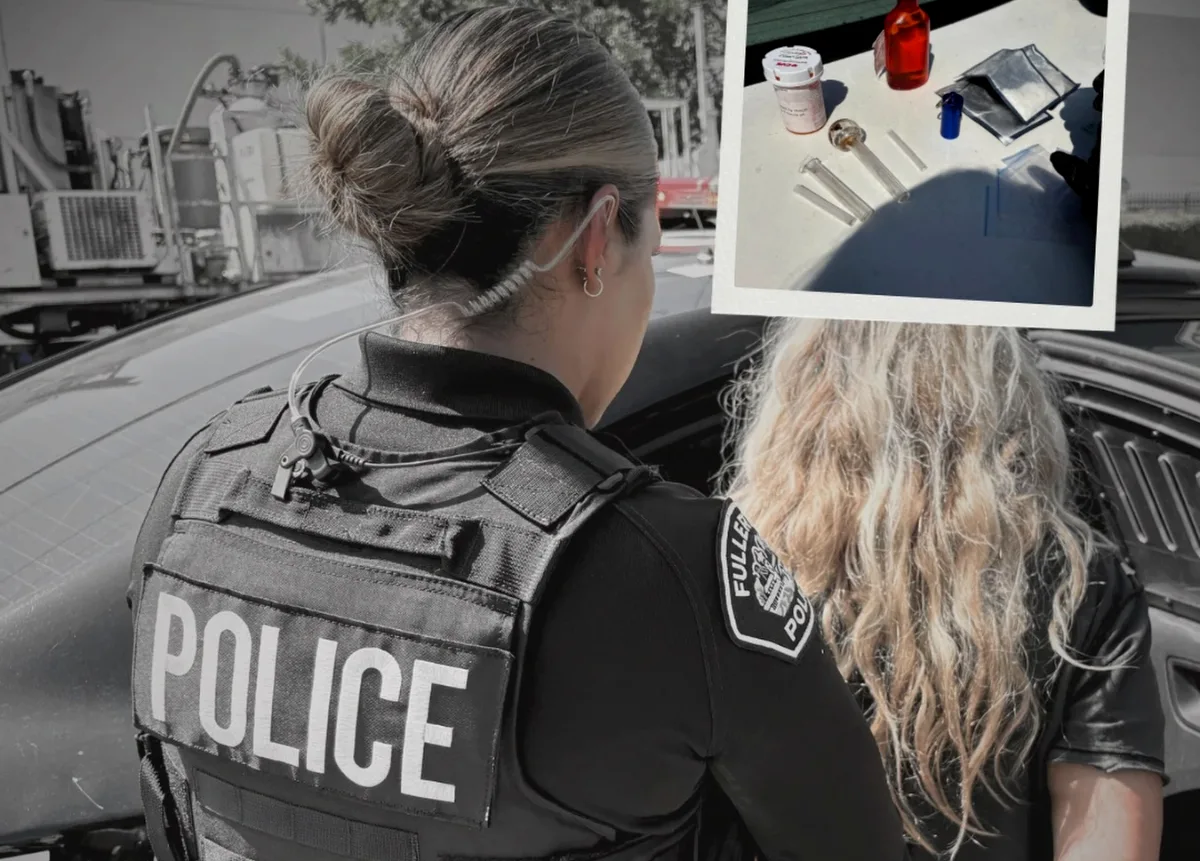
A day watch police officer was patrolling the area of S. State College and E. Orangethorpe when she conducted a traffic stop on a vehicle, according to the Fullerton Police Department.
The stop led to the arrest of a male with an outstanding warrant and ultimately resulted in two adults being taken into custody.
Both were booked on multiple misdemeanor and felony drug-related charges.
Potential Felony Penalties
Felony charges are typically reserved for possession with intent to sell, transportation, or manufacturing of controlled substances.
- Possession for Sale (HS 11351/11378): Conviction for possessing narcotics like cocaine, heroin, or methamphetamine with intent to sell generally carries 2, 3, or 4 years in county jail or state prison.
- Transportation or Sales (HS 11352): Selling or transporting controlled substances is a more serious felony, punishable by 3, 4, 5, 6, or 9 years in prison, depending on the quantity and whether the drugs were moved across non-contiguous counties.
- Aggravated Factors: If the suspects were in possession of a firearm or if the offense occurred near a school, they could face significant “enhancements” adding several years to their base sentence.
McCready Law Group +4
Potential Misdemeanor Penalties
Misdemeanor charges often apply to simple possession for personal use or possession of drug paraphernalia.
- Simple Possession (HS 11350/11377): Under Proposition 47, most personal-use possession is a misdemeanor punishable by up to 1 year in county jail and/or a fine of up to $1,000.
- Drug Paraphernalia: Possession of items like pipes or needles is a misdemeanor that can lead to up to 6 months in jail and a fine.
California Legislative Information (.gov) +2
Additional Consequences
- Outstanding Warrants: The male suspect with an outstanding warrant faces immediate detention and potential additional sentencing for the original charge that triggered the warrant.
- Drug Diversion: First-time offenders may be eligible for programs like Penal Code 1000, which allows them to complete drug treatment in exchange for having the charges dismissed.
- Collateral Penalties: A felony conviction can result in a permanent criminal record, loss of firearm rights, and negative impacts on future employment or housing.
Activists are Trying to Ban Police Traffic Stops in California
While there is no statewide ban on all traffic stops in California, several activist groups, city leaders, and state lawmakers are actively working to limit or end specific types of stops, particularly “pretextual” stops. These efforts focus on reducing interactions for minor, non-safety issues like expired registration or broken taillights to address racial disparities and improve community trust.
Major Efforts to Limit Traffic Stops
- Statewide Legislation (SB 50): Proposed by State Senator Steven Bradford, this bill aims to prohibit police from stopping drivers for “low-level infractions” (e.g., single broken light, window tint, registration issues) unless there is another independent reason for the stop. It would allow agencies to mail citations or warning letters instead.
- Local Bans and Restrictions:
- San Francisco: The Police Commission voted in 2024 to ban stops for nine low-level offenses, such as minor registration issues or failing to signal a turn.
- Los Angeles: The LAPD has implemented policies requiring officers to have a reason to suspect a more serious crime before making a pretextual stop and to record their reasoning on body cameras. The City Council has also explored using unarmed civilian teams for traffic enforcement.
- Oakland & Berkeley: Activist groups like the Anti Police-Terror Project (APTP) have pushed to remove traffic enforcement from police duties entirely, advocating for a separate unarmed agency.
Recent Policy Changes (Effective 2024–2026)
- Mandatory Disclosure (AB 2773): As of January 1, 2024, California officers must state the actual reason for a stop before asking other questions. They are no longer permitted to start by asking, “Do you know why I pulled you over?”
- Expanded Monitoring: Under the Racial and Identity Profiling Act (RIPA), all police agencies must now track and report detailed data on every stop to identify and address racial profiling.
Arguments for and Against
- Proponents (e.g., ACLU, PUSH LA): Argue that minor stops are often used as an excuse for “fishing expeditions” that disproportionately target people of color and rarely lead to the discovery of serious contraband like guns or drugs.
- Opponents (e.g., Police Unions, CA District Attorneys Association): Maintain that traffic stops are a critical tool for public safety, helping officers recover illegal firearms and take dangerous criminals off the street.