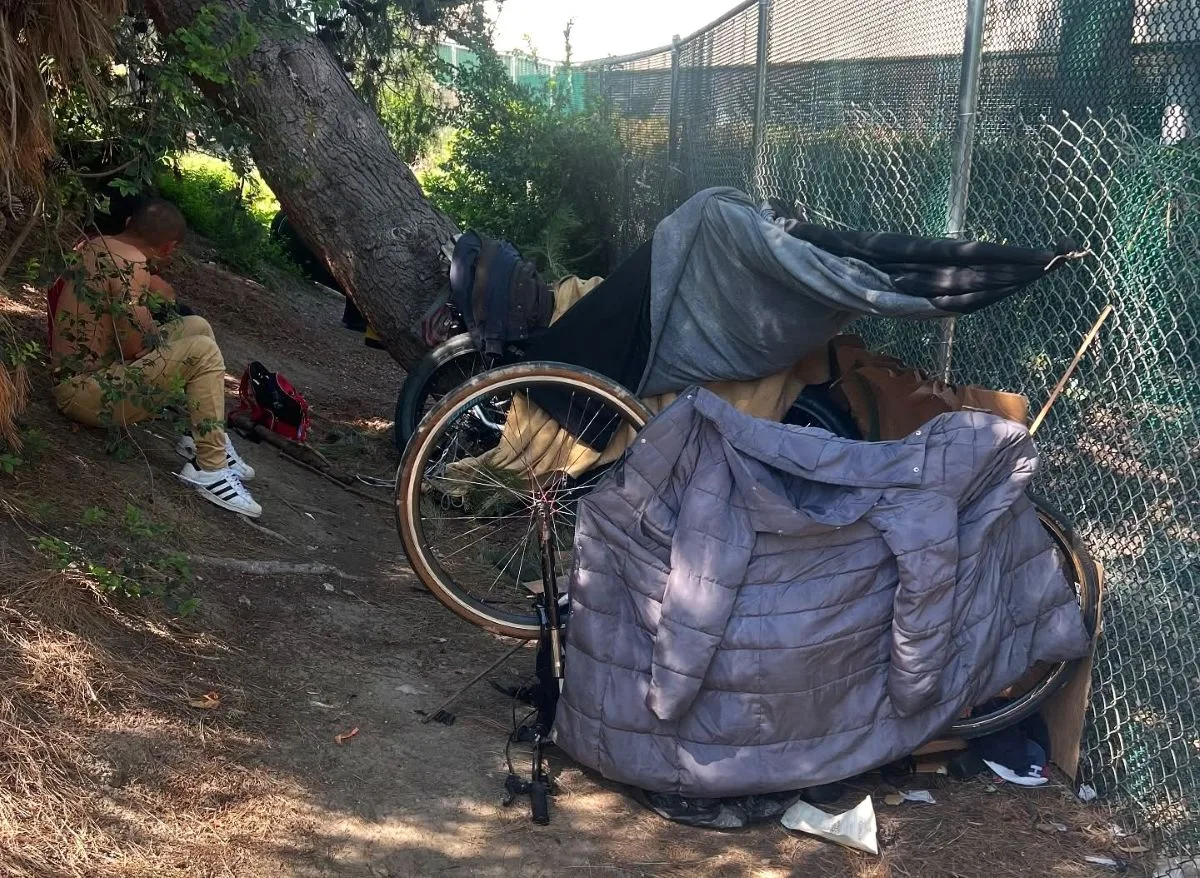
Last week, the Community Policing Unit addressed an encampment in the easement of the Bristol off-ramp of the 405, according to the Costa Mesa Police Department.
Four arrests were made for a variety of charges including camping and drug paraphernalia.
When the officers contact individuals experiencing homelessness, the resources offered are either accepted or refused. First and foremost, they always try to help. The aim is to maintain safety and order, and ensure these public spaces remain free of illegal encampments and activities.
Please call the local police wherever you live in Orange County to report any illegal encampments.
The Local Governments in Orange County that are widely arresting transients
At least four major local government entities in Orange County—the cities of Santa Ana, Anaheim, Fullerton, and the County of Orange itself—have actively used arrests and stricter ordinances to manage transient populations in 2026. This follows a broader trend of “ramped up” enforcement after the 2024 Supreme Court Grants Pass ruling, which allowed cities to cite or arrest people for sleeping in public even when shelter space is unavailable.

Enforcement Numbers & City Activities (2026)
While a total county-wide arrest count for “transients” specifically is not aggregated into a single public real-time database, recent high-profile operations provide the following figures:
- Santa Ana: Conducted a citywide sweep on February 13, 2026, resulting in 92 arrests of transients.
- 76 were misdemeanor arrests.
- 13 were felony arrests.
- 10 were for trespassing on railroad tracks.
- 10 were related to Proposition 36 violations.
- Anaheim: A police sweep on January 13, 2026, involved contact with 21 unhoused individuals, 13 of whom were arrested for various offenses. The remaining 8 were redirected to services.
- Fullerton: Enacted new anti-camping laws in March 2025, significantly increasing the power to cite or arrest for lying on benches or sidewalks.
- County-Governed Areas: The Orange County Board of Supervisors adopted an ordinance in late 2025 making it a misdemeanor to sleep or camp on county-owned property, including parks and flood control facilities. Violators face up to six months in jail or a $1,000 fine.
Legal Penalties faced by the Transients
Suspects arrested for illegal camping and possession of drug paraphernalia in Orange County typically face misdemeanor charges. While actual sentencing varies based on criminal history and the specific circumstances of the arrest, the standard legal penalties are as follows:
1. Illegal Camping Penalties
Following the 2024 Supreme Court Grants Pass ruling, Orange County and individual cities like Costa Mesa have updated their ordinances to allow for stricter enforcement.
- Classification: Usually a misdemeanor.
- Jail Time: Up to six months in county jail.
- Fines: Up to $1,000 per violation.
- Costa Mesa Specifics: In Costa Mesa, general ordinance violations can also result in escalating fines starting at $100 for a first offense, $200 for a second, and $500 for subsequent violations within the same year.
2. Drug Paraphernalia Penalties
Possession of drug paraphernalia (such as pipes or needles for controlled substances) is governed by California Health and Safety Code 11364 HS.
- Classification: A misdemeanor.
- Jail Time: Up to six months (some sources cite up to 364 days for certain aggravating factors).
- Fines: Up to $1,000.
- Additional Consequences: Conviction can lead to a permanent criminal record, affecting employment and housing.
3. Alternative Sentencing & Diversion
For many first-time or non-violent offenders, the court may offer alternatives to jail time:
- Drug Diversion (PC 1000): Eligible suspects may participate in a drug treatment program. Upon successful completion, the charges may be dismissed.
- Probation: Judges often order informal probation, which may include community service, drug counseling, and random drug testing.
- Proposition 36: Allows some defendants to receive drug treatment instead of incarceration.
“Let’s do evil so good will result”
These officials condemnation will be just
Probably placed in environment where they will have to keep moving before the demon hoard shows up
Only in their version it will be forever
Yeah ok. Keep spewing moral righteousness until there’s a homeless camp next to your house and people are rummaging through your backyard at 3AM looking for stuff to sell for drugs.