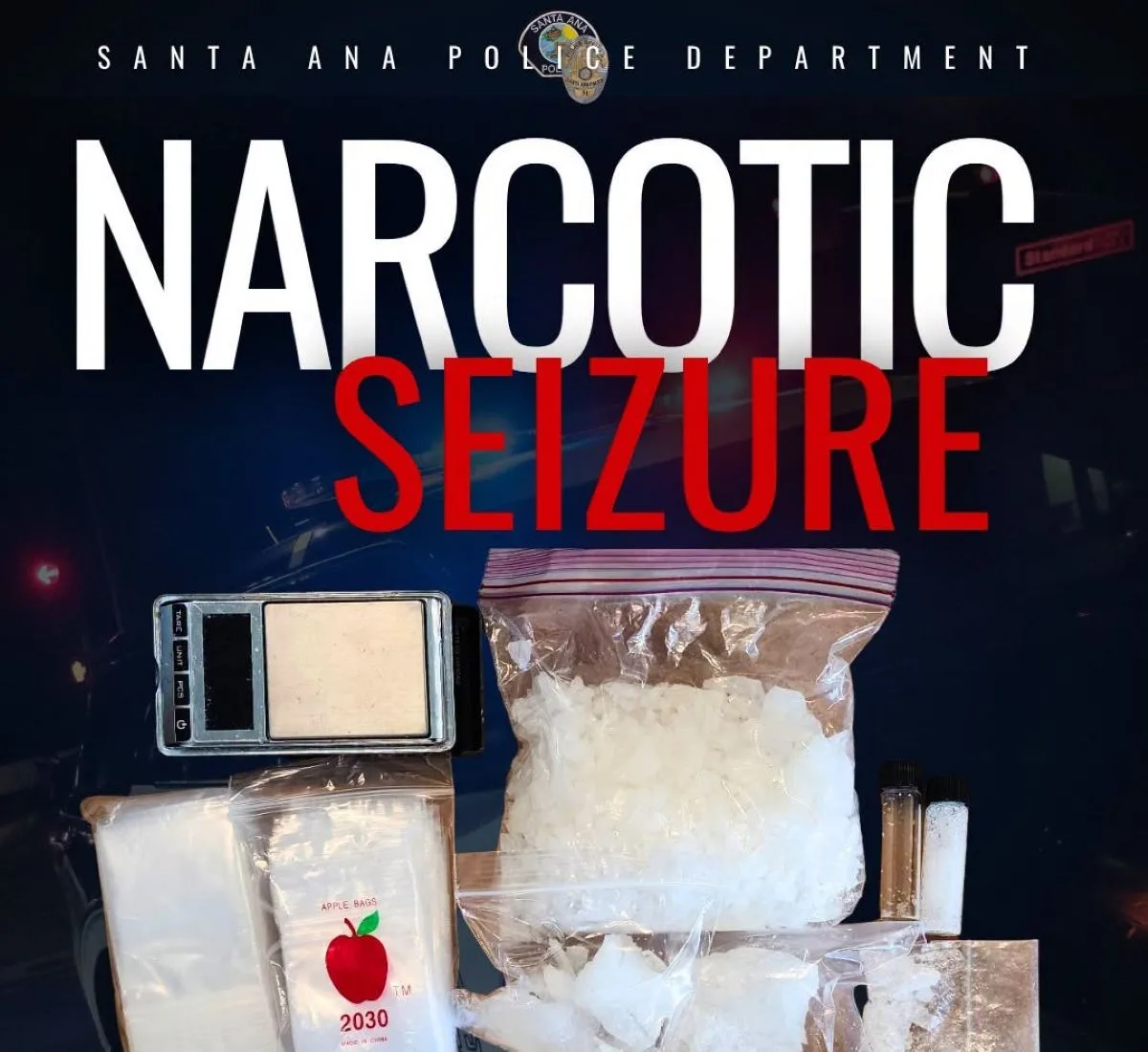
A targeted robbery investigation by the Santa Ana Police Department has escalated into a major narcotics bust, taking an extensive cache of illicit street drugs out of the community. Directed Patrol officers successfully identified a prime suspect connected to a recent local robbery.

Upon executing a court-approved search warrant at the suspect’s residence, officers discovered that the property was operating as an active drug distribution hub.
Law enforcement recovered over 321 grams of methamphetamine, commercial packaging materials, multiple electronic digital scales, and a supply of psilocybin mushrooms.
Both the primary robbery suspect and his cohabitating roommate were taken into custody without incident and booked into the Santa Ana Jail on multiple severe felony charges.
Estimated Street Value of Seized Methamphetamine
The recovery of 321 grams of bulk methamphetamine represents a significant financial disruption to local illicit supply chains. In Southern California’s current illicit drug market, the street value of methamphetamine varies based on wholesale purity, regional availability, and distribution methods.
- Wholesale Value: When traded in bulk quantities, methamphetamine typically commands between $2 to $5 per gram, putting the immediate wholesale value of the 321-gram cache between $650 and $1,600.
- Mid-Level Distribution Value: If divided into ounce-sized increments (approximately 11.3 ounces total), mid-level distributors often sell each ounce for $100 to $300, raising the valuation up to $3,400.
- Street-Level Retail Value: Methamphetamine is primarily sold on the street in small, single-use units known as “points” (0.1 grams) or half-grams, retailing for roughly $10 to $20 per half-gram. Because bulk packaging and digital scales were found at the scene, it indicates intent to distribute at this retail tier. Broken down entirely into small consumer doses, the estimated retail street value of the seized 321 grams could reach as high as $6,500 to $12,800.
Severe Legal Penalties and Potential Criminal Charges
The bundled discovery of a violent crime connection alongside distribution-ready narcotics exposes both arrested individuals to a severe array of state criminal prosecutions under the California Health and Safety Code and Penal Code.
- Robbery (California Penal Code 211): The primary suspect faces felony robbery charges, which carry a state prison sentence of up to five years for a second-degree conviction, alongside a permanent strike under California’s Three Strikes Law.
- Possession of a Controlled Substance for Sale (Health and Safety Code 11378): The recovery of 321 grams of methamphetamine—far exceeding any reasonable threshold for personal use—combined with digital scales and empty packaging bags provides clear evidence of commercial intent. This felony charge carries structured prison sentences of up to three years.
- Possession of Psilocybin Mushrooms for Sale (Health and Safety Code 11378): The separate recovery of psilocybin mushrooms adds an independent felony count of possessing a Schedule I controlled substance for commercial sale.
- Maintaining a Place for Drug Sales (Health and Safety Code 11366): Because both roommates inhabited the residence where an active drug packaging and distribution setup was operating, prosecutors can file felony charges for knowingly maintaining a location for the purpose of selling controlled substances.
Severe Physical Dangers and Symptoms of Methamphetamine Abuse
Methamphetamine is a highly addictive, synthetic central nervous system stimulant that exerts destructive psychological and physical effects on the human body. The drug forces a massive, artificial flood of dopamine into the brain’s reward centers, rapidly destroying neural pathways and creating severe chemical dependency.
- Short-Term Psychological and Physical Symptoms: Users frequently exhibit intense hyperactivity, erratic behavior, severe insomnia, dilated pupils, rapid heart rate (tachycardia), and dangerously elevated blood pressure. Extreme psychological symptoms include acute paranoia, vivid auditory and visual hallucinations, hyper-aggression, and severe delusions of grandeur.
- Long-Term Systematic Destruction: Chronic methamphetamine dependency causes irreversible damage to blood vessels throughout the body, exponentially increasing the risk of strokes, sudden heart attacks, and permanent organ failure. Long-term users frequently suffer from severe dental decay and tooth loss (commonly known as “meth mouth”), profound weight loss, skin lesions caused by compulsive picking, and permanent cognitive impairment.
Escalating Overdose Fatality Rates in Southern California
The public health threat posed by regional methamphetamine distribution remains exceptionally severe, with stimulant-related deaths rising continuously across California. According to public health tracking data from the California Department of Public Health, methamphetamine overdose fatalities have surged dramatically over the past decade, driven heavily by increased wholesale purity and the lethal contamination of the street supply with synthetic opioids like fentanyl.
Medical data indicates that the raw fatality rate directly attributed to psychostimulant overdoses in California exceeds 15 deaths per 100,000 residents annually. Methamphetamine fatalities rarely occur in isolation; instead, they manifest as acute cardiac arrests, lethal hemorrhagic strokes, or total respiratory failure when combined with other illicit substances. Law enforcement operations, like this targeted raid by the Santa Ana Police Department, serve as a vital line of community defense by intercepting these dangerous chemical compounds before they can contribute to the state’s rising overdose statistics.
Medical Disclaimer
The medical information regarding substance abuse, physiological symptoms, and overdose risks provided in this post is intended for general educational and informational purposes only. It should not be used as a substitute for professional medical advice, psychiatric diagnosis, or structured addiction treatment.
Individuals seeking confidential support for substance dependency or mental health crises are encouraged to contact the Substance Abuse and Mental Health Services Administration (SAMHSA) National Helpline at 1-800-662-4357 for free, 24/7 assistance.