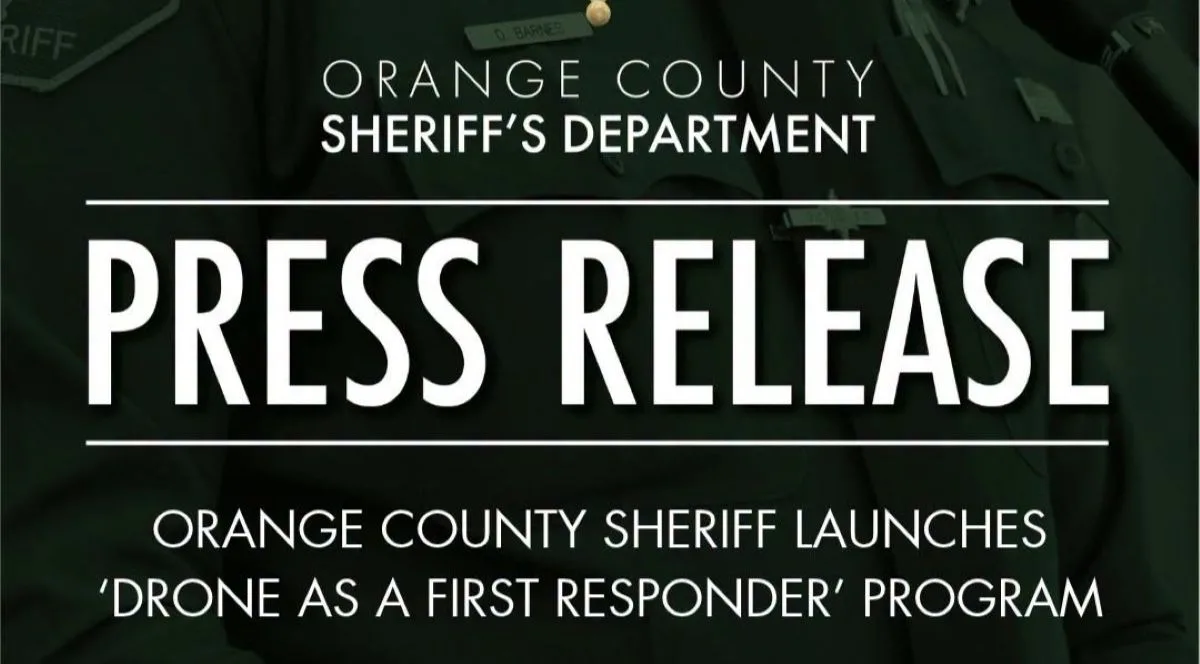
The Orange County Sheriff’s Department announced today that it will launch the first phase of its new Drone as a First Responder (DFR) program in October 2026, deploying unmanned aerial vehicles to support patrol operations in Laguna Hills, Lake Forest, and Stanton. The drones are designed to respond to calls for service, critical incidents, and missing person cases, often arriving before deputies to provide real-time intelligence and improve situational awareness.

According to the Sheriff’s Department, the drones will not replace deputies or other emergency personnel. Instead, they will provide responding units with live video and aerial intelligence that can help identify hazards, locate suspects, assess threats, and coordinate safer responses before officers arrive on scene. The aircraft will be operated by FAA-certified personnel and will be restricted to authorized public safety missions.
Sheriff Don Barnes called the initiative “an incredible advancement in public safety technology,” emphasizing that real-time aerial information allows deputies to make faster and more informed decisions during emergencies. The department has also pledged transparency, with flight reporting information available to the public through its DFR program website.
Drones Are Becoming Common Across Orange County
The Sheriff’s Department is joining a growing list of Orange County law enforcement agencies that have embraced drone technology as a force multiplier.
Among the agencies currently operating significant drone programs are:
- Anaheim Police Department, which launched a Drone as First Responder assessment program in 2026 to send drones to calls before patrol officers arrive. Officials say the aerial view helps determine whether a situation is escalating, whether additional resources are needed, or whether a call has already been resolved.
- Irvine Police Department, which has become one of the region’s most active drone operators. According to city reports cited by Voice of OC, Irvine logged more than 4,300 drone flights and over 850 flight hours in a single year.
- Santa Ana Police Department, which has expanded its drone capabilities and approved additional spending on drone technology to improve situational awareness during major events and critical incidents.
- Huntington Beach Police Department, which recently launched an advanced DFR system utilizing remotely stationed drones capable of reaching emergency scenes in less than two minutes. City officials report the program has significantly reduced response times.
- Cypress Police Department, which approved a new contract in 2026 to expand its drone operations.
Even before today’s announcement, Sheriff officials had been testing DFR operations in contract cities such as San Juan Capistrano, where the department evaluated how drone responses could improve emergency operations and deputy safety.
Helping Locate Suspects Faster
One of the primary selling points of DFR programs nationwide is the ability to locate suspects before they flee or to track them without initiating dangerous vehicle pursuits.
Law enforcement agencies across the country report that drones can provide a continuous overhead view of suspects while keeping patrol units at a safer distance. The technology is particularly effective in:
- Burglary and theft investigations
- Fleeing suspect incidents
- Missing person searches
- DUI enforcement
- Disaster and fire response
- Tactical operations involving armed suspects
Local agencies have already demonstrated the effectiveness of the technology. In Huntington Beach, police recently used a DFR drone to track retail theft suspects and direct officers to conduct a successful traffic stop. Officials say the live aerial feed allowed officers to maintain visual contact while coordinating ground units.
Irvine police have similarly credited drones with helping officers quickly locate and stop suspected intoxicated drivers before they could endanger other motorists.
Nationwide Drone Adoption Continues to Accelerate
Police drone usage has expanded dramatically throughout the United States over the past decade.
Industry and surveillance-tracking organizations estimate that roughly 1,400 to 1,500 law enforcement agencies nationwide now operate drone programs, making drones one of the fastest-growing technologies in modern policing.
The rapid expansion has been fueled by:
- Lower equipment costs
- Improved camera and thermal imaging technology
- Expanded FAA approvals
- The growth of Drone as First Responder programs
- Staffing shortages affecting many police agencies
Research conducted for public safety agencies has found drones particularly valuable for search-and-rescue operations, crime scene documentation, crowd management, disaster response, and locating armed or dangerous suspects.
Are Apprehension Rates Improving?
While national arrest-rate statistics specific to DFR programs remain limited, departments that have implemented mature drone programs consistently report faster suspect identification, quicker scene assessments, and increased success locating fleeing suspects. DFR advocates argue that the technology makes it easier to maintain visual contact on suspects while reducing the need for risky pursuits and manpower-intensive perimeter searches.
Police agencies from California to Kansas have reported numerous cases where drones located suspects within minutes, often before officers could establish containment on the ground. In some jurisdictions, drones now routinely reach emergency scenes before patrol units, giving responding officers crucial information that can lead to faster apprehensions and safer outcomes.
Looking Ahead
The Orange County Sheriff’s Department says this initial deployment in Laguna Hills, Lake Forest, and Stanton is only the beginning. Officials describe the October rollout as Phase 1 of a broader effort to expand Drone as First Responder capabilities throughout the department’s service area in coming years.
If the program performs as expected, residents across additional sheriff-patrolled communities may soon see drones becoming a routine part of emergency response, joining a growing network of Orange County agencies that are increasingly relying on aerial technology to locate suspects, gather intelligence, and improve public safety.