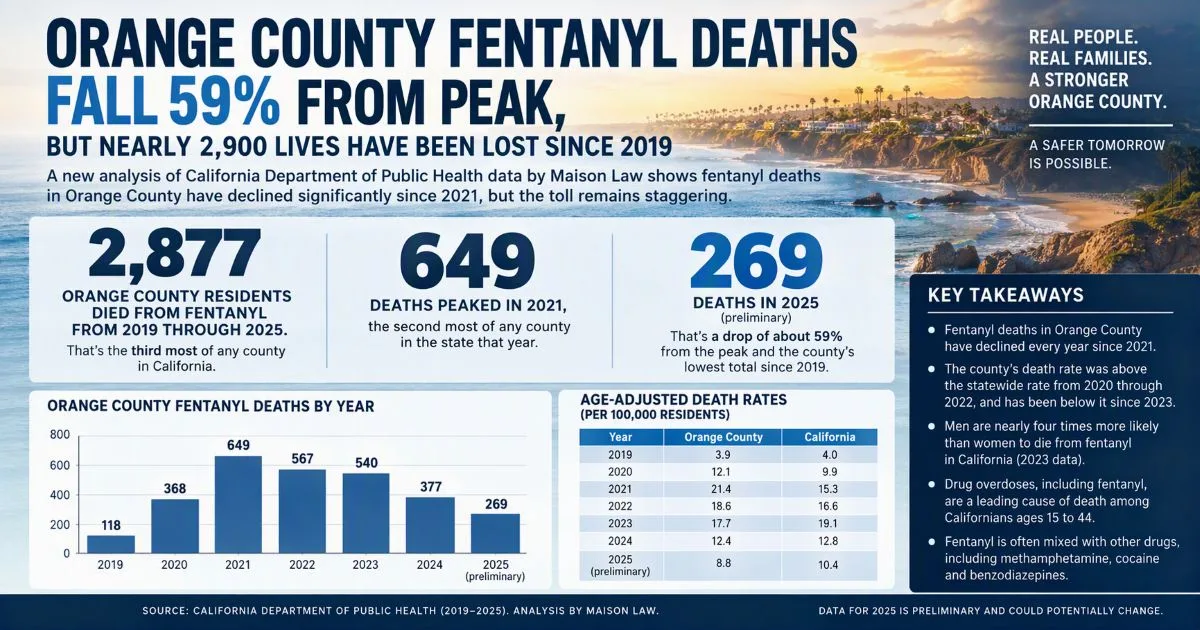
A new analysis of California overdose data shows that Orange County’s fentanyl crisis may be easing, but the human toll remains immense. According to a review of California Department of Public Health data by Maison Law, 2,877 Orange County residents died from fentanyl-related overdoses between 2019 and 2025, the third-highest total of any county in California. The findings come from Maison Law’s statewide fentanyl analysis and interactive county-by-county tracking map.

Fentanyl deaths in Orange County peaked in 2021, when 649 residents lost their lives. That was the second-highest county total in California that year. Since then, deaths have declined annually, reaching a preliminary total of 269 in 2025, a drop of approximately 59% from the 2021 high.
The decline is notable because Orange County was once experiencing fentanyl death rates above the statewide average. Between 2020 and 2022, the county’s age-adjusted fentanyl death rate exceeded California’s overall rate. Since 2023, however, Orange County has fallen below the statewide average.
Age-adjusted fentanyl death rates per 100,000 residents were:
- 2019: Orange County 3.9 / California 4.0
- 2020: Orange County 12.1 / California 9.9
- 2021: Orange County 21.4 / California 15.3
- 2022: Orange County 18.6 / California 16.6
- 2023: Orange County 17.7 / California 19.1
- 2024: Orange County 12.4 / California 12.8
- 2025 (preliminary): Orange County 8.8 / California 10.4
A Public Health Crisis That Touched Every Community
The numbers illustrate how rapidly fentanyl spread through Orange County during the pandemic era and its aftermath. Fentanyl, a synthetic opioid far more potent than morphine and heroin, became increasingly common in counterfeit prescription pills and other illicit drugs. Public health officials have repeatedly warned that many overdose victims never intended to take fentanyl and may not have realized the drugs they consumed contained it.
What makes the fentanyl epidemic different from earlier opioid waves is that it has affected a much broader segment of the population. While overdose deaths remain highest among adults in their working years, California data also shows a troubling impact on teenagers and young adults. State researchers have found that overdose deaths have become a leading driver of increased mortality among Californians ages 15 to 44, with fentanyl playing a major role in that trend. The California Legislative Analyst’s Office reported that drug overdoses account for roughly 60 percent of the increase in mortality among Californians in that age group, with synthetic opioids such as fentanyl driving much of the surge.
For Orange County, that finding is especially significant given the region’s large student population, including those attending UC Irvine, Cal State Fullerton, Chapman University, Vanguard University, Concordia University Irvine, Orange Coast College, Irvine Valley College, Saddleback College, and other local campuses.
Men Face a Much Higher Risk
State data also reveals that men are disproportionately affected by fentanyl. In California, males experienced fentanyl-related overdose death rates nearly four times higher than females in 2023. According to the California Department of Public Health, the fentanyl death rate for men was 30.2 deaths per 100,000 residents compared to 7.7 for women.
Officials say the reasons are complex and may involve differences in drug use patterns, risk-taking behavior, and exposure to illicit drug markets.
Fentanyl Is Often Mixed With Other Drugs
Another troubling aspect of the epidemic is that fentanyl frequently appears alongside other substances. California health officials reported that thousands of overdose deaths involved both opioids and stimulants such as methamphetamine. Other fatalities involved combinations of opioids, cocaine, or benzodiazepines.
As a result, experts increasingly refer to the crisis as a polysubstance epidemic rather than simply an opioid epidemic. Someone using what they believe is methamphetamine, cocaine, or a prescription pill may unknowingly consume fentanyl.
Why Are Deaths Falling?
Experts point to several possible reasons for the decline in fatalities seen in Orange County and California.
These include:
- Wider distribution of naloxone, often sold under the brand name Narcan.
- Increased public awareness campaigns about counterfeit pills.
- Improved access to overdose prevention and treatment resources.
- Greater availability of fentanyl test strips and harm-reduction programs.
- Enhanced law enforcement efforts targeting fentanyl trafficking networks.
While it is difficult to attribute the decline to any single factor, public health researchers note that fentanyl-related deaths have been falling across much of the country in recent years even as they remain well above pre-pandemic levels.
The Crisis Is Far From Over
Despite the encouraging downward trend, Orange County’s preliminary total of 269 fentanyl deaths in 2025 still represents hundreds of lives lost in a single year. The county’s seven-year total of 2,877 deaths underscores the devastating impact fentanyl has had on families, schools, workplaces, and neighborhoods throughout the region.
For local officials, the latest data offers a measure of hope, but also a reminder that fentanyl remains one of the most lethal drugs in circulation. Even one counterfeit pill can contain enough fentanyl to cause a fatal overdose.
Readers interested in exploring the data further can review Maison Law’s interactive map, which tracks fentanyl deaths in every California county from 2019 through 2025 and provides a broader picture of how the crisis has evolved across the state.